

210
G. D. Johnson and D. J. Krusienski
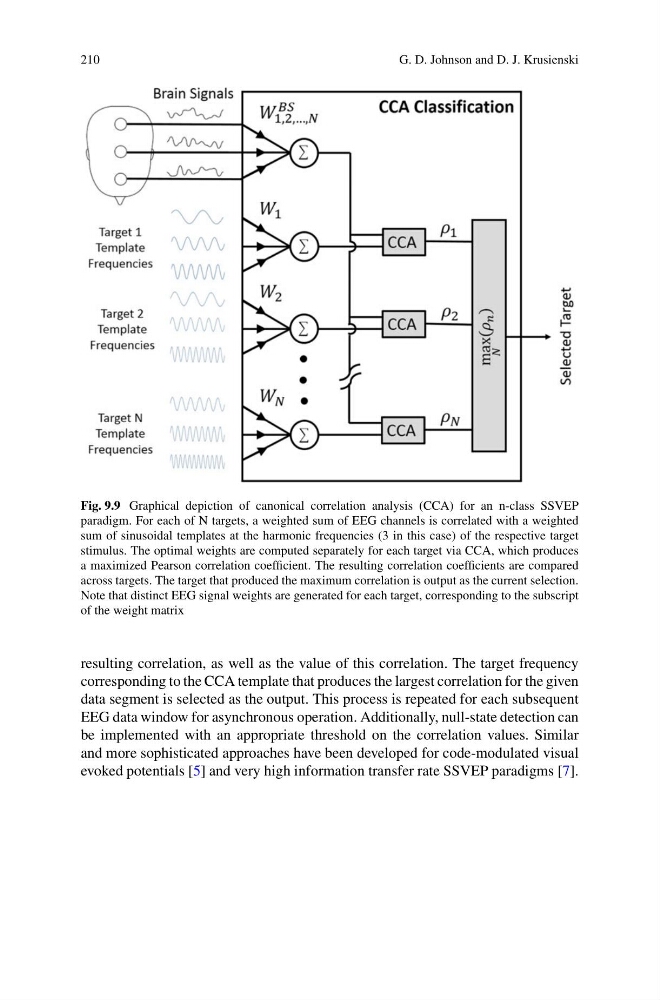
Fig. 9.9 Graphical depiction of canonical correlation analysis (CCA) for an n-class SSVEP
paradigm. For each of N targets, a weighted sum of EEG channels is correlated with a weighted
sum of sinusoidal templates at the harmonic frequencies (3 in this case) of the respective target
stimulus. The optimal weights are computed separately for each target via CCA, which produces
a maximized Pearson correlation coefficient. The resulting correlation coefficients are compared
across targets. The target that produced the maximum correlation is output as the current selection.
Note that distinct EEG signal weights are generated for each target, corresponding to the subscript
of the weight matrix
resulting correlation, as well as the value of this correlation. The target frequency
corresponding to the CCA template that produces the largest correlation for the given
data segment is selected as the output. This process is repeated for each subsequent
EEG data window for asynchronous operation. Additionally, null-state detection can
be implemented with an appropriate threshold on the correlation values. Similar
and more sophisticated approaches have been developed for code-modulated visual
evoked potentials [5] and very high information transfer rate SSVEP paradigms [7].
G. D. Johnson and D. J. Krusienski
Fig. 9.9 Graphical depiction of canonical correlation analysis (CCA) for an n-class SSVEP
paradigm. For each of N targets, a weighted sum of EEG channels is correlated with a weighted
sum of sinusoidal templates at the harmonic frequencies (3 in this case) of the respective target
stimulus. The optimal weights are computed separately for each target via CCA, which produces
a maximized Pearson correlation coefficient. The resulting correlation coefficients are compared
across targets. The target that produced the maximum correlation is output as the current selection.
Note that distinct EEG signal weights are generated for each target, corresponding to the subscript
of the weight matrix
resulting correlation, as well as the value of this correlation. The target frequency
corresponding to the CCA template that produces the largest correlation for the given
data segment is selected as the output. This process is repeated for each subsequent
EEG data window for asynchronous operation. Additionally, null-state detection can
be implemented with an appropriate threshold on the correlation values. Similar
and more sophisticated approaches have been developed for code-modulated visual
evoked potentials [5] and very high information transfer rate SSVEP paradigms [7].