

200
G. D. Johnson and D. J. Krusienski
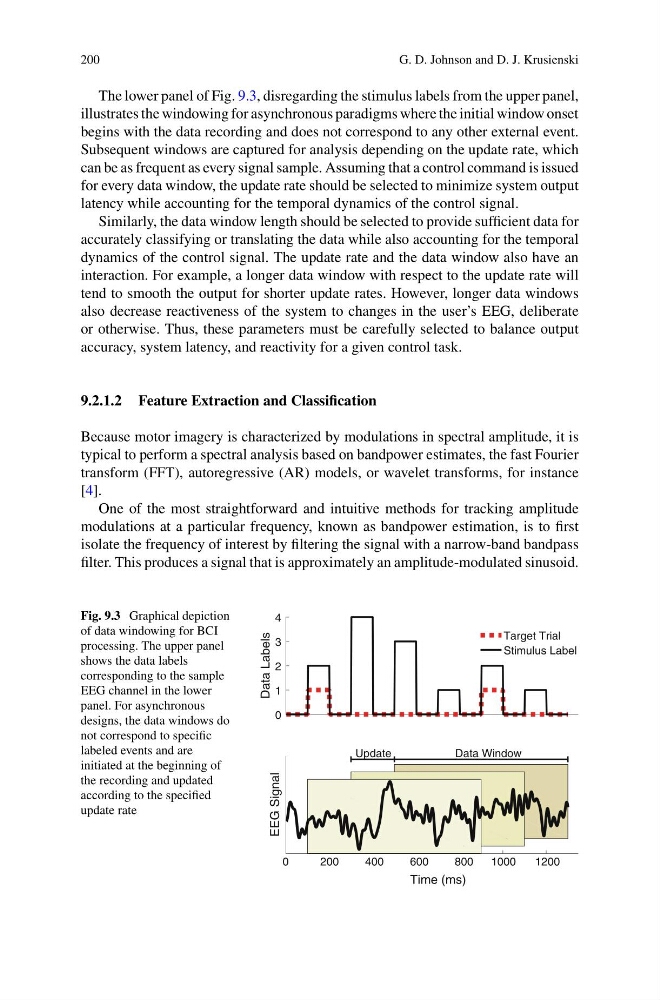
The lower panel of Fig. 9.3, disregarding the stimulus labels from the upper panel,
illustrates the windowing for asynchronous paradigms where the initial window onset
begins with the data recording and does not correspond to any other external event.
Subsequent windows are captured for analysis depending on the update rate, which
can be as frequent as every signal sample. Assuming that a control command is issued
for every data window, the update rate should be selected to minimize system output
latency while accounting for the temporal dynamics of the control signal.
Similarly, the data window length should be selected to provide sufficient data for
accurately classifying or translating the data while also accounting for the temporal
dynamics of the control signal. The update rate and the data window also have an
interaction. For example, a longer data window with respect to the update rate will
tend to smooth the output for shorter update rates. However, longer data windows
also decrease reactiveness of the system to changes in the user’s EEG, deliberate
or otherwise. Thus, these parameters must be carefully selected to balance output
accuracy, system latency, and reactivity for a given control task.
9.2.1.2 Feature Extraction and Classification
Because motor imagery is characterized by modulations in spectral amplitude, it is
typical to perform a spectral analysis based on bandpower estimates, the fast Fourier
transform (FFT), autoregressive (AR) models, or wavelet transforms, for instance
[4].
One of the most straightforward and intuitive methods for tracking amplitude
modulations at a particular frequency, known as bandpower estimation, is to first
isolate the frequency of interest by filtering the signal with a narrow-band bandpass
filter. This produces a signal that is approximately an amplitude-modulated sinusoid.
Fig. 9.3 Graphical depiction
of data windowing for BCI
processing. The upper panel
shows the data labels
corresponding to the sample
EEG channel in the lower
panel. For asynchronous
designs, the data windows do
not correspond to specific
labeled events and are
initiated at the beginning of
the recording and updated
according to the specified
update rate
0
1
2
3
4
Data Labels
Target Trial
Stimulus Label
0
200
400
600
800
1000
1200
Time (ms)
EEG Signal
Data Window
Update
G. D. Johnson and D. J. Krusienski
The lower panel of Fig. 9.3, disregarding the stimulus labels from the upper panel,
illustrates the windowing for asynchronous paradigms where the initial window onset
begins with the data recording and does not correspond to any other external event.
Subsequent windows are captured for analysis depending on the update rate, which
can be as frequent as every signal sample. Assuming that a control command is issued
for every data window, the update rate should be selected to minimize system output
latency while accounting for the temporal dynamics of the control signal.
Similarly, the data window length should be selected to provide sufficient data for
accurately classifying or translating the data while also accounting for the temporal
dynamics of the control signal. The update rate and the data window also have an
interaction. For example, a longer data window with respect to the update rate will
tend to smooth the output for shorter update rates. However, longer data windows
also decrease reactiveness of the system to changes in the user’s EEG, deliberate
or otherwise. Thus, these parameters must be carefully selected to balance output
accuracy, system latency, and reactivity for a given control task.
9.2.1.2 Feature Extraction and Classification
Because motor imagery is characterized by modulations in spectral amplitude, it is
typical to perform a spectral analysis based on bandpower estimates, the fast Fourier
transform (FFT), autoregressive (AR) models, or wavelet transforms, for instance
[4].
One of the most straightforward and intuitive methods for tracking amplitude
modulations at a particular frequency, known as bandpower estimation, is to first
isolate the frequency of interest by filtering the signal with a narrow-band bandpass
filter. This produces a signal that is approximately an amplitude-modulated sinusoid.
Fig. 9.3 Graphical depiction
of data windowing for BCI
processing. The upper panel
shows the data labels
corresponding to the sample
EEG channel in the lower
panel. For asynchronous
designs, the data windows do
not correspond to specific
labeled events and are
initiated at the beginning of
the recording and updated
according to the specified
update rate
0
1
2
3
4
Data Labels
Target Trial
Stimulus Label
0
200
400
600
800
1000
1200
Time (ms)
EEG Signal
Data Window
Update