

130
J. W. Choi and K. H. Kim
due to the common sources, the phase differences are expected to be symmetrically
distributed around zero.
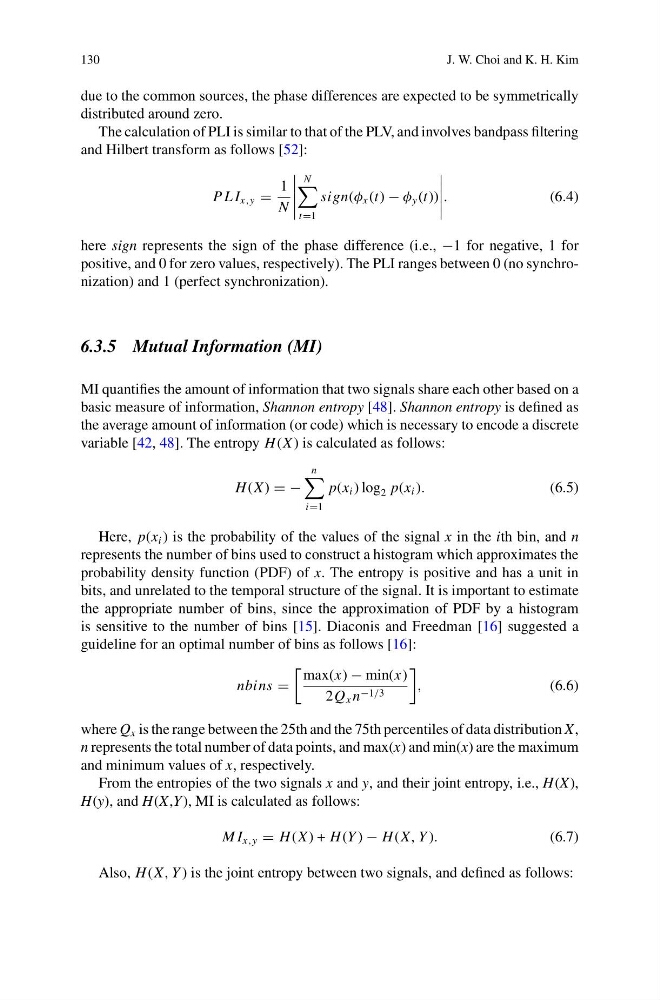
The calculation of PLI is similar to that of the PLV, and involves bandpass filtering
and Hilbert transform as follows [52]:
P L I x,y
1
N
N
t1
sign(φ x (t) − φ y (t))
.
(6.4)
here sign represents the sign of the phase difference (i.e., −1 for negative, 1 for
positive, and 0 for zero values, respectively). The PLI ranges between 0 (no synchronization) and 1 (perfect synchronization).
6.3.5 Mutual Information (MI)
MI quantifies the amount of information that two signals share each other based on a
basic measure of information, Shannon entropy [48]. Shannon entropy is defined as
the average amount of information (or code) which is necessary to encode a discrete
variable [42, 48]. The entropy H (X ) is calculated as follows:
H (X ) −
n
i1
p(x i ) log 2 p(x i ).
(6.5)
Here, p(x i ) is the probability of the values of the signal x in the ith bin, and n
represents the number of bins used to construct a histogram which approximates the
probability density function (PDF) of x. The entropy is positive and has a unit in
bits, and unrelated to the temporal structure of the signal. It is important to estimate
the appropriate number of bins, since the approximation of PDF by a histogram
is sensitive to the number of bins [15]. Diaconis and Freedman [16] suggested a
guideline for an optimal number of bins as follows [16]:
nbins
max(x) − min(x)
2Q x n −1/3
,
(6.6)
where Q x is the range between the 25th and the 75th percentiles of data distribution X,
n represents the total number of data points, and max(x) and min(x) are the maximum
and minimum values of x, respectively.
From the entropies of the two signals x and y, and their joint entropy, i.e., H(X),
H(y), and H(X,Y ), MI is calculated as follows:
M I x,y H (X ) + H (Y ) − H (X, Y ).
(6.7)
Also, H (X, Y ) is the joint entropy between two signals, and defined as follows:
J. W. Choi and K. H. Kim
due to the common sources, the phase differences are expected to be symmetrically
distributed around zero.
The calculation of PLI is similar to that of the PLV, and involves bandpass filtering
and Hilbert transform as follows [52]:
P L I x,y
1
N
N
t1
sign(φ x (t) − φ y (t))
.
(6.4)
here sign represents the sign of the phase difference (i.e., −1 for negative, 1 for
positive, and 0 for zero values, respectively). The PLI ranges between 0 (no synchronization) and 1 (perfect synchronization).
6.3.5 Mutual Information (MI)
MI quantifies the amount of information that two signals share each other based on a
basic measure of information, Shannon entropy [48]. Shannon entropy is defined as
the average amount of information (or code) which is necessary to encode a discrete
variable [42, 48]. The entropy H (X ) is calculated as follows:
H (X ) −
n
i1
p(x i ) log 2 p(x i ).
(6.5)
Here, p(x i ) is the probability of the values of the signal x in the ith bin, and n
represents the number of bins used to construct a histogram which approximates the
probability density function (PDF) of x. The entropy is positive and has a unit in
bits, and unrelated to the temporal structure of the signal. It is important to estimate
the appropriate number of bins, since the approximation of PDF by a histogram
is sensitive to the number of bins [15]. Diaconis and Freedman [16] suggested a
guideline for an optimal number of bins as follows [16]:
nbins
max(x) − min(x)
2Q x n −1/3
,
(6.6)
where Q x is the range between the 25th and the 75th percentiles of data distribution X,
n represents the total number of data points, and max(x) and min(x) are the maximum
and minimum values of x, respectively.
From the entropies of the two signals x and y, and their joint entropy, i.e., H(X),
H(y), and H(X,Y ), MI is calculated as follows:
M I x,y H (X ) + H (Y ) − H (X, Y ).
(6.7)
Also, H (X, Y ) is the joint entropy between two signals, and defined as follows: