

6 Methods for Functional Connectivity Analysis
129
Here · indicates average over a predetermined time interval. S x,y represents the
cross spectral density function (CSDF) of two signals, x and y, which is derived by
Fourier transform of the CCF in Sect. 6.3.1. The definition of coherence includes the
normalization of CSDF S x,y by auto-spectral density functions, S x,x and S y,y , so that
the range of coherence becomes between 0 and 1.
It should be noted that the coherence is still sensitive to spectral power even though
its definition contains the normalization by spectral powers of the two signals. Thus,
it is often unclear whether the coherence at a specific frequency is dominated by
powers of the signals and/or phase relationships between them [30].
6.3.3 Phase Locking Value (PLV)
PLV measures the degree of phase locking between two signals over time, by observing whether the phase difference between them is relatively constant within a temporal interval. Prior to calculating the PLV, the signals are first transformed into
narrowband signal in the frequency band of interest (e.g., theta or gamma band)
by bandpass filtering. The instantaneous phase angle, φ(t) is calculated from the
narrowband signal x(t) and its Hilbert transform, ˜
x(t), as follows [23, 30]:
φ(t) arctan
˜
x(t)
x(t)
.
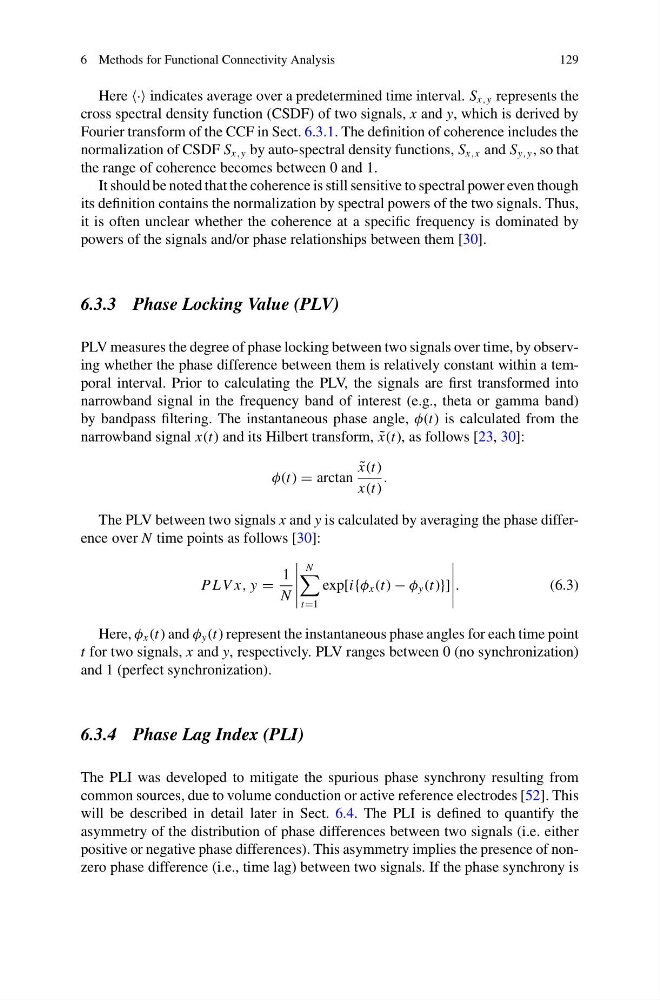
The PLV between two signals x and y is calculated by averaging the phase difference over N time points as follows [30]:
P LV x, y
1
N
N
t1
exp[i{φ x (t) − φ y (t)}]
.
(6.3)
Here, φ x (t) and φ y (t) represent the instantaneous phase angles for each time point
t for two signals, x and y, respectively. PLV ranges between 0 (no synchronization)
and 1 (perfect synchronization).
6.3.4 Phase Lag Index (PLI)
The PLI was developed to mitigate the spurious phase synchrony resulting from
common sources, due to volume conduction or active reference electrodes [52]. This
will be described in detail later in Sect. 6.4. The PLI is defined to quantify the
asymmetry of the distribution of phase differences between two signals (i.e. either
positive or negative phase differences). This asymmetry implies the presence of nonzero phase difference (i.e., time lag) between two signals. If the phase synchrony is
129
Here · indicates average over a predetermined time interval. S x,y represents the
cross spectral density function (CSDF) of two signals, x and y, which is derived by
Fourier transform of the CCF in Sect. 6.3.1. The definition of coherence includes the
normalization of CSDF S x,y by auto-spectral density functions, S x,x and S y,y , so that
the range of coherence becomes between 0 and 1.
It should be noted that the coherence is still sensitive to spectral power even though
its definition contains the normalization by spectral powers of the two signals. Thus,
it is often unclear whether the coherence at a specific frequency is dominated by
powers of the signals and/or phase relationships between them [30].
6.3.3 Phase Locking Value (PLV)
PLV measures the degree of phase locking between two signals over time, by observing whether the phase difference between them is relatively constant within a temporal interval. Prior to calculating the PLV, the signals are first transformed into
narrowband signal in the frequency band of interest (e.g., theta or gamma band)
by bandpass filtering. The instantaneous phase angle, φ(t) is calculated from the
narrowband signal x(t) and its Hilbert transform, ˜
x(t), as follows [23, 30]:
φ(t) arctan
˜
x(t)
x(t)
.
The PLV between two signals x and y is calculated by averaging the phase difference over N time points as follows [30]:
P LV x, y
1
N
N
t1
exp[i{φ x (t) − φ y (t)}]
.
(6.3)
Here, φ x (t) and φ y (t) represent the instantaneous phase angles for each time point
t for two signals, x and y, respectively. PLV ranges between 0 (no synchronization)
and 1 (perfect synchronization).
6.3.4 Phase Lag Index (PLI)
The PLI was developed to mitigate the spurious phase synchrony resulting from
common sources, due to volume conduction or active reference electrodes [52]. This
will be described in detail later in Sect. 6.4. The PLI is defined to quantify the
asymmetry of the distribution of phase differences between two signals (i.e. either
positive or negative phase differences). This asymmetry implies the presence of nonzero phase difference (i.e., time lag) between two signals. If the phase synchrony is