

nanoprobes for PET and MRI was constructed via nanoporphyrin chelation with
both
64 Cu(II) and Gd(III) (Fig. 3.7c) [43].
Cai and co-workers developed a liposome-based sequentially activated nanotheranostic system [44]. This was prepared by encapsulating the hydrophobic
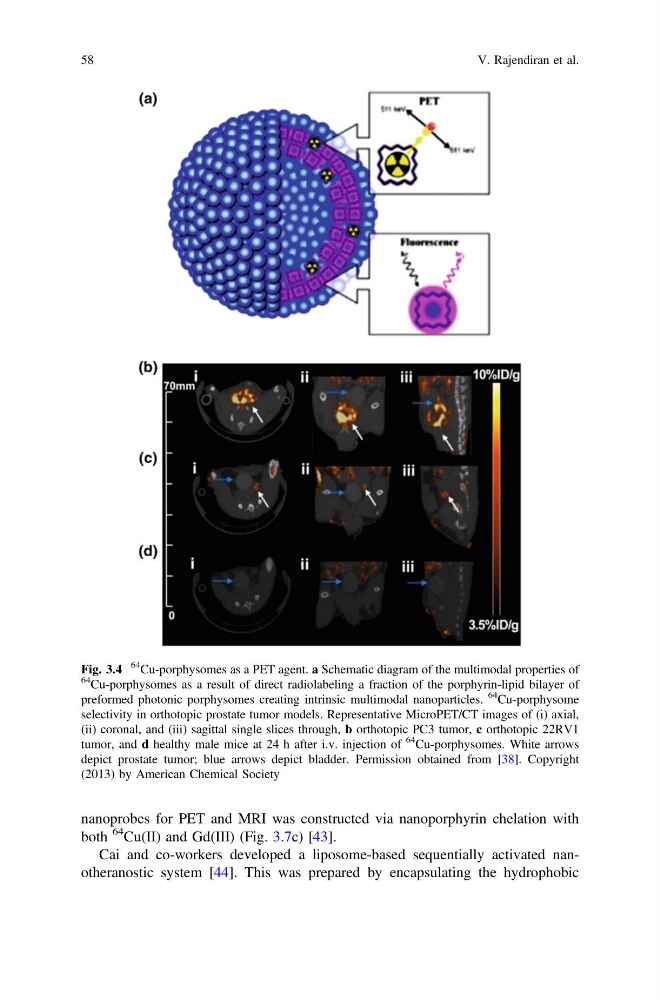
Fig. 3.4
64
Cu-porphysomes as a PET agent. a Schematic diagram of the multimodal properties of
64
Cu-porphysomes as a result of direct radiolabeling a fraction of the porphyrin-lipid bilayer of
preformed photonic porphysomes creating intrinsic multimodal nanoparticles.
64
Cu-porphysome
selectivity in orthotopic prostate tumor models. Representative MicroPET/CT images of (i) axial,
(ii) coronal, and (iii) sagittal single slices through, b orthotopic PC3 tumor, c orthotopic 22RV1
tumor, and d healthy male mice at 24 h after i.v. injection of
64
Cu-porphysomes. White arrows
depict prostate tumor; blue arrows depict bladder. Permission obtained from [38]. Copyright
(2013) by American Chemical Society
58
V. Rajendiran et al.
both
64 Cu(II) and Gd(III) (Fig. 3.7c) [43].
Cai and co-workers developed a liposome-based sequentially activated nanotheranostic system [44]. This was prepared by encapsulating the hydrophobic
Fig. 3.4
64
Cu-porphysomes as a PET agent. a Schematic diagram of the multimodal properties of
64
Cu-porphysomes as a result of direct radiolabeling a fraction of the porphyrin-lipid bilayer of
preformed photonic porphysomes creating intrinsic multimodal nanoparticles.
64
Cu-porphysome
selectivity in orthotopic prostate tumor models. Representative MicroPET/CT images of (i) axial,
(ii) coronal, and (iii) sagittal single slices through, b orthotopic PC3 tumor, c orthotopic 22RV1
tumor, and d healthy male mice at 24 h after i.v. injection of
64
Cu-porphysomes. White arrows
depict prostate tumor; blue arrows depict bladder. Permission obtained from [38]. Copyright
(2013) by American Chemical Society
58
V. Rajendiran et al.