

toxicity of cadmium-based QDs and contributing to future biomedical applications
[78]. In another study, liposomes have been labeled with both radionuclides and
gadolinium for SPECT imaging and MRI in vitro [79].
Most of the aforementioned studies demonstrated the possibility of
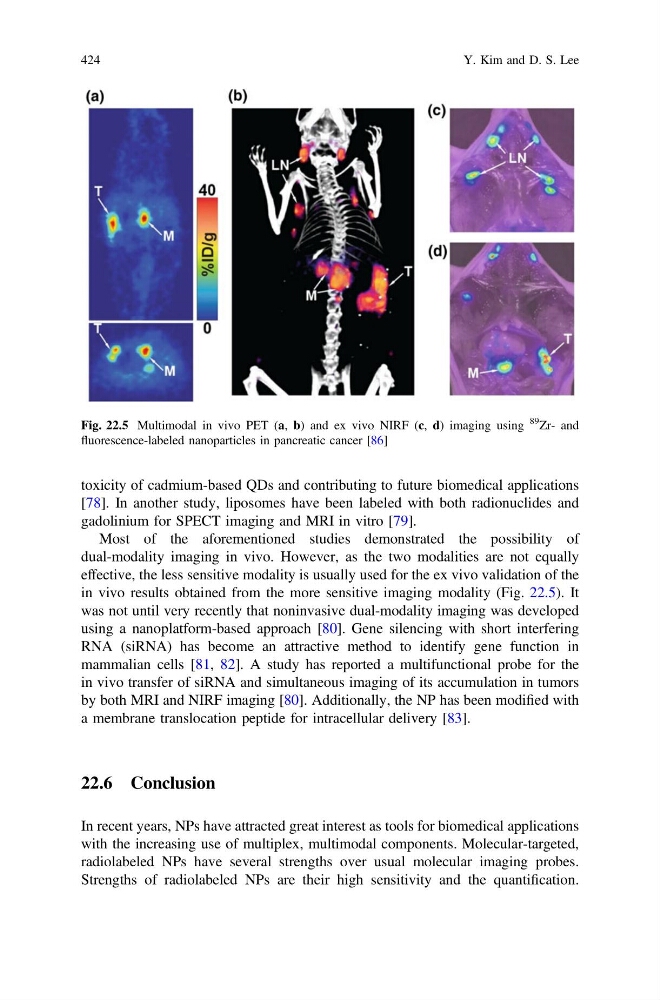
dual-modality imaging in vivo. However, as the two modalities are not equally
effective, the less sensitive modality is usually used for the ex vivo validation of the
in vivo results obtained from the more sensitive imaging modality (Fig. 22.5). It
was not until very recently that noninvasive dual-modality imaging was developed
using a nanoplatform-based approach [80]. Gene silencing with short interfering
RNA (siRNA) has become an attractive method to identify gene function in
mammalian cells [81, 82]. A study has reported a multifunctional probe for the
in vivo transfer of siRNA and simultaneous imaging of its accumulation in tumors
by both MRI and NIRF imaging [80]. Additionally, the NP has been modified with
a membrane translocation peptide for intracellular delivery [83].
22.6 Conclusion
In recent years, NPs have attracted great interest as tools for biomedical applications
with the increasing use of multiplex, multimodal components. Molecular-targeted,
radiolabeled NPs have several strengths over usual molecular imaging probes.
Strengths of radiolabeled NPs are their high sensitivity and the quantification.
Fig. 22.5 Multimodal in vivo PET (a, b) and ex vivo NIRF (c, d) imaging using
89
Zr- and
fluorescence-labeled nanoparticles in pancreatic cancer [86]
424
Y. Kim and D. S. Lee
[78]. In another study, liposomes have been labeled with both radionuclides and
gadolinium for SPECT imaging and MRI in vitro [79].
Most of the aforementioned studies demonstrated the possibility of
dual-modality imaging in vivo. However, as the two modalities are not equally
effective, the less sensitive modality is usually used for the ex vivo validation of the
in vivo results obtained from the more sensitive imaging modality (Fig. 22.5). It
was not until very recently that noninvasive dual-modality imaging was developed
using a nanoplatform-based approach [80]. Gene silencing with short interfering
RNA (siRNA) has become an attractive method to identify gene function in
mammalian cells [81, 82]. A study has reported a multifunctional probe for the
in vivo transfer of siRNA and simultaneous imaging of its accumulation in tumors
by both MRI and NIRF imaging [80]. Additionally, the NP has been modified with
a membrane translocation peptide for intracellular delivery [83].
22.6 Conclusion
In recent years, NPs have attracted great interest as tools for biomedical applications
with the increasing use of multiplex, multimodal components. Molecular-targeted,
radiolabeled NPs have several strengths over usual molecular imaging probes.
Strengths of radiolabeled NPs are their high sensitivity and the quantification.
Fig. 22.5 Multimodal in vivo PET (a, b) and ex vivo NIRF (c, d) imaging using
89
Zr- and
fluorescence-labeled nanoparticles in pancreatic cancer [86]
424
Y. Kim and D. S. Lee