

22.4.2 PET
PET utilizes positron emitting radioisotopes for imaging and measurement of
biological processes [67]. With the development of micro-PET scanners dedicated
to small-animal imaging studies, knowledge and molecular measurements can be
readily transferred between species, thus facilitating the clinical translation of newly
developed PET agents [68]. PET imaging is feasible because of the annihilation
process of an emitted positron with its counterpart, the electron. Annihilation
process releases two 511-keV photons at an angle of nearly 180°. Most of the
released photons are identified by detectors around the subject. Importantly, the
more matter these photons get through, the greater the attenuation or absorption of
the photons are induced [69]. When combined with CT or MRI, quantitation of the
PET images (e.g., standard uptake values [SUVs]) could be easily done by CT- or
MRI-based attenuation correction [70]. Common radioisotopes for PET imaging are
11 C,
68 Ga,
18 F,
64 Cu,
89 Zr, and
124 I (Table 22.2).
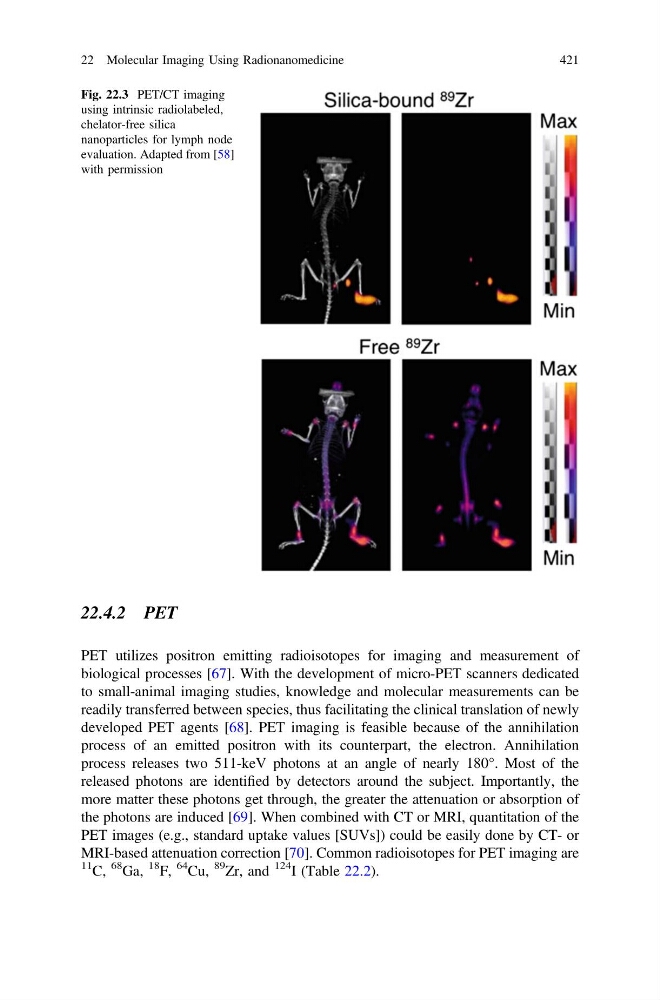
Fig. 22.3 PET/CT imaging
using intrinsic radiolabeled,
chelator-free silica
nanoparticles for lymph node
evaluation. Adapted from [58]
with permission
22 Molecular Imaging Using Radionanomedicine
421
PET utilizes positron emitting radioisotopes for imaging and measurement of
biological processes [67]. With the development of micro-PET scanners dedicated
to small-animal imaging studies, knowledge and molecular measurements can be
readily transferred between species, thus facilitating the clinical translation of newly
developed PET agents [68]. PET imaging is feasible because of the annihilation
process of an emitted positron with its counterpart, the electron. Annihilation
process releases two 511-keV photons at an angle of nearly 180°. Most of the
released photons are identified by detectors around the subject. Importantly, the
more matter these photons get through, the greater the attenuation or absorption of
the photons are induced [69]. When combined with CT or MRI, quantitation of the
PET images (e.g., standard uptake values [SUVs]) could be easily done by CT- or
MRI-based attenuation correction [70]. Common radioisotopes for PET imaging are
11 C,
68 Ga,
18 F,
64 Cu,
89 Zr, and
124 I (Table 22.2).
Fig. 22.3 PET/CT imaging
using intrinsic radiolabeled,
chelator-free silica
nanoparticles for lymph node
evaluation. Adapted from [58]
with permission
22 Molecular Imaging Using Radionanomedicine
421