

nanoparticles (SNPs) [55]. Another example of a
99m Tc tracer is the FDA-approved
formulation of filtered
99m Tc-sulfur nanocolloid (<100 nm) for the imaging of
sentinel lymph nodes (SLNs) in prostate cancer [56]. In addition, SLN mapping
with ultra-small SNPs has been studied [57].
For longer duration imaging,
67 Ga,
111 In, and various iodine species can be used.
67 Ga (t1/2 = 2.2 days) and
111 In (t1/2 = 2.8 days) have been utilized for radiolabel
NPs using chelator-free methods [58, 59] (Fig. 22.3). Certain isotopes release both
therapeutic electrons and gamma photons, enabling the use of the same isotope for
both therapy and SPECT imaging (e.g.,
131
I [t1/2 = 8 days] and
177 Lu [t1/
2 = 6.7 days]). Nontherapeutic uses of
131 I often serve as
124 I analogs in preclinical
studies because of the lower cost.
125
I-labeled albumin and transferrin (t1/
2 = 50 days) have been utilized to investigate the protein corona of
59 Fe-SPIOs
[60].
Since lead collimators are used to check the angle of incidence, SPECT imaging
has a low efficiency of detection (<10
−4 times from emitted gamma rays) [61].
Recently, SPECT have been evolving with higher sensitivity and spatial resolution
[62]. In addition to superior spatial resolution, the main strength of SPECT over
PET is that simultaneous imaging of several radioisotope is possible, as the emitted
gamma rays from different radioisotopes can be discerned according to their energy
[63]. Whereas PET has higher detection efficiency than SPECT (up to 10%) [64].
PET was first invented in the mid-1970s [65], and micro-PET for small animal was
first emerged in the late-1990s [66]. Until now, PET imaging is widely used in
preclinical and clinical studies.
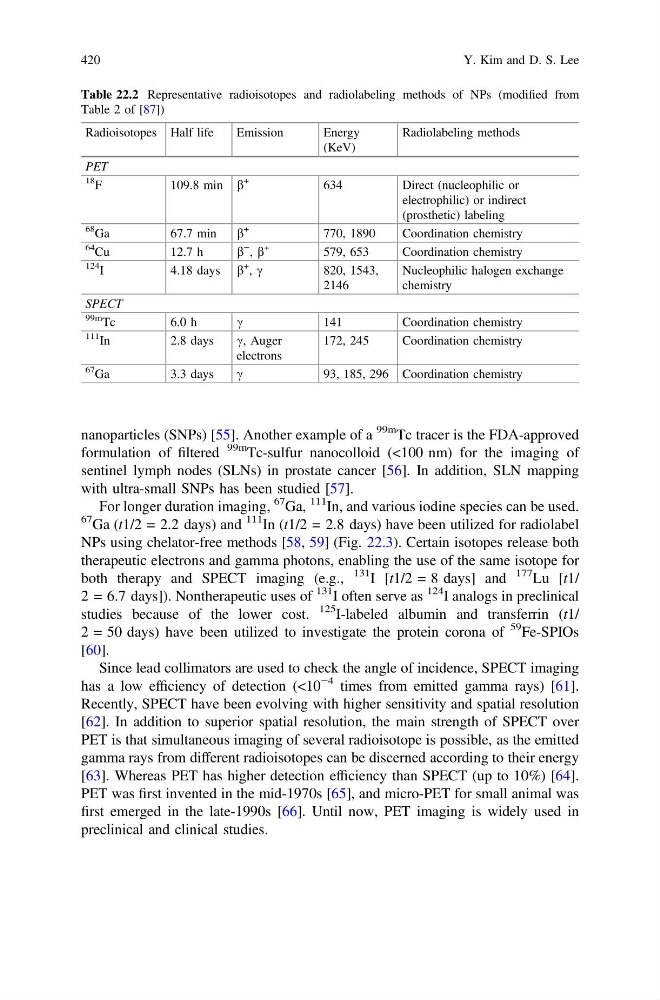
Table 22.2 Representative radioisotopes and radiolabeling methods of NPs (modified from
Table 2 of [87])
Radioisotopes Half life
Emission
Energy
(KeV)
Radiolabeling methods
PET
18
F
109.8 min b
+
634
Direct (nucleophilic or
electrophilic) or indirect
(prosthetic) labeling
68
Ga
67.7 min
b
+
770, 1890
Coordination chemistry
64
Cu
12.7 h
b
−
, b
+
579, 653
Coordination chemistry
124
I
4.18 days b
+ , c
820, 1543,
2146
Nucleophilic halogen exchange
chemistry
SPECT
99m
Tc
6.0 h
c
141
Coordination chemistry
111
In
2.8 days
c, Auger
electrons
172, 245
Coordination chemistry
67
Ga
3.3 days
c
93, 185, 296 Coordination chemistry
420
Y. Kim and D. S. Lee
99m Tc tracer is the FDA-approved
formulation of filtered
99m Tc-sulfur nanocolloid (<100 nm) for the imaging of
sentinel lymph nodes (SLNs) in prostate cancer [56]. In addition, SLN mapping
with ultra-small SNPs has been studied [57].
For longer duration imaging,
67 Ga,
111 In, and various iodine species can be used.
67 Ga (t1/2 = 2.2 days) and
111 In (t1/2 = 2.8 days) have been utilized for radiolabel
NPs using chelator-free methods [58, 59] (Fig. 22.3). Certain isotopes release both
therapeutic electrons and gamma photons, enabling the use of the same isotope for
both therapy and SPECT imaging (e.g.,
131
I [t1/2 = 8 days] and
177 Lu [t1/
2 = 6.7 days]). Nontherapeutic uses of
131 I often serve as
124 I analogs in preclinical
studies because of the lower cost.
125
I-labeled albumin and transferrin (t1/
2 = 50 days) have been utilized to investigate the protein corona of
59 Fe-SPIOs
[60].
Since lead collimators are used to check the angle of incidence, SPECT imaging
has a low efficiency of detection (<10
−4 times from emitted gamma rays) [61].
Recently, SPECT have been evolving with higher sensitivity and spatial resolution
[62]. In addition to superior spatial resolution, the main strength of SPECT over
PET is that simultaneous imaging of several radioisotope is possible, as the emitted
gamma rays from different radioisotopes can be discerned according to their energy
[63]. Whereas PET has higher detection efficiency than SPECT (up to 10%) [64].
PET was first invented in the mid-1970s [65], and micro-PET for small animal was
first emerged in the late-1990s [66]. Until now, PET imaging is widely used in
preclinical and clinical studies.
Table 22.2 Representative radioisotopes and radiolabeling methods of NPs (modified from
Table 2 of [87])
Radioisotopes Half life
Emission
Energy
(KeV)
Radiolabeling methods
PET
18
F
109.8 min b
+
634
Direct (nucleophilic or
electrophilic) or indirect
(prosthetic) labeling
68
Ga
67.7 min
b
+
770, 1890
Coordination chemistry
64
Cu
12.7 h
b
−
, b
+
579, 653
Coordination chemistry
124
I
4.18 days b
+ , c
820, 1543,
2146
Nucleophilic halogen exchange
chemistry
SPECT
99m
Tc
6.0 h
c
141
Coordination chemistry
111
In
2.8 days
c, Auger
electrons
172, 245
Coordination chemistry
67
Ga
3.3 days
c
93, 185, 296 Coordination chemistry
420
Y. Kim and D. S. Lee