

cell receptors). As is expected, circulation physiology predates immune response
and thus one can refer to the anatomy of liver and spleen detailed in the chapter to
predict the fate and final disposal of injected nanomaterials.
21.1 Immune Responses to Foreign Materials
Immunity works for the defense of the body to extraneous materials, either living or
non-living things. Immune response to the living things are well understood and
even controlled for therapeutic or diagnostic purposes. Investigators tried to
understand how the human body recognize the patterns of invasive living things to
defend individuals. Understanding immune response has progressed a lot to reach
the re-interpretation of the entire feature by systems immunology and/or single cell
immunology. The most striking is that the discrimination between innate and
adaptive immune responses has been being obliterated [1–3].
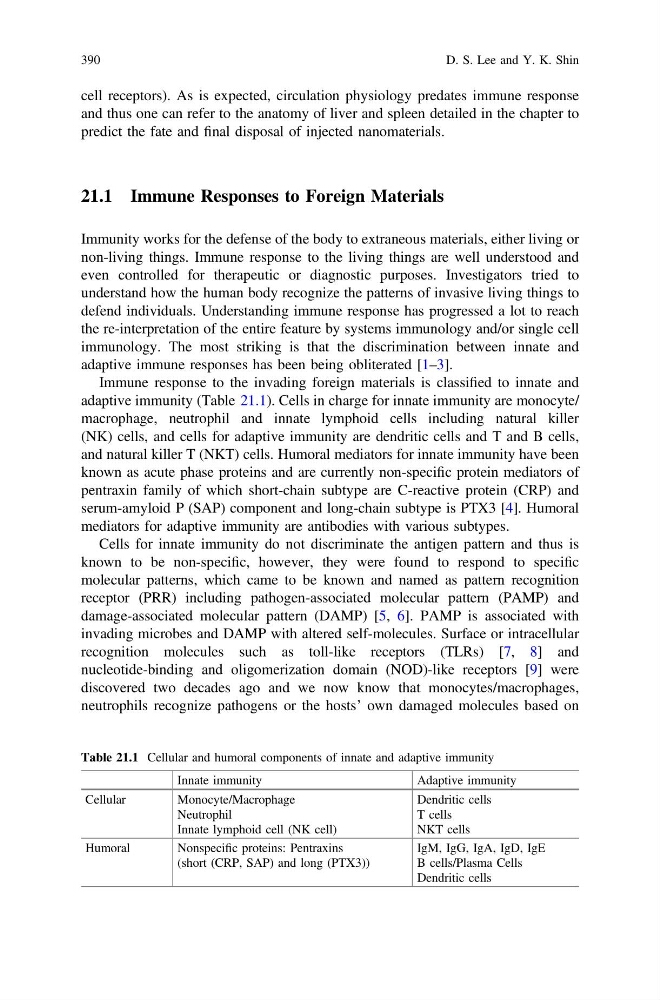
Immune response to the invading foreign materials is classified to innate and
adaptive immunity (Table 21.1). Cells in charge for innate immunity are monocyte/
macrophage, neutrophil and innate lymphoid cells including natural killer
(NK) cells, and cells for adaptive immunity are dendritic cells and T and B cells,
and natural killer T (NKT) cells. Humoral mediators for innate immunity have been
known as acute phase proteins and are currently non-specific protein mediators of
pentraxin family of which short-chain subtype are C-reactive protein (CRP) and
serum-amyloid P (SAP) component and long-chain subtype is PTX3 [4]. Humoral
mediators for adaptive immunity are antibodies with various subtypes.
Cells for innate immunity do not discriminate the antigen pattern and thus is
known to be non-specific, however, they were found to respond to specific
molecular patterns, which came to be known and named as pattern recognition
receptor (PRR) including pathogen-associated molecular pattern (PAMP) and
damage-associated molecular pattern (DAMP) [5, 6]. PAMP is associated with
invading microbes and DAMP with altered self-molecules. Surface or intracellular
recognition molecules such as toll-like receptors (TLRs) [7, 8] and
nucleotide-binding and oligomerization domain (NOD)-like receptors [9] were
discovered two decades ago and we now know that monocytes/macrophages,
neutrophils recognize pathogens or the hosts’ own damaged molecules based on
Table 21.1 Cellular and humoral components of innate and adaptive immunity
Innate immunity
Adaptive immunity
Cellular
Monocyte/Macrophage
Neutrophil
Innate lymphoid cell (NK cell)
Dendritic cells
T cells
NKT cells
Humoral
Nonspecific proteins: Pentraxins
(short (CRP, SAP) and long (PTX3))
IgM, IgG, IgA, IgD, IgE
B cells/Plasma Cells
Dendritic cells
390
D. S. Lee and Y. K. Shin
and thus one can refer to the anatomy of liver and spleen detailed in the chapter to
predict the fate and final disposal of injected nanomaterials.
21.1 Immune Responses to Foreign Materials
Immunity works for the defense of the body to extraneous materials, either living or
non-living things. Immune response to the living things are well understood and
even controlled for therapeutic or diagnostic purposes. Investigators tried to
understand how the human body recognize the patterns of invasive living things to
defend individuals. Understanding immune response has progressed a lot to reach
the re-interpretation of the entire feature by systems immunology and/or single cell
immunology. The most striking is that the discrimination between innate and
adaptive immune responses has been being obliterated [1–3].
Immune response to the invading foreign materials is classified to innate and
adaptive immunity (Table 21.1). Cells in charge for innate immunity are monocyte/
macrophage, neutrophil and innate lymphoid cells including natural killer
(NK) cells, and cells for adaptive immunity are dendritic cells and T and B cells,
and natural killer T (NKT) cells. Humoral mediators for innate immunity have been
known as acute phase proteins and are currently non-specific protein mediators of
pentraxin family of which short-chain subtype are C-reactive protein (CRP) and
serum-amyloid P (SAP) component and long-chain subtype is PTX3 [4]. Humoral
mediators for adaptive immunity are antibodies with various subtypes.
Cells for innate immunity do not discriminate the antigen pattern and thus is
known to be non-specific, however, they were found to respond to specific
molecular patterns, which came to be known and named as pattern recognition
receptor (PRR) including pathogen-associated molecular pattern (PAMP) and
damage-associated molecular pattern (DAMP) [5, 6]. PAMP is associated with
invading microbes and DAMP with altered self-molecules. Surface or intracellular
recognition molecules such as toll-like receptors (TLRs) [7, 8] and
nucleotide-binding and oligomerization domain (NOD)-like receptors [9] were
discovered two decades ago and we now know that monocytes/macrophages,
neutrophils recognize pathogens or the hosts’ own damaged molecules based on
Table 21.1 Cellular and humoral components of innate and adaptive immunity
Innate immunity
Adaptive immunity
Cellular
Monocyte/Macrophage
Neutrophil
Innate lymphoid cell (NK cell)
Dendritic cells
T cells
NKT cells
Humoral
Nonspecific proteins: Pentraxins
(short (CRP, SAP) and long (PTX3))
IgM, IgG, IgA, IgD, IgE
B cells/Plasma Cells
Dendritic cells
390
D. S. Lee and Y. K. Shin