

molecular pattern of hydrophobicity. Each PAMP has the corresponding TLR
which makes homo- or heterodimer to elicit downward signal transduction. For
example, lipopolysaccharide (LPS) of Gram-negative bacteria is bound to TLR4 to
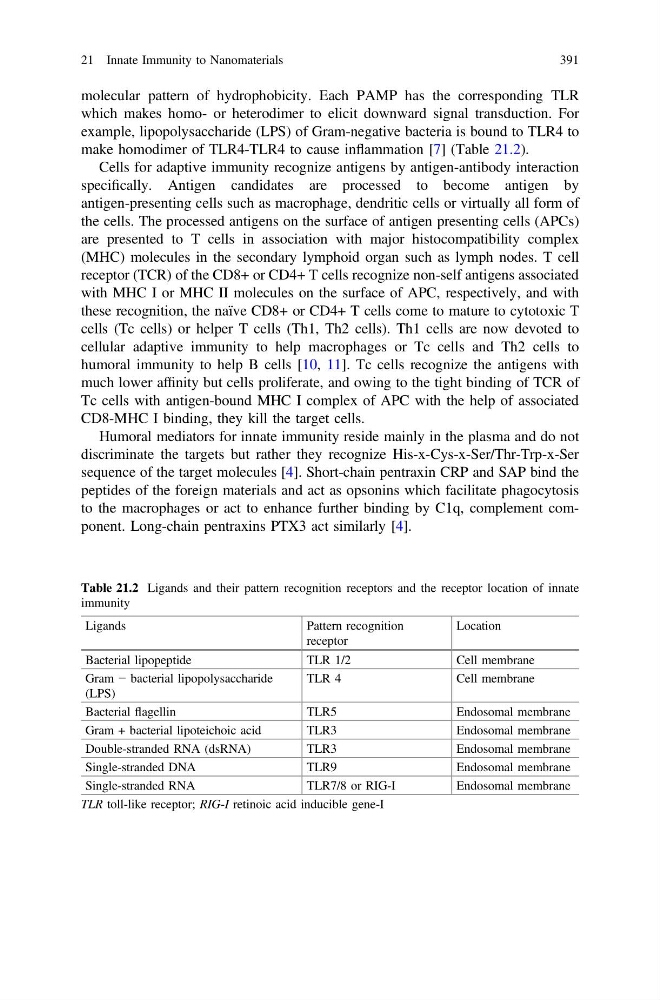
make homodimer of TLR4-TLR4 to cause inflammation [7] (Table 21.2).
Cells for adaptive immunity recognize antigens by antigen-antibody interaction
specifically. Antigen candidates are processed to become antigen by
antigen-presenting cells such as macrophage, dendritic cells or virtually all form of
the cells. The processed antigens on the surface of antigen presenting cells (APCs)
are presented to T cells in association with major histocompatibility complex
(MHC) molecules in the secondary lymphoid organ such as lymph nodes. T cell
receptor (TCR) of the CD8+ or CD4+ T cells recognize non-self antigens associated
with MHC I or MHC II molecules on the surface of APC, respectively, and with
these recognition, the naïve CD8+ or CD4+ T cells come to mature to cytotoxic T
cells (Tc cells) or helper T cells (Th1, Th2 cells). Th1 cells are now devoted to
cellular adaptive immunity to help macrophages or Tc cells and Th2 cells to
humoral immunity to help B cells [10, 11]. Tc cells recognize the antigens with
much lower affinity but cells proliferate, and owing to the tight binding of TCR of
Tc cells with antigen-bound MHC I complex of APC with the help of associated
CD8-MHC I binding, they kill the target cells.
Humoral mediators for innate immunity reside mainly in the plasma and do not
discriminate the targets but rather they recognize His-x-Cys-x-Ser/Thr-Trp-x-Ser
sequence of the target molecules [4]. Short-chain pentraxin CRP and SAP bind the
peptides of the foreign materials and act as opsonins which facilitate phagocytosis
to the macrophages or act to enhance further binding by C1q, complement component. Long-chain pentraxins PTX3 act similarly [4].
Table 21.2 Ligands and their pattern recognition receptors and the receptor location of innate
immunity
Ligands
Pattern recognition
receptor
Location
Bacterial lipopeptide
TLR 1/2
Cell membrane
Gram − bacterial lipopolysaccharide
(LPS)
TLR 4
Cell membrane
Bacterial flagellin
TLR5
Endosomal membrane
Gram + bacterial lipoteichoic acid
TLR3
Endosomal membrane
Double-stranded RNA (dsRNA)
TLR3
Endosomal membrane
Single-stranded DNA
TLR9
Endosomal membrane
Single-stranded RNA
TLR7/8 or RIG-I
Endosomal membrane
TLR toll-like receptor; RIG-I retinoic acid inducible gene-I
21 Innate Immunity to Nanomaterials
391
which makes homo- or heterodimer to elicit downward signal transduction. For
example, lipopolysaccharide (LPS) of Gram-negative bacteria is bound to TLR4 to
make homodimer of TLR4-TLR4 to cause inflammation [7] (Table 21.2).
Cells for adaptive immunity recognize antigens by antigen-antibody interaction
specifically. Antigen candidates are processed to become antigen by
antigen-presenting cells such as macrophage, dendritic cells or virtually all form of
the cells. The processed antigens on the surface of antigen presenting cells (APCs)
are presented to T cells in association with major histocompatibility complex
(MHC) molecules in the secondary lymphoid organ such as lymph nodes. T cell
receptor (TCR) of the CD8+ or CD4+ T cells recognize non-self antigens associated
with MHC I or MHC II molecules on the surface of APC, respectively, and with
these recognition, the naïve CD8+ or CD4+ T cells come to mature to cytotoxic T
cells (Tc cells) or helper T cells (Th1, Th2 cells). Th1 cells are now devoted to
cellular adaptive immunity to help macrophages or Tc cells and Th2 cells to
humoral immunity to help B cells [10, 11]. Tc cells recognize the antigens with
much lower affinity but cells proliferate, and owing to the tight binding of TCR of
Tc cells with antigen-bound MHC I complex of APC with the help of associated
CD8-MHC I binding, they kill the target cells.
Humoral mediators for innate immunity reside mainly in the plasma and do not
discriminate the targets but rather they recognize His-x-Cys-x-Ser/Thr-Trp-x-Ser
sequence of the target molecules [4]. Short-chain pentraxin CRP and SAP bind the
peptides of the foreign materials and act as opsonins which facilitate phagocytosis
to the macrophages or act to enhance further binding by C1q, complement component. Long-chain pentraxins PTX3 act similarly [4].
Table 21.2 Ligands and their pattern recognition receptors and the receptor location of innate
immunity
Ligands
Pattern recognition
receptor
Location
Bacterial lipopeptide
TLR 1/2
Cell membrane
Gram − bacterial lipopolysaccharide
(LPS)
TLR 4
Cell membrane
Bacterial flagellin
TLR5
Endosomal membrane
Gram + bacterial lipoteichoic acid
TLR3
Endosomal membrane
Double-stranded RNA (dsRNA)
TLR3
Endosomal membrane
Single-stranded DNA
TLR9
Endosomal membrane
Single-stranded RNA
TLR7/8 or RIG-I
Endosomal membrane
TLR toll-like receptor; RIG-I retinoic acid inducible gene-I
21 Innate Immunity to Nanomaterials
391