

As in the case of GSH–AuNP, short circulation time of renal clearable NPs
reduces the chance of delivering NPs to a target lesion. Thus balancing the efficient
renal excretion and sufficient circulation time is an important issue. Enhancing EPR
without sacrificing renal clearance is quite challenging but can be achieved.
Switching surface ligand of AuNPs from GSH to PEGylated ligand can significantly increase the blood retention time of AuNPs, which can further enhance tumor
targeting efficiency of renal clearable AuNPs [20]. Renal clearable PEG–AuNPs
exhibited the higher targeting efficiency than GSH–AuNPs (8.3 vs. 2.3%ID/g).
Pharmacokinetics analysis indicated that enhanced circulation half-life resulted
in high EPR effect and thus high tumor targeting of PEG–AuNPs. Liang et al.
reported the efficient renal excretion and passive targeting of tetra
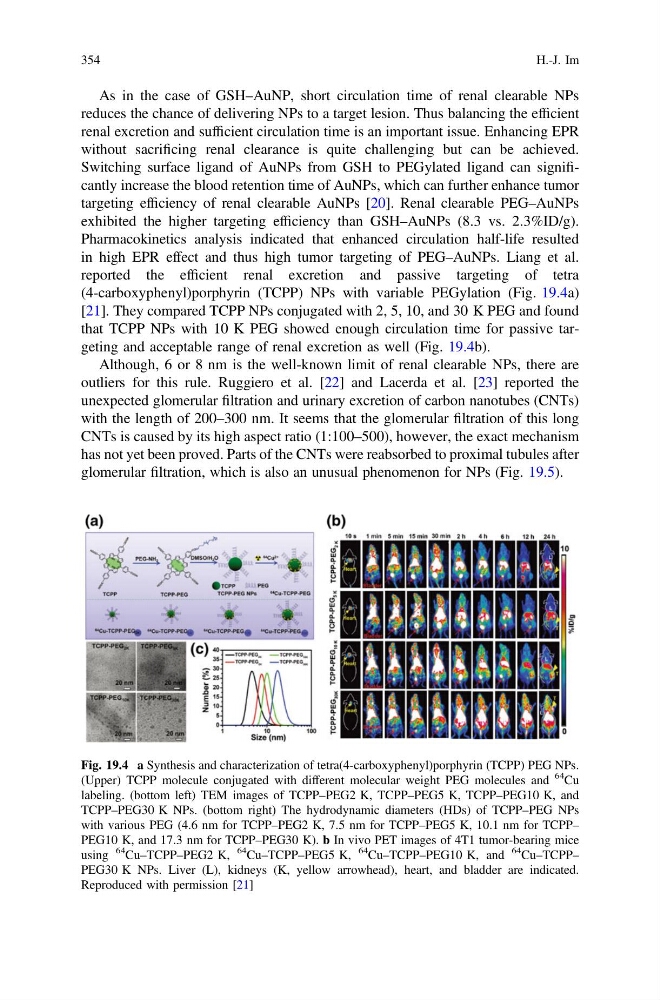
(4-carboxyphenyl)porphyrin (TCPP) NPs with variable PEGylation (Fig. 19.4a)
[21]. They compared TCPP NPs conjugated with 2, 5, 10, and 30 K PEG and found
that TCPP NPs with 10 K PEG showed enough circulation time for passive targeting and acceptable range of renal excretion as well (Fig. 19.4b).
Although, 6 or 8 nm is the well-known limit of renal clearable NPs, there are
outliers for this rule. Ruggiero et al. [22] and Lacerda et al. [23] reported the
unexpected glomerular filtration and urinary excretion of carbon nanotubes (CNTs)
with the length of 200–300 nm. It seems that the glomerular filtration of this long
CNTs is caused by its high aspect ratio (1:100–500), however, the exact mechanism
has not yet been proved. Parts of the CNTs were reabsorbed to proximal tubules after
glomerular filtration, which is also an unusual phenomenon for NPs (Fig. 19.5).
Fig. 19.4 a Synthesis and characterization of tetra(4-carboxyphenyl)porphyrin (TCPP) PEG NPs.
(Upper) TCPP molecule conjugated with different molecular weight PEG molecules and
64
Cu
labeling. (bottom left) TEM images of TCPP–PEG2 K, TCPP–PEG5 K, TCPP–PEG10 K, and
TCPP–PEG30 K NPs. (bottom right) The hydrodynamic diameters (HDs) of TCPP–PEG NPs
with various PEG (4.6 nm for TCPP–PEG2 K, 7.5 nm for TCPP–PEG5 K, 10.1 nm for TCPP–
PEG10 K, and 17.3 nm for TCPP–PEG30 K). b In vivo PET images of 4T1 tumor-bearing mice
using
64
Cu–TCPP–PEG2 K,
64
Cu–TCPP–PEG5 K,
64
Cu–TCPP–PEG10 K, and
64
Cu–TCPP–
PEG30 K NPs. Liver (L), kidneys (K, yellow arrowhead), heart, and bladder are indicated.
Reproduced with permission [21]
354
H.-J. Im
reduces the chance of delivering NPs to a target lesion. Thus balancing the efficient
renal excretion and sufficient circulation time is an important issue. Enhancing EPR
without sacrificing renal clearance is quite challenging but can be achieved.
Switching surface ligand of AuNPs from GSH to PEGylated ligand can significantly increase the blood retention time of AuNPs, which can further enhance tumor
targeting efficiency of renal clearable AuNPs [20]. Renal clearable PEG–AuNPs
exhibited the higher targeting efficiency than GSH–AuNPs (8.3 vs. 2.3%ID/g).
Pharmacokinetics analysis indicated that enhanced circulation half-life resulted
in high EPR effect and thus high tumor targeting of PEG–AuNPs. Liang et al.
reported the efficient renal excretion and passive targeting of tetra
(4-carboxyphenyl)porphyrin (TCPP) NPs with variable PEGylation (Fig. 19.4a)
[21]. They compared TCPP NPs conjugated with 2, 5, 10, and 30 K PEG and found
that TCPP NPs with 10 K PEG showed enough circulation time for passive targeting and acceptable range of renal excretion as well (Fig. 19.4b).
Although, 6 or 8 nm is the well-known limit of renal clearable NPs, there are
outliers for this rule. Ruggiero et al. [22] and Lacerda et al. [23] reported the
unexpected glomerular filtration and urinary excretion of carbon nanotubes (CNTs)
with the length of 200–300 nm. It seems that the glomerular filtration of this long
CNTs is caused by its high aspect ratio (1:100–500), however, the exact mechanism
has not yet been proved. Parts of the CNTs were reabsorbed to proximal tubules after
glomerular filtration, which is also an unusual phenomenon for NPs (Fig. 19.5).
Fig. 19.4 a Synthesis and characterization of tetra(4-carboxyphenyl)porphyrin (TCPP) PEG NPs.
(Upper) TCPP molecule conjugated with different molecular weight PEG molecules and
64
Cu
labeling. (bottom left) TEM images of TCPP–PEG2 K, TCPP–PEG5 K, TCPP–PEG10 K, and
TCPP–PEG30 K NPs. (bottom right) The hydrodynamic diameters (HDs) of TCPP–PEG NPs
with various PEG (4.6 nm for TCPP–PEG2 K, 7.5 nm for TCPP–PEG5 K, 10.1 nm for TCPP–
PEG10 K, and 17.3 nm for TCPP–PEG30 K). b In vivo PET images of 4T1 tumor-bearing mice
using
64
Cu–TCPP–PEG2 K,
64
Cu–TCPP–PEG5 K,
64
Cu–TCPP–PEG10 K, and
64
Cu–TCPP–
PEG30 K NPs. Liver (L), kidneys (K, yellow arrowhead), heart, and bladder are indicated.
Reproduced with permission [21]
354
H.-J. Im