

these nanomaterials cannot pass through alveolar capillaries of the lungs if the size is
over the capillary lumen size [1] or draw attention of the innate immune cells [2].
Innate immune cells recognize pathogen-associated molecular pattern (PAMP) or
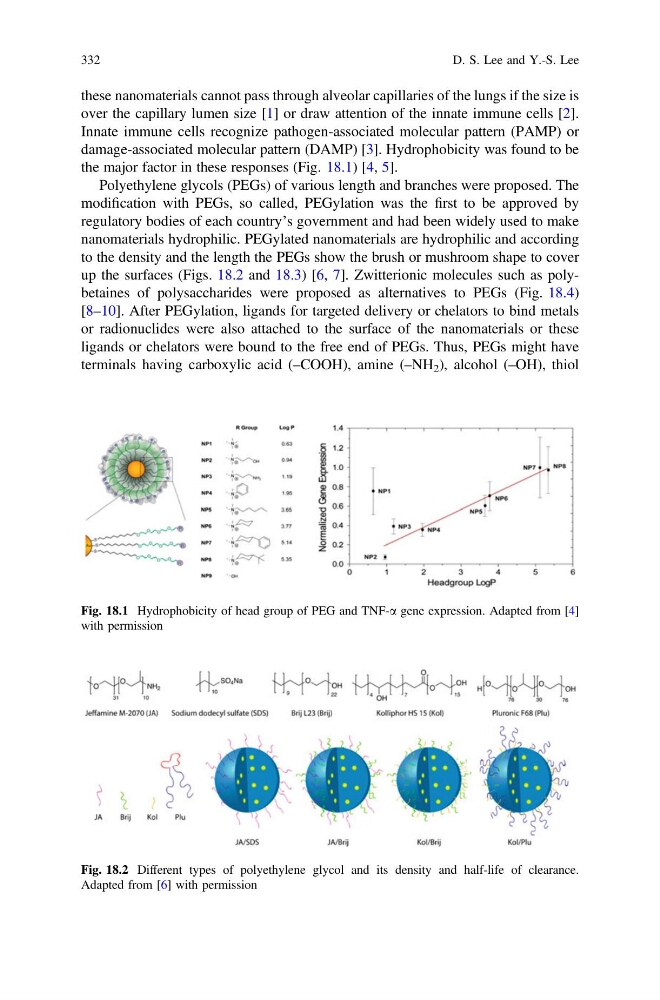
damage-associated molecular pattern (DAMP) [3]. Hydrophobicity was found to be
the major factor in these responses (Fig. 18.1) [4, 5].
Polyethylene glycols (PEGs) of various length and branches were proposed. The
modification with PEGs, so called, PEGylation was the first to be approved by
regulatory bodies of each country’s government and had been widely used to make
nanomaterials hydrophilic. PEGylated nanomaterials are hydrophilic and according
to the density and the length the PEGs show the brush or mushroom shape to cover
up the surfaces (Figs. 18.2 and 18.3) [6, 7]. Zwitterionic molecules such as polybetaines of polysaccharides were proposed as alternatives to PEGs (Fig. 18.4)
[8–10]. After PEGylation, ligands for targeted delivery or chelators to bind metals
or radionuclides were also attached to the surface of the nanomaterials or these
ligands or chelators were bound to the free end of PEGs. Thus, PEGs might have
terminals having carboxylic acid (–COOH), amine (–NH 2 ), alcohol (–OH), thiol
Fig. 18.1 Hydrophobicity of head group of PEG and TNF-a gene expression. Adapted from [4]
with permission
Fig. 18.2 Different types of polyethylene glycol and its density and half-life of clearance.
Adapted from [6] with permission
332
D. S. Lee and Y.-S. Lee
over the capillary lumen size [1] or draw attention of the innate immune cells [2].
Innate immune cells recognize pathogen-associated molecular pattern (PAMP) or
damage-associated molecular pattern (DAMP) [3]. Hydrophobicity was found to be
the major factor in these responses (Fig. 18.1) [4, 5].
Polyethylene glycols (PEGs) of various length and branches were proposed. The
modification with PEGs, so called, PEGylation was the first to be approved by
regulatory bodies of each country’s government and had been widely used to make
nanomaterials hydrophilic. PEGylated nanomaterials are hydrophilic and according
to the density and the length the PEGs show the brush or mushroom shape to cover
up the surfaces (Figs. 18.2 and 18.3) [6, 7]. Zwitterionic molecules such as polybetaines of polysaccharides were proposed as alternatives to PEGs (Fig. 18.4)
[8–10]. After PEGylation, ligands for targeted delivery or chelators to bind metals
or radionuclides were also attached to the surface of the nanomaterials or these
ligands or chelators were bound to the free end of PEGs. Thus, PEGs might have
terminals having carboxylic acid (–COOH), amine (–NH 2 ), alcohol (–OH), thiol
Fig. 18.1 Hydrophobicity of head group of PEG and TNF-a gene expression. Adapted from [4]
with permission
Fig. 18.2 Different types of polyethylene glycol and its density and half-life of clearance.
Adapted from [6] with permission
332
D. S. Lee and Y.-S. Lee