

complex dynamics of shape-dependent tumor extravasation [95]. For example,
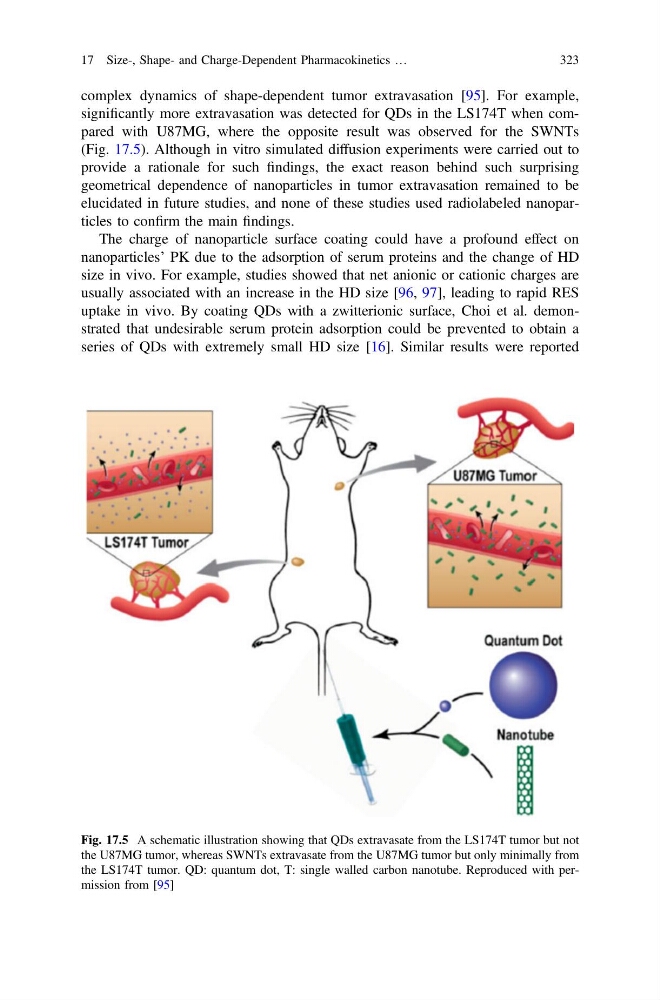
significantly more extravasation was detected for QDs in the LS174T when compared with U87MG, where the opposite result was observed for the SWNTs
(Fig. 17.5). Although in vitro simulated diffusion experiments were carried out to
provide a rationale for such findings, the exact reason behind such surprising
geometrical dependence of nanoparticles in tumor extravasation remained to be
elucidated in future studies, and none of these studies used radiolabeled nanoparticles to confirm the main findings.
The charge of nanoparticle surface coating could have a profound effect on
nanoparticles’ PK due to the adsorption of serum proteins and the change of HD
size in vivo. For example, studies showed that net anionic or cationic charges are
usually associated with an increase in the HD size [96, 97], leading to rapid RES
uptake in vivo. By coating QDs with a zwitterionic surface, Choi et al. demonstrated that undesirable serum protein adsorption could be prevented to obtain a
series of QDs with extremely small HD size [16]. Similar results were reported
Fig. 17.5 A schematic illustration showing that QDs extravasate from the LS174T tumor but not
the U87MG tumor, whereas SWNTs extravasate from the U87MG tumor but only minimally from
the LS174T tumor. QD: quantum dot, T: single walled carbon nanotube. Reproduced with permission from [95]
17 Size-, Shape- and Charge-Dependent Pharmacokinetics …
323
significantly more extravasation was detected for QDs in the LS174T when compared with U87MG, where the opposite result was observed for the SWNTs
(Fig. 17.5). Although in vitro simulated diffusion experiments were carried out to
provide a rationale for such findings, the exact reason behind such surprising
geometrical dependence of nanoparticles in tumor extravasation remained to be
elucidated in future studies, and none of these studies used radiolabeled nanoparticles to confirm the main findings.
The charge of nanoparticle surface coating could have a profound effect on
nanoparticles’ PK due to the adsorption of serum proteins and the change of HD
size in vivo. For example, studies showed that net anionic or cationic charges are
usually associated with an increase in the HD size [96, 97], leading to rapid RES
uptake in vivo. By coating QDs with a zwitterionic surface, Choi et al. demonstrated that undesirable serum protein adsorption could be prevented to obtain a
series of QDs with extremely small HD size [16]. Similar results were reported
Fig. 17.5 A schematic illustration showing that QDs extravasate from the LS174T tumor but not
the U87MG tumor, whereas SWNTs extravasate from the U87MG tumor but only minimally from
the LS174T tumor. QD: quantum dot, T: single walled carbon nanotube. Reproduced with permission from [95]
17 Size-, Shape- and Charge-Dependent Pharmacokinetics …
323