

C T ðtÞ ¼ C 1 ðtÞ þ C 2 ðtÞ
¼ K 1 C p ðtÞ
k 3 þ k 4 À q 1
q 2 À q 1
e
Àq 1 t
À
k 3 þ k 4 À q 2
q 2 À q 1
e
Àq 2 t
!
ð16:5Þ
q 1 ; q 2 ¼
ðk 2 þ k 3 þ k 4 Þ Ç
ffiffiffiffiffiffiffiffiffiffiffiffiffiffiffiffiffiffiffiffiffiffiffiffiffiffiffiffiffiffiffiffiffiffiffiffiffiffiffiffiffiffiffiffiffi
ðk 2 þ k 3 þ k 4 Þ
2 À 4k 2 k 4
q
2
ð16:6Þ
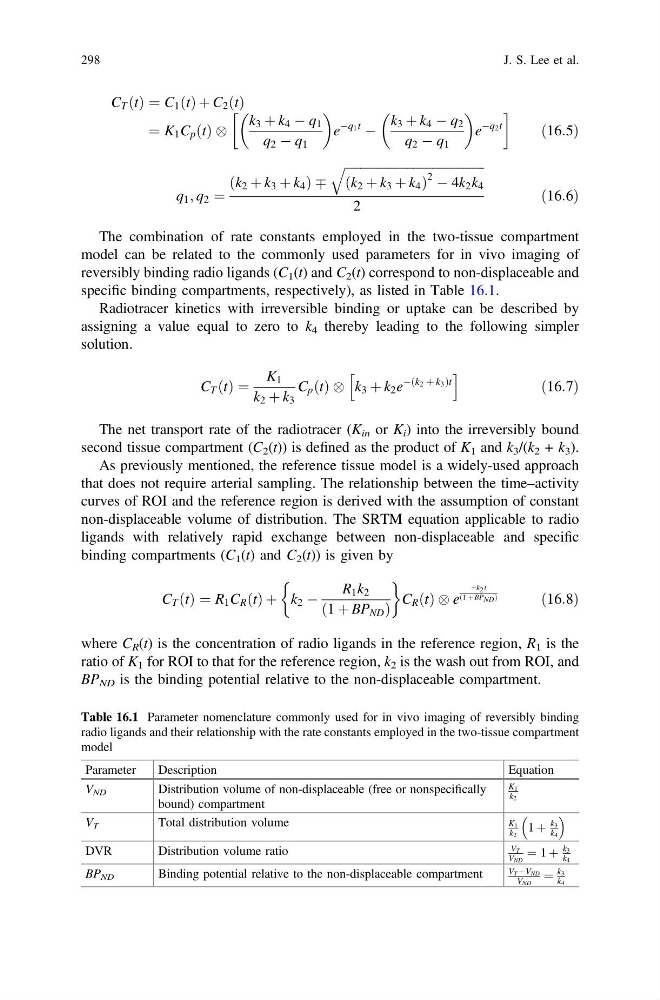
The combination of rate constants employed in the two-tissue compartment
model can be related to the commonly used parameters for in vivo imaging of
reversibly binding radio ligands (C 1 (t) and C 2 (t) correspond to non-displaceable and
specific binding compartments, respectively), as listed in Table 16.1.
Radiotracer kinetics with irreversible binding or uptake can be described by
assigning a value equal to zero to k 4 thereby leading to the following simpler
solution.
C T ðtÞ ¼
K 1
k 2 þ k 3
C p ðtÞ k 3 þ k 2 e
Àðk 2 þ k 3 Þt
h
i
ð16:7Þ
The net transport rate of the radiotracer (K in or K i ) into the irreversibly bound
second tissue compartment (C 2 (t)) is defined as the product of K 1 and k 3 /(k 2 + k 3 ).
As previously mentioned, the reference tissue model is a widely-used approach
that does not require arterial sampling. The relationship between the time–activity
curves of ROI and the reference region is derived with the assumption of constant
non-displaceable volume of distribution. The SRTM equation applicable to radio
ligands with relatively rapid exchange between non-displaceable and specific
binding compartments (C 1 (t) and C 2 (t)) is given by
C T ðtÞ ¼ R 1 C R ðtÞ þ k 2 À
R 1 k 2
ð1 þ BP ND Þ
&
'
C R ðtÞ e
Àk 2 t
ð1 þ BP ND Þ
ð16:8Þ
where C R (t) is the concentration of radio ligands in the reference region, R 1 is the
ratio of K 1 for ROI to that for the reference region, k 2 is the wash out from ROI, and
BP ND is the binding potential relative to the non-displaceable compartment.
Table 16.1 Parameter nomenclature commonly used for in vivo imaging of reversibly binding
radio ligands and their relationship with the rate constants employed in the two-tissue compartment
model
Parameter
Description
Equation
V ND
Distribution volume of non-displaceable (free or nonspecifically
bound) compartment
K1
k2
V T
Total distribution volume
K1
k2 1 þ
k3
k4
DVR
Distribution volume ratio
VT
VND ¼ 1 þ
k3
k4
BP ND
Binding potential relative to the non-displaceable compartment
VT ÀVND
VND ¼
k3
k4
298
J. S. Lee et al.
¼ K 1 C p ðtÞ
k 3 þ k 4 À q 1
q 2 À q 1
e
Àq 1 t
À
k 3 þ k 4 À q 2
q 2 À q 1
e
Àq 2 t
!
ð16:5Þ
q 1 ; q 2 ¼
ðk 2 þ k 3 þ k 4 Þ Ç
ffiffiffiffiffiffiffiffiffiffiffiffiffiffiffiffiffiffiffiffiffiffiffiffiffiffiffiffiffiffiffiffiffiffiffiffiffiffiffiffiffiffiffiffiffi
ðk 2 þ k 3 þ k 4 Þ
2 À 4k 2 k 4
q
2
ð16:6Þ
The combination of rate constants employed in the two-tissue compartment
model can be related to the commonly used parameters for in vivo imaging of
reversibly binding radio ligands (C 1 (t) and C 2 (t) correspond to non-displaceable and
specific binding compartments, respectively), as listed in Table 16.1.
Radiotracer kinetics with irreversible binding or uptake can be described by
assigning a value equal to zero to k 4 thereby leading to the following simpler
solution.
C T ðtÞ ¼
K 1
k 2 þ k 3
C p ðtÞ k 3 þ k 2 e
Àðk 2 þ k 3 Þt
h
i
ð16:7Þ
The net transport rate of the radiotracer (K in or K i ) into the irreversibly bound
second tissue compartment (C 2 (t)) is defined as the product of K 1 and k 3 /(k 2 + k 3 ).
As previously mentioned, the reference tissue model is a widely-used approach
that does not require arterial sampling. The relationship between the time–activity
curves of ROI and the reference region is derived with the assumption of constant
non-displaceable volume of distribution. The SRTM equation applicable to radio
ligands with relatively rapid exchange between non-displaceable and specific
binding compartments (C 1 (t) and C 2 (t)) is given by
C T ðtÞ ¼ R 1 C R ðtÞ þ k 2 À
R 1 k 2
ð1 þ BP ND Þ
&
'
C R ðtÞ e
Àk 2 t
ð1 þ BP ND Þ
ð16:8Þ
where C R (t) is the concentration of radio ligands in the reference region, R 1 is the
ratio of K 1 for ROI to that for the reference region, k 2 is the wash out from ROI, and
BP ND is the binding potential relative to the non-displaceable compartment.
Table 16.1 Parameter nomenclature commonly used for in vivo imaging of reversibly binding
radio ligands and their relationship with the rate constants employed in the two-tissue compartment
model
Parameter
Description
Equation
V ND
Distribution volume of non-displaceable (free or nonspecifically
bound) compartment
K1
k2
V T
Total distribution volume
K1
k2 1 þ
k3
k4
DVR
Distribution volume ratio
VT
VND ¼ 1 þ
k3
k4
BP ND
Binding potential relative to the non-displaceable compartment
VT ÀVND
VND ¼
k3
k4
298
J. S. Lee et al.