

radiolabeled Tz species (Fig. 13.5) [53–56]. The alternative scenario (i.e. involving
a Tz-modified antibody/nanomaterial and a radiolabeled TCO secondary agent) has
not been so extensively studied, most likely because TCO has a tendency to
undergo rapid isomerisation to its comparatively unreactive cis isomer in the
presence of copper-containing proteins within the plasma. Such pretargeting
strategies based on IEDDA reactions have demonstrated a promising ability in
preclinical studies to improve upon some of the limitations of directly radiolabeled
antibodies (e.g. slow blood clearance) leading to enhanced image quality and a
lower radiation burden to the body [56]. Recently, the scope of this approach has
also been significantly expanded as primary agents based on nanomaterials have
been evaluated within the context of IEDDA-based pretargeting strategies.
In a highly innovate study, Hou et al. developed supramolecular nanoparticles
(SNPs) comprised of a cyclodextrin-polyethylenimine polymer (CD-PEI),
adamantine-grafted polyamidoamine, and adamantine-grafted polyethylene glycol
[57]. In this case, TCO was grafted on to the CD-PEI polymer and was
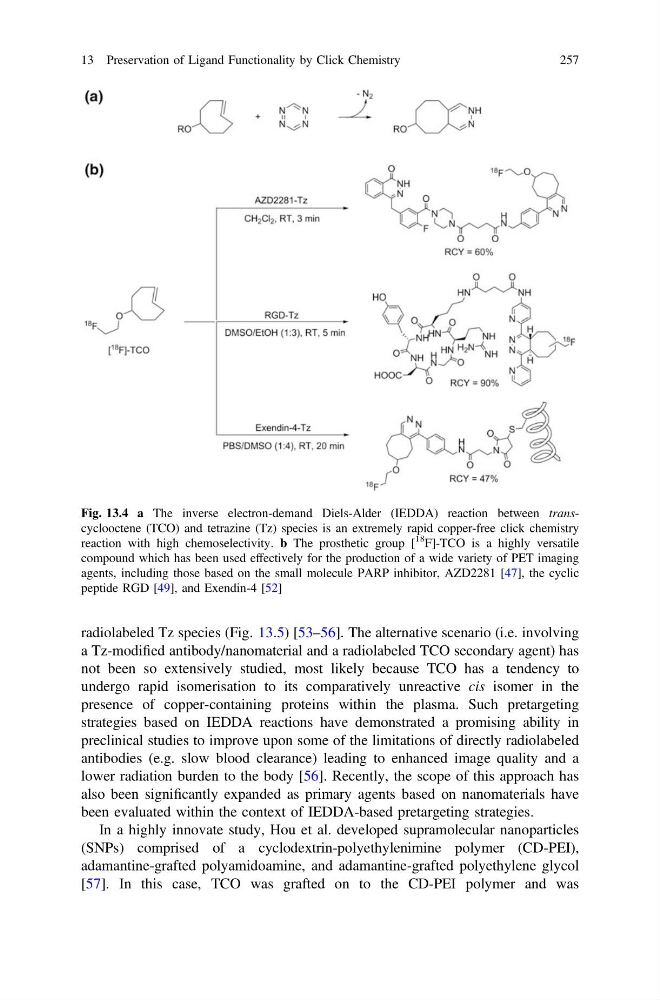
Fig. 13.4 a The inverse electron-demand Diels-Alder (IEDDA) reaction between transcyclooctene (TCO) and tetrazine (Tz) species is an extremely rapid copper-free click chemistry
reaction with high chemoselectivity. b The prosthetic group [
18
F]-TCO is a highly versatile
compound which has been used effectively for the production of a wide variety of PET imaging
agents, including those based on the small molecule PARP inhibitor, AZD2281 [47], the cyclic
peptide RGD [49], and Exendin-4 [52]
13 Preservation of Ligand Functionality by Click Chemistry
257
a Tz-modified antibody/nanomaterial and a radiolabeled TCO secondary agent) has
not been so extensively studied, most likely because TCO has a tendency to
undergo rapid isomerisation to its comparatively unreactive cis isomer in the
presence of copper-containing proteins within the plasma. Such pretargeting
strategies based on IEDDA reactions have demonstrated a promising ability in
preclinical studies to improve upon some of the limitations of directly radiolabeled
antibodies (e.g. slow blood clearance) leading to enhanced image quality and a
lower radiation burden to the body [56]. Recently, the scope of this approach has
also been significantly expanded as primary agents based on nanomaterials have
been evaluated within the context of IEDDA-based pretargeting strategies.
In a highly innovate study, Hou et al. developed supramolecular nanoparticles
(SNPs) comprised of a cyclodextrin-polyethylenimine polymer (CD-PEI),
adamantine-grafted polyamidoamine, and adamantine-grafted polyethylene glycol
[57]. In this case, TCO was grafted on to the CD-PEI polymer and was
Fig. 13.4 a The inverse electron-demand Diels-Alder (IEDDA) reaction between transcyclooctene (TCO) and tetrazine (Tz) species is an extremely rapid copper-free click chemistry
reaction with high chemoselectivity. b The prosthetic group [
18
F]-TCO is a highly versatile
compound which has been used effectively for the production of a wide variety of PET imaging
agents, including those based on the small molecule PARP inhibitor, AZD2281 [47], the cyclic
peptide RGD [49], and Exendin-4 [52]
13 Preservation of Ligand Functionality by Click Chemistry
257