

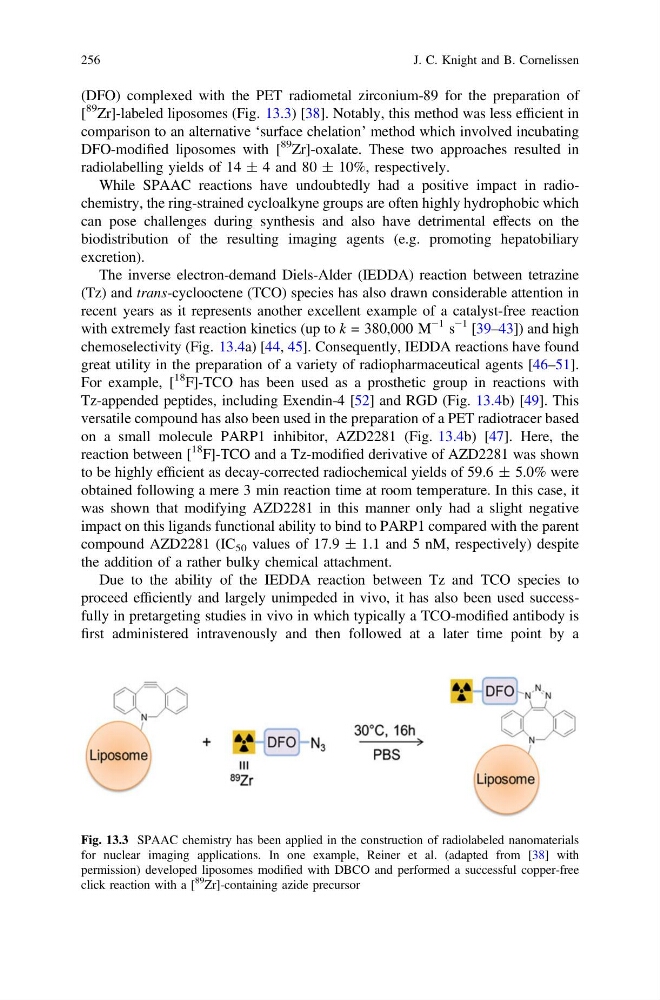
(DFO) complexed with the PET radiometal zirconium-89 for the preparation of
[
89 Zr]-labeled liposomes (Fig. 13.3) [38]. Notably, this method was less efficient in
comparison to an alternative ‘surface chelation’ method which involved incubating
DFO-modified liposomes with [
89 Zr]-oxalate. These two approaches resulted in
radiolabelling yields of 14 ± 4 and 80 ± 10%, respectively.
While SPAAC reactions have undoubtedly had a positive impact in radiochemistry, the ring-strained cycloalkyne groups are often highly hydrophobic which
can pose challenges during synthesis and also have detrimental effects on the
biodistribution of the resulting imaging agents (e.g. promoting hepatobiliary
excretion).
The inverse electron-demand Diels-Alder (IEDDA) reaction between tetrazine
(Tz) and trans-cyclooctene (TCO) species has also drawn considerable attention in
recent years as it represents another excellent example of a catalyst-free reaction
with extremely fast reaction kinetics (up to k = 380,000 M
−1 s
−1 [39–43]) and high
chemoselectivity (Fig. 13.4a) [44, 45]. Consequently, IEDDA reactions have found
great utility in the preparation of a variety of radiopharmaceutical agents [46–51].
For example, [
18 F]-TCO has been used as a prosthetic group in reactions with
Tz-appended peptides, including Exendin-4 [52] and RGD (Fig. 13.4b) [49]. This
versatile compound has also been used in the preparation of a PET radiotracer based
on a small molecule PARP1 inhibitor, AZD2281 (Fig. 13.4b) [47]. Here, the
reaction between [
18 F]-TCO and a Tz-modified derivative of AZD2281 was shown
to be highly efficient as decay-corrected radiochemical yields of 59.6 ± 5.0% were
obtained following a mere 3 min reaction time at room temperature. In this case, it
was shown that modifying AZD2281 in this manner only had a slight negative
impact on this ligands functional ability to bind to PARP1 compared with the parent
compound AZD2281 (IC 50 values of 17.9 ± 1.1 and 5 nM, respectively) despite
the addition of a rather bulky chemical attachment.
Due to the ability of the IEDDA reaction between Tz and TCO species to
proceed efficiently and largely unimpeded in vivo, it has also been used successfully in pretargeting studies in vivo in which typically a TCO-modified antibody is
first administered intravenously and then followed at a later time point by a
Fig. 13.3 SPAAC chemistry has been applied in the construction of radiolabeled nanomaterials
for nuclear imaging applications. In one example, Reiner et al. (adapted from [38] with
permission) developed liposomes modified with DBCO and performed a successful copper-free
click reaction with a [
89
Zr]-containing azide precursor
256
J. C. Knight and B. Cornelissen
[
89 Zr]-labeled liposomes (Fig. 13.3) [38]. Notably, this method was less efficient in
comparison to an alternative ‘surface chelation’ method which involved incubating
DFO-modified liposomes with [
89 Zr]-oxalate. These two approaches resulted in
radiolabelling yields of 14 ± 4 and 80 ± 10%, respectively.
While SPAAC reactions have undoubtedly had a positive impact in radiochemistry, the ring-strained cycloalkyne groups are often highly hydrophobic which
can pose challenges during synthesis and also have detrimental effects on the
biodistribution of the resulting imaging agents (e.g. promoting hepatobiliary
excretion).
The inverse electron-demand Diels-Alder (IEDDA) reaction between tetrazine
(Tz) and trans-cyclooctene (TCO) species has also drawn considerable attention in
recent years as it represents another excellent example of a catalyst-free reaction
with extremely fast reaction kinetics (up to k = 380,000 M
−1 s
−1 [39–43]) and high
chemoselectivity (Fig. 13.4a) [44, 45]. Consequently, IEDDA reactions have found
great utility in the preparation of a variety of radiopharmaceutical agents [46–51].
For example, [
18 F]-TCO has been used as a prosthetic group in reactions with
Tz-appended peptides, including Exendin-4 [52] and RGD (Fig. 13.4b) [49]. This
versatile compound has also been used in the preparation of a PET radiotracer based
on a small molecule PARP1 inhibitor, AZD2281 (Fig. 13.4b) [47]. Here, the
reaction between [
18 F]-TCO and a Tz-modified derivative of AZD2281 was shown
to be highly efficient as decay-corrected radiochemical yields of 59.6 ± 5.0% were
obtained following a mere 3 min reaction time at room temperature. In this case, it
was shown that modifying AZD2281 in this manner only had a slight negative
impact on this ligands functional ability to bind to PARP1 compared with the parent
compound AZD2281 (IC 50 values of 17.9 ± 1.1 and 5 nM, respectively) despite
the addition of a rather bulky chemical attachment.
Due to the ability of the IEDDA reaction between Tz and TCO species to
proceed efficiently and largely unimpeded in vivo, it has also been used successfully in pretargeting studies in vivo in which typically a TCO-modified antibody is
first administered intravenously and then followed at a later time point by a
Fig. 13.3 SPAAC chemistry has been applied in the construction of radiolabeled nanomaterials
for nuclear imaging applications. In one example, Reiner et al. (adapted from [38] with
permission) developed liposomes modified with DBCO and performed a successful copper-free
click reaction with a [
89
Zr]-containing azide precursor
256
J. C. Knight and B. Cornelissen