

4 Theoretical Conception of Stem Form
Pressler (1865) suggested that the ring basal area growth of a stem is proportional to
the amount of foliage above that point, implying that the growth is constant below
the crown base and decreases from crown base to the tree apex. Metzger (1893)
on the other hand conceived a tree as a cantilever beam that had to resist bending
forces brought on by the wind on the crown. This led to the “d3” law whereby the
distance from the crown centre is proportional to the diameter to the power of three at
that point (distance / d
3 ) in order to respect an equal bending stress along the
cantilever. Since then, there has been a lot of debate on why tree stems have the form
they have. Larson (1963) identified four theories to explain stem form: nutritional,
water conductance, hormonal and biomechanical. In the following section, theories
explaining stem form based on both hydraulic and biomechanical approaches will be
reviewed.
4.1 Hydraulic Approaches
One of the functions of tree stem is to transport metabolites and water between the
roots and the foliage, and to a lesser extent store nutrients and metabolites. The stem
of a tree was thus proposed to be a collection of pipes connecting root units to foliage
units (Shinozaki et al. 1964):
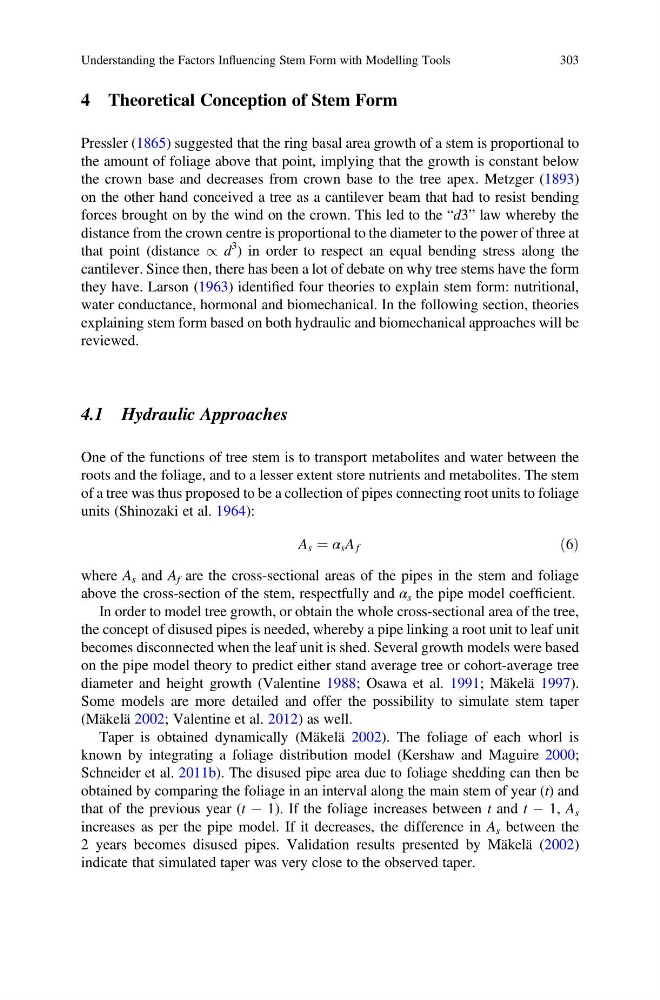
A s ¼ α s A f
ð6Þ
where A s and A f are the cross-sectional areas of the pipes in the stem and foliage
above the cross-section of the stem, respectfully and α s the pipe model coefficient.
In order to model tree growth, or obtain the whole cross-sectional area of the tree,
the concept of disused pipes is needed, whereby a pipe linking a root unit to leaf unit
becomes disconnected when the leaf unit is shed. Several growth models were based
on the pipe model theory to predict either stand average tree or cohort-average tree
diameter and height growth (Valentine 1988; Osawa et al. 1991; Mäkelä 1997).
Some models are more detailed and offer the possibility to simulate stem taper
(Mäkelä 2002; Valentine et al. 2012) as well.
Taper is obtained dynamically (Mäkelä 2002). The foliage of each whorl is
known by integrating a foliage distribution model (Kershaw and Maguire 2000;
Schneider et al. 2011b). The disused pipe area due to foliage shedding can then be
obtained by comparing the foliage in an interval along the main stem of year (t) and
that of the previous year (t À 1). If the foliage increases between t and t À 1, A s
increases as per the pipe model. If it decreases, the difference in A s between the
2 years becomes disused pipes. Validation results presented by Mäkelä (2002)
indicate that simulated taper was very close to the observed taper.
Understanding the Factors Influencing Stem Form with Modelling Tools
303
Pressler (1865) suggested that the ring basal area growth of a stem is proportional to
the amount of foliage above that point, implying that the growth is constant below
the crown base and decreases from crown base to the tree apex. Metzger (1893)
on the other hand conceived a tree as a cantilever beam that had to resist bending
forces brought on by the wind on the crown. This led to the “d3” law whereby the
distance from the crown centre is proportional to the diameter to the power of three at
that point (distance / d
3 ) in order to respect an equal bending stress along the
cantilever. Since then, there has been a lot of debate on why tree stems have the form
they have. Larson (1963) identified four theories to explain stem form: nutritional,
water conductance, hormonal and biomechanical. In the following section, theories
explaining stem form based on both hydraulic and biomechanical approaches will be
reviewed.
4.1 Hydraulic Approaches
One of the functions of tree stem is to transport metabolites and water between the
roots and the foliage, and to a lesser extent store nutrients and metabolites. The stem
of a tree was thus proposed to be a collection of pipes connecting root units to foliage
units (Shinozaki et al. 1964):
A s ¼ α s A f
ð6Þ
where A s and A f are the cross-sectional areas of the pipes in the stem and foliage
above the cross-section of the stem, respectfully and α s the pipe model coefficient.
In order to model tree growth, or obtain the whole cross-sectional area of the tree,
the concept of disused pipes is needed, whereby a pipe linking a root unit to leaf unit
becomes disconnected when the leaf unit is shed. Several growth models were based
on the pipe model theory to predict either stand average tree or cohort-average tree
diameter and height growth (Valentine 1988; Osawa et al. 1991; Mäkelä 1997).
Some models are more detailed and offer the possibility to simulate stem taper
(Mäkelä 2002; Valentine et al. 2012) as well.
Taper is obtained dynamically (Mäkelä 2002). The foliage of each whorl is
known by integrating a foliage distribution model (Kershaw and Maguire 2000;
Schneider et al. 2011b). The disused pipe area due to foliage shedding can then be
obtained by comparing the foliage in an interval along the main stem of year (t) and
that of the previous year (t À 1). If the foliage increases between t and t À 1, A s
increases as per the pipe model. If it decreases, the difference in A s between the
2 years becomes disused pipes. Validation results presented by Mäkelä (2002)
indicate that simulated taper was very close to the observed taper.
Understanding the Factors Influencing Stem Form with Modelling Tools
303