

diameter, etc.) in the X and Y positions have been proposed by the metabolic scaling
theory (West et al. 1999, 2009). Other studies have shown that divergences exist
between the theoretical and observed exponent values (Duursma et al. 2010;
Pretzsch et al. 2013; Franceschini and Schneider 2014). The divergences have
been partially explained by modifying the paradigms of the metabolic scaling theory,
such as varying the fractal dimension of the branching pattern (Smith et al. 2014) or
adding climate dependencies such as variations in metabolic activity with temperature (Gillooly et al. 2001).
Even if the allometric exponents differ from theoretical values, they can still be
used to gain insight on changes in stem form. For example, Franceschini et al. (2016)
found that the D to volume and D to H allometric exponents are both influenced by
growing season temperature for six North American species. If both allometric
relationships vary in the same manner, then the changes in volume can be attributed
to changes in height growth. On the other hand, if the D to volume allometric
exponent increases more than the D to H allometric exponent, this would indicate
that there are changes in stem form. This is what is observed for four of the six
species. This thus implies that tree form changes with climate. This approach
however cannot identify precisely what changes explain the observed shifts in
tree form.
0
50 100 150 200
0
5
1 0
1 5
2 0
Stem taper
Diameter (mm)
Height (m)
0.2
0.6
1.0
0
5
10
15
20
Variance function
Variance function
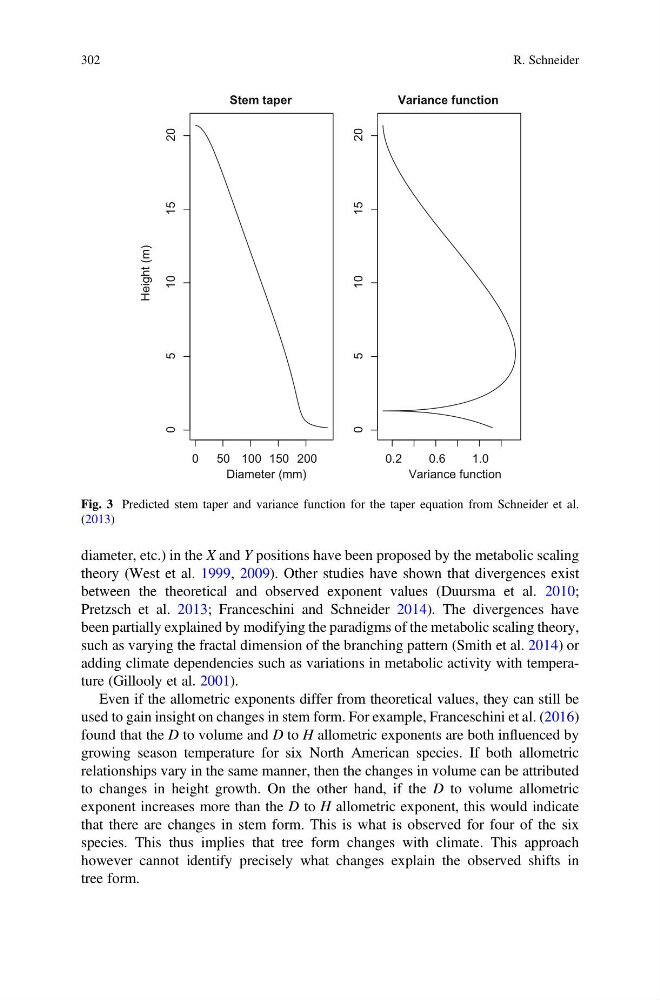
Fig. 3 Predicted stem taper and variance function for the taper equation from Schneider et al.
(2013)
302
R. Schneider
theory (West et al. 1999, 2009). Other studies have shown that divergences exist
between the theoretical and observed exponent values (Duursma et al. 2010;
Pretzsch et al. 2013; Franceschini and Schneider 2014). The divergences have
been partially explained by modifying the paradigms of the metabolic scaling theory,
such as varying the fractal dimension of the branching pattern (Smith et al. 2014) or
adding climate dependencies such as variations in metabolic activity with temperature (Gillooly et al. 2001).
Even if the allometric exponents differ from theoretical values, they can still be
used to gain insight on changes in stem form. For example, Franceschini et al. (2016)
found that the D to volume and D to H allometric exponents are both influenced by
growing season temperature for six North American species. If both allometric
relationships vary in the same manner, then the changes in volume can be attributed
to changes in height growth. On the other hand, if the D to volume allometric
exponent increases more than the D to H allometric exponent, this would indicate
that there are changes in stem form. This is what is observed for four of the six
species. This thus implies that tree form changes with climate. This approach
however cannot identify precisely what changes explain the observed shifts in
tree form.
0
50 100 150 200
0
5
1 0
1 5
2 0
Stem taper
Diameter (mm)
Height (m)
0.2
0.6
1.0
0
5
10
15
20
Variance function
Variance function
Fig. 3 Predicted stem taper and variance function for the taper equation from Schneider et al.
(2013)
302
R. Schneider