

3.2 Stem Taper
Stem taper models are equations that predict the diameter at any height using the
diameter at breast height and total height of the tree. The parameters of these models
can be used to evaluate how the form of a tree changes with environmental variables
(e.g. Schneider et al. 2018; Sharma and Parton 2009). These models can be classified
into two large groups, the first one where the function is segmented into several parts
(Max and Burkhart 1976) and the second where the diameter is predicted by one
function. Segmented taper functions separate the tree into two or three sections, with
a function for each section based on the form of the tree. The second group can be
subdivided into three subgroups, whereby (1) the exponent varies with height within
the tree in order to adjust to the changing shape of the stem (Kozak 1988), (2) the
exponent is height invariant (Ormerod 1973) or (3) the equation is either a polynomial (Bruce et al. 1968) or trigonometric function (Thomas and Parresol 1991). By
comparing different taper models, Rojo et al. (2005) and Li and Weiskittel (2010)
concluded that variable exponent models performed the best.
A few variable exponent stem taper models are variations of the fixed exponent
model proposed by Ormerod (1973):
d ¼ D
H À h
H À BH
β
ð3Þ
where BH is the breast height (i.e. height where D is measured), d is the stem
diameter at height h, D the diameter at breast height, H the total tree height and β the
20
10
0
–10
–20
0.00
0.25
0.50
0.75
1.00
Relative height
Relative height
Standardized residuals
Standardized residuals
20
10
0
–10
–20
0.00
0.25
0.50
0.75
1.00
a
b
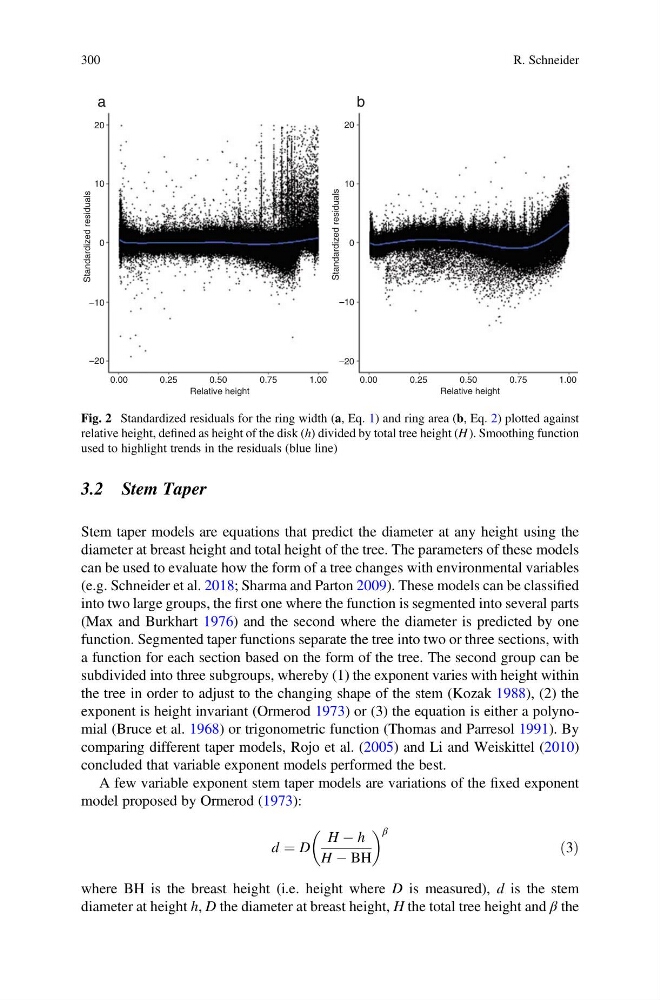
Fig. 2 Standardized residuals for the ring width (a, Eq. 1) and ring area (b, Eq. 2) plotted against
relative height, defined as height of the disk (h) divided by total tree height (H ). Smoothing function
used to highlight trends in the residuals (blue line)
300
R. Schneider
Stem taper models are equations that predict the diameter at any height using the
diameter at breast height and total height of the tree. The parameters of these models
can be used to evaluate how the form of a tree changes with environmental variables
(e.g. Schneider et al. 2018; Sharma and Parton 2009). These models can be classified
into two large groups, the first one where the function is segmented into several parts
(Max and Burkhart 1976) and the second where the diameter is predicted by one
function. Segmented taper functions separate the tree into two or three sections, with
a function for each section based on the form of the tree. The second group can be
subdivided into three subgroups, whereby (1) the exponent varies with height within
the tree in order to adjust to the changing shape of the stem (Kozak 1988), (2) the
exponent is height invariant (Ormerod 1973) or (3) the equation is either a polynomial (Bruce et al. 1968) or trigonometric function (Thomas and Parresol 1991). By
comparing different taper models, Rojo et al. (2005) and Li and Weiskittel (2010)
concluded that variable exponent models performed the best.
A few variable exponent stem taper models are variations of the fixed exponent
model proposed by Ormerod (1973):
d ¼ D
H À h
H À BH
β
ð3Þ
where BH is the breast height (i.e. height where D is measured), d is the stem
diameter at height h, D the diameter at breast height, H the total tree height and β the
20
10
0
–10
–20
0.00
0.25
0.50
0.75
1.00
Relative height
Relative height
Standardized residuals
Standardized residuals
20
10
0
–10
–20
0.00
0.25
0.50
0.75
1.00
a
b
Fig. 2 Standardized residuals for the ring width (a, Eq. 1) and ring area (b, Eq. 2) plotted against
relative height, defined as height of the disk (h) divided by total tree height (H ). Smoothing function
used to highlight trends in the residuals (blue line)
300
R. Schneider