

Vertical growth distribution models can thus be used to study the effects of
various factors on tree development. These models can be divided into two groups,
the first comprising a segmented regression (Courbet 1999; Courbet and Houllier
2002; Cortini et al. 2013) and the second using trigonometric functions (Deleuze and
Houllier 2002). Here, the models proposed by Courbet and Houllier (2002) and
Deleuze and Houllier (2002) are compared using balsam fir stem analysis data
presented in Sect. 2.
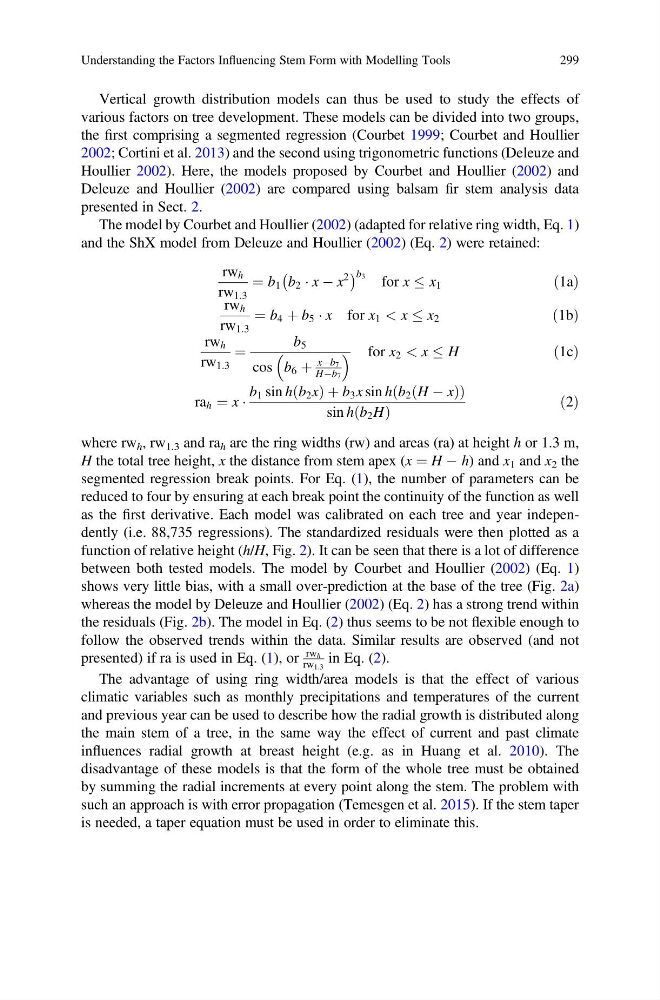
The model by Courbet and Houllier (2002) (adapted for relative ring width, Eq. 1)
and the ShX model from Deleuze and Houllier (2002) (Eq. 2) were retained:
rw h
rw 1:3
¼ b 1 b 2 Á x À x
2
À
Á b 3 for x x 1
ð1aÞ
rw h
rw 1:3
¼ b 4 þ b 5 Á x for x 1 < x x 2
ð1bÞ
rw h
rw 1:3
¼
b 5
cos b 6 þ
xÀb 7
HÀb 7
for x 2 < x H
ð1cÞ
ra h ¼ x Á
b 1 sin h b 2 x
ð Þþb 3 x sin h b 2 H À x
ð
Þ
ð
Þ
sin h b 2 H
ð
Þ
ð2Þ
where rw h , rw 1.3 and ra h are the ring widths (rw) and areas (ra) at height h or 1.3 m,
H the total tree height, x the distance from stem apex (x ¼ H À h) and x 1 and x 2 the
segmented regression break points. For Eq. (1), the number of parameters can be
reduced to four by ensuring at each break point the continuity of the function as well
as the first derivative. Each model was calibrated on each tree and year independently (i.e. 88,735 regressions). The standardized residuals were then plotted as a
function of relative height (h/H, Fig. 2). It can be seen that there is a lot of difference
between both tested models. The model by Courbet and Houllier (2002) (Eq. 1)
shows very little bias, with a small over-prediction at the base of the tree (Fig. 2a)
whereas the model by Deleuze and Houllier (2002) (Eq. 2) has a strong trend within
the residuals (Fig. 2b). The model in Eq. (2) thus seems to be not flexible enough to
follow the observed trends within the data. Similar results are observed (and not
presented) if ra is used in Eq. (1), or
rw h
rw 1:3
in Eq. (2).
The advantage of using ring width/area models is that the effect of various
climatic variables such as monthly precipitations and temperatures of the current
and previous year can be used to describe how the radial growth is distributed along
the main stem of a tree, in the same way the effect of current and past climate
influences radial growth at breast height (e.g. as in Huang et al. 2010). The
disadvantage of these models is that the form of the whole tree must be obtained
by summing the radial increments at every point along the stem. The problem with
such an approach is with error propagation (Temesgen et al. 2015). If the stem taper
is needed, a taper equation must be used in order to eliminate this.
Understanding the Factors Influencing Stem Form with Modelling Tools
299
various factors on tree development. These models can be divided into two groups,
the first comprising a segmented regression (Courbet 1999; Courbet and Houllier
2002; Cortini et al. 2013) and the second using trigonometric functions (Deleuze and
Houllier 2002). Here, the models proposed by Courbet and Houllier (2002) and
Deleuze and Houllier (2002) are compared using balsam fir stem analysis data
presented in Sect. 2.
The model by Courbet and Houllier (2002) (adapted for relative ring width, Eq. 1)
and the ShX model from Deleuze and Houllier (2002) (Eq. 2) were retained:
rw h
rw 1:3
¼ b 1 b 2 Á x À x
2
À
Á b 3 for x x 1
ð1aÞ
rw h
rw 1:3
¼ b 4 þ b 5 Á x for x 1 < x x 2
ð1bÞ
rw h
rw 1:3
¼
b 5
cos b 6 þ
xÀb 7
HÀb 7
for x 2 < x H
ð1cÞ
ra h ¼ x Á
b 1 sin h b 2 x
ð Þþb 3 x sin h b 2 H À x
ð
Þ
ð
Þ
sin h b 2 H
ð
Þ
ð2Þ
where rw h , rw 1.3 and ra h are the ring widths (rw) and areas (ra) at height h or 1.3 m,
H the total tree height, x the distance from stem apex (x ¼ H À h) and x 1 and x 2 the
segmented regression break points. For Eq. (1), the number of parameters can be
reduced to four by ensuring at each break point the continuity of the function as well
as the first derivative. Each model was calibrated on each tree and year independently (i.e. 88,735 regressions). The standardized residuals were then plotted as a
function of relative height (h/H, Fig. 2). It can be seen that there is a lot of difference
between both tested models. The model by Courbet and Houllier (2002) (Eq. 1)
shows very little bias, with a small over-prediction at the base of the tree (Fig. 2a)
whereas the model by Deleuze and Houllier (2002) (Eq. 2) has a strong trend within
the residuals (Fig. 2b). The model in Eq. (2) thus seems to be not flexible enough to
follow the observed trends within the data. Similar results are observed (and not
presented) if ra is used in Eq. (1), or
rw h
rw 1:3
in Eq. (2).
The advantage of using ring width/area models is that the effect of various
climatic variables such as monthly precipitations and temperatures of the current
and previous year can be used to describe how the radial growth is distributed along
the main stem of a tree, in the same way the effect of current and past climate
influences radial growth at breast height (e.g. as in Huang et al. 2010). The
disadvantage of these models is that the form of the whole tree must be obtained
by summing the radial increments at every point along the stem. The problem with
such an approach is with error propagation (Temesgen et al. 2015). If the stem taper
is needed, a taper equation must be used in order to eliminate this.
Understanding the Factors Influencing Stem Form with Modelling Tools
299