

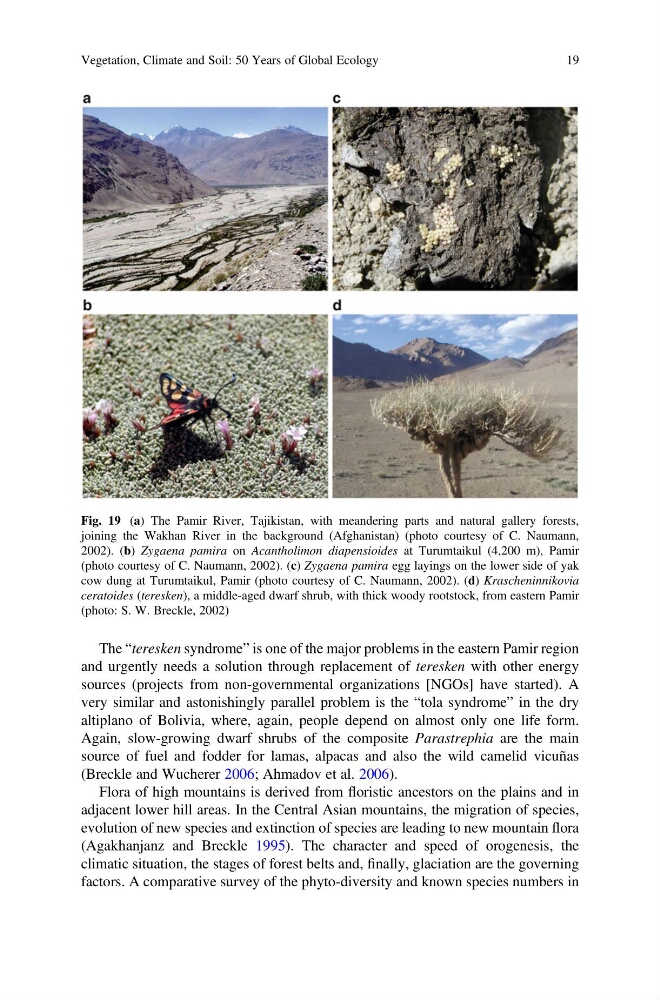
The “teresken syndrome” is one of the major problems in the eastern Pamir region
and urgently needs a solution through replacement of teresken with other energy
sources (projects from non-governmental organizations [NGOs] have started). A
very similar and astonishingly parallel problem is the “tola syndrome” in the dry
altiplano of Bolivia, where, again, people depend on almost only one life form.
Again, slow-growing dwarf shrubs of the composite Parastrephia are the main
source of fuel and fodder for lamas, alpacas and also the wild camelid vicuñas
(Breckle and Wucherer 2006; Ahmadov et al. 2006).
Flora of high mountains is derived from floristic ancestors on the plains and in
adjacent lower hill areas. In the Central Asian mountains, the migration of species,
evolution of new species and extinction of species are leading to new mountain flora
(Agakhanjanz and Breckle 1995). The character and speed of orogenesis, the
climatic situation, the stages of forest belts and, finally, glaciation are the governing
factors. A comparative survey of the phyto-diversity and known species numbers in
Fig. 19 (a) The Pamir River, Tajikistan, with meandering parts and natural gallery forests,
joining the Wakhan River in the background (Afghanistan) (photo courtesy of C. Naumann,
2002). (b) Zygaena pamira on Acantholimon diapensioides at Turumtaikul (4,200 m), Pamir
(photo courtesy of C. Naumann, 2002). (c) Zygaena pamira egg layings on the lower side of yak
cow dung at Turumtaikul, Pamir (photo courtesy of C. Naumann, 2002). (d) Krascheninnikovia
ceratoides (teresken), a middle-aged dwarf shrub, with thick woody rootstock, from eastern Pamir
(photo: S. W. Breckle, 2002)
Vegetation, Climate and Soil: 50 Years of Global Ecology
19
and urgently needs a solution through replacement of teresken with other energy
sources (projects from non-governmental organizations [NGOs] have started). A
very similar and astonishingly parallel problem is the “tola syndrome” in the dry
altiplano of Bolivia, where, again, people depend on almost only one life form.
Again, slow-growing dwarf shrubs of the composite Parastrephia are the main
source of fuel and fodder for lamas, alpacas and also the wild camelid vicuñas
(Breckle and Wucherer 2006; Ahmadov et al. 2006).
Flora of high mountains is derived from floristic ancestors on the plains and in
adjacent lower hill areas. In the Central Asian mountains, the migration of species,
evolution of new species and extinction of species are leading to new mountain flora
(Agakhanjanz and Breckle 1995). The character and speed of orogenesis, the
climatic situation, the stages of forest belts and, finally, glaciation are the governing
factors. A comparative survey of the phyto-diversity and known species numbers in
Fig. 19 (a) The Pamir River, Tajikistan, with meandering parts and natural gallery forests,
joining the Wakhan River in the background (Afghanistan) (photo courtesy of C. Naumann,
2002). (b) Zygaena pamira on Acantholimon diapensioides at Turumtaikul (4,200 m), Pamir
(photo courtesy of C. Naumann, 2002). (c) Zygaena pamira egg layings on the lower side of yak
cow dung at Turumtaikul, Pamir (photo courtesy of C. Naumann, 2002). (d) Krascheninnikovia
ceratoides (teresken), a middle-aged dwarf shrub, with thick woody rootstock, from eastern Pamir
(photo: S. W. Breckle, 2002)
Vegetation, Climate and Soil: 50 Years of Global Ecology
19