

along the upper Abe Panj and Pamir River, and reaching Zorkul (at an altitude of
4,200 m), the lake being one of the sources of the Amu Darya. The contrasts between
western and eastern Pamir in terms of landscape morphology, climate and vegetation
were striking. Also the comparison of old vegetation maps (Vanselow et al. 2016) and
the present-day situation showed strong desertification.
The expedition to the high mountain deserts of eastern Pamir enabled a survey
and comparison of mountain ecological conditions between eastern and western
Pamir. This was the last research trip of Clas Naumann, during which he finally
clarified the biology of the moth Zygaena pamira (Fig. 19b, c); at 4,250 m the eggs
were found developing on the lower side of yak cow dung, close to our campsite.
An almost symbolic plant of eastern Pamir is teresken (Ceratoides papposa,
Fig. 19d). This species has an enormous geographical distribution (from the Ebro
basin in Spain, the Vienna area and Pannonia to Mongolia and western China) in
deserts and semi-deserts. Teresken has been the main energy source for the people
since the break-up of the Soviet Union and the civil wars in Tajikistan, and is also the
main fodder for sheep and goats, for donkeys and camels, and for the famous Marco
Polo sheep (Ovis ammon polii). But, interestingly, teresken is a rather slow-growing
dwarf shrub with a shoot-to-root ratio of up to 1:40, thus it is very drought resistant.
For fuel, the woody root is used. Old plants have a thick rootstock and can reach
130 years of age (Walter and Breckle 1994).
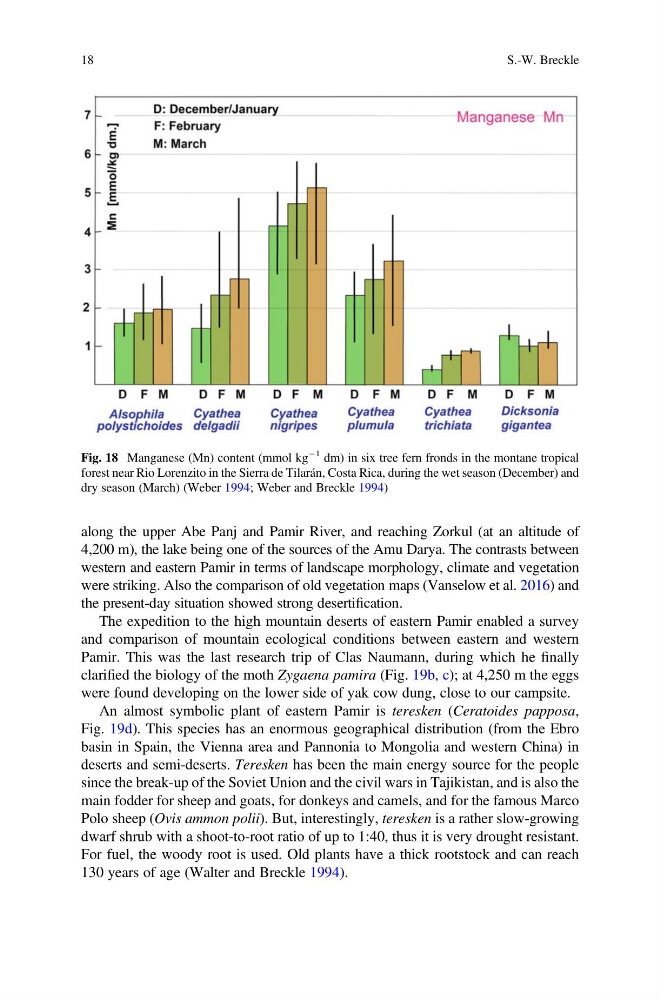
Fig. 18 Manganese (Mn) content (mmol kg
À1 dm) in six tree fern fronds in the montane tropical
forest near Rio Lorenzito in the Sierra de Tilarán, Costa Rica, during the wet season (December) and
dry season (March) (Weber 1994; Weber and Breckle 1994)
18
S.-W. Breckle
4,200 m), the lake being one of the sources of the Amu Darya. The contrasts between
western and eastern Pamir in terms of landscape morphology, climate and vegetation
were striking. Also the comparison of old vegetation maps (Vanselow et al. 2016) and
the present-day situation showed strong desertification.
The expedition to the high mountain deserts of eastern Pamir enabled a survey
and comparison of mountain ecological conditions between eastern and western
Pamir. This was the last research trip of Clas Naumann, during which he finally
clarified the biology of the moth Zygaena pamira (Fig. 19b, c); at 4,250 m the eggs
were found developing on the lower side of yak cow dung, close to our campsite.
An almost symbolic plant of eastern Pamir is teresken (Ceratoides papposa,
Fig. 19d). This species has an enormous geographical distribution (from the Ebro
basin in Spain, the Vienna area and Pannonia to Mongolia and western China) in
deserts and semi-deserts. Teresken has been the main energy source for the people
since the break-up of the Soviet Union and the civil wars in Tajikistan, and is also the
main fodder for sheep and goats, for donkeys and camels, and for the famous Marco
Polo sheep (Ovis ammon polii). But, interestingly, teresken is a rather slow-growing
dwarf shrub with a shoot-to-root ratio of up to 1:40, thus it is very drought resistant.
For fuel, the woody root is used. Old plants have a thick rootstock and can reach
130 years of age (Walter and Breckle 1994).
Fig. 18 Manganese (Mn) content (mmol kg
À1 dm) in six tree fern fronds in the montane tropical
forest near Rio Lorenzito in the Sierra de Tilarán, Costa Rica, during the wet season (December) and
dry season (March) (Weber 1994; Weber and Breckle 1994)
18
S.-W. Breckle