

Metallophytes – plants that are able to withstand high levels of heavy metals in
the soil – often accumulate heavy metals in the plant body (Breckle 1997b). They are
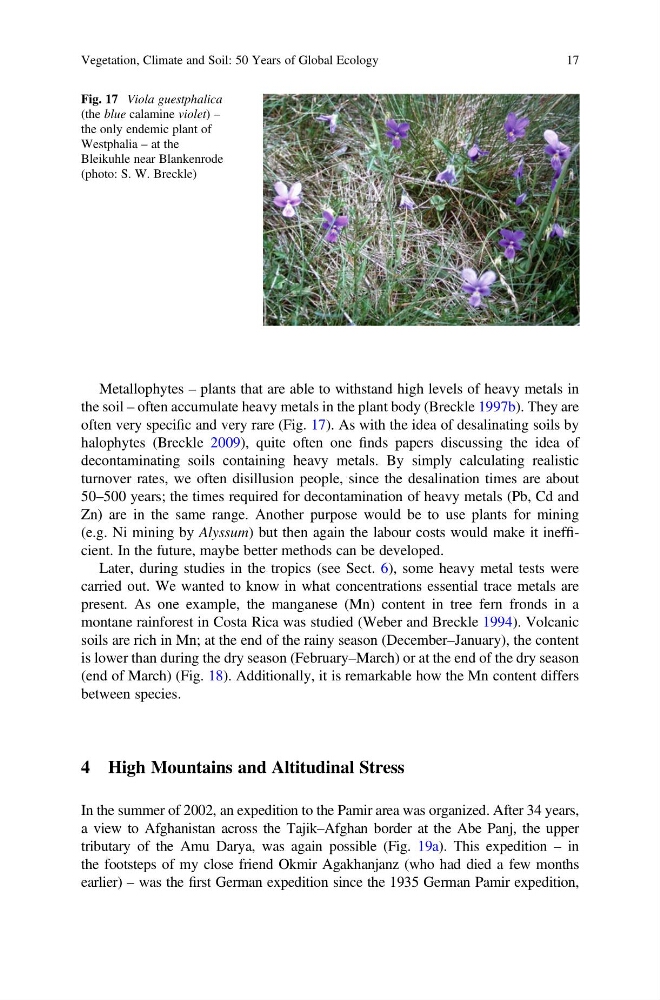
often very specific and very rare (Fig. 17). As with the idea of desalinating soils by
halophytes (Breckle 2009), quite often one finds papers discussing the idea of
decontaminating soils containing heavy metals. By simply calculating realistic
turnover rates, we often disillusion people, since the desalination times are about
50–500 years; the times required for decontamination of heavy metals (Pb, Cd and
Zn) are in the same range. Another purpose would be to use plants for mining
(e.g. Ni mining by Alyssum) but then again the labour costs would make it inefficient. In the future, maybe better methods can be developed.
Later, during studies in the tropics (see Sect. 6), some heavy metal tests were
carried out. We wanted to know in what concentrations essential trace metals are
present. As one example, the manganese (Mn) content in tree fern fronds in a
montane rainforest in Costa Rica was studied (Weber and Breckle 1994). Volcanic
soils are rich in Mn; at the end of the rainy season (December–January), the content
is lower than during the dry season (February–March) or at the end of the dry season
(end of March) (Fig. 18). Additionally, it is remarkable how the Mn content differs
between species.
4 High Mountains and Altitudinal Stress
In the summer of 2002, an expedition to the Pamir area was organized. After 34 years,
a view to Afghanistan across the Tajik–Afghan border at the Abe Panj, the upper
tributary of the Amu Darya, was again possible (Fig. 19a). This expedition – in
the footsteps of my close friend Okmir Agakhanjanz (who had died a few months
earlier) – was the first German expedition since the 1935 German Pamir expedition,
Fig. 17 Viola guestphalica
(the blue calamine violet) –
the only endemic plant of
Westphalia – at the
Bleikuhle near Blankenrode
(photo: S. W. Breckle)
Vegetation, Climate and Soil: 50 Years of Global Ecology
17
the soil – often accumulate heavy metals in the plant body (Breckle 1997b). They are
often very specific and very rare (Fig. 17). As with the idea of desalinating soils by
halophytes (Breckle 2009), quite often one finds papers discussing the idea of
decontaminating soils containing heavy metals. By simply calculating realistic
turnover rates, we often disillusion people, since the desalination times are about
50–500 years; the times required for decontamination of heavy metals (Pb, Cd and
Zn) are in the same range. Another purpose would be to use plants for mining
(e.g. Ni mining by Alyssum) but then again the labour costs would make it inefficient. In the future, maybe better methods can be developed.
Later, during studies in the tropics (see Sect. 6), some heavy metal tests were
carried out. We wanted to know in what concentrations essential trace metals are
present. As one example, the manganese (Mn) content in tree fern fronds in a
montane rainforest in Costa Rica was studied (Weber and Breckle 1994). Volcanic
soils are rich in Mn; at the end of the rainy season (December–January), the content
is lower than during the dry season (February–March) or at the end of the dry season
(end of March) (Fig. 18). Additionally, it is remarkable how the Mn content differs
between species.
4 High Mountains and Altitudinal Stress
In the summer of 2002, an expedition to the Pamir area was organized. After 34 years,
a view to Afghanistan across the Tajik–Afghan border at the Abe Panj, the upper
tributary of the Amu Darya, was again possible (Fig. 19a). This expedition – in
the footsteps of my close friend Okmir Agakhanjanz (who had died a few months
earlier) – was the first German expedition since the 1935 German Pamir expedition,
Fig. 17 Viola guestphalica
(the blue calamine violet) –
the only endemic plant of
Westphalia – at the
Bleikuhle near Blankenrode
(photo: S. W. Breckle)
Vegetation, Climate and Soil: 50 Years of Global Ecology
17