

was much research on forest dieback, especially in spruce. We started with beech.
Later it became clear that deciduous trees also exhibited distinct signs of stress, with
lowered soil pH, soluble aluminium (Al) in soil, and ozone (O 3 ) on leaves. With
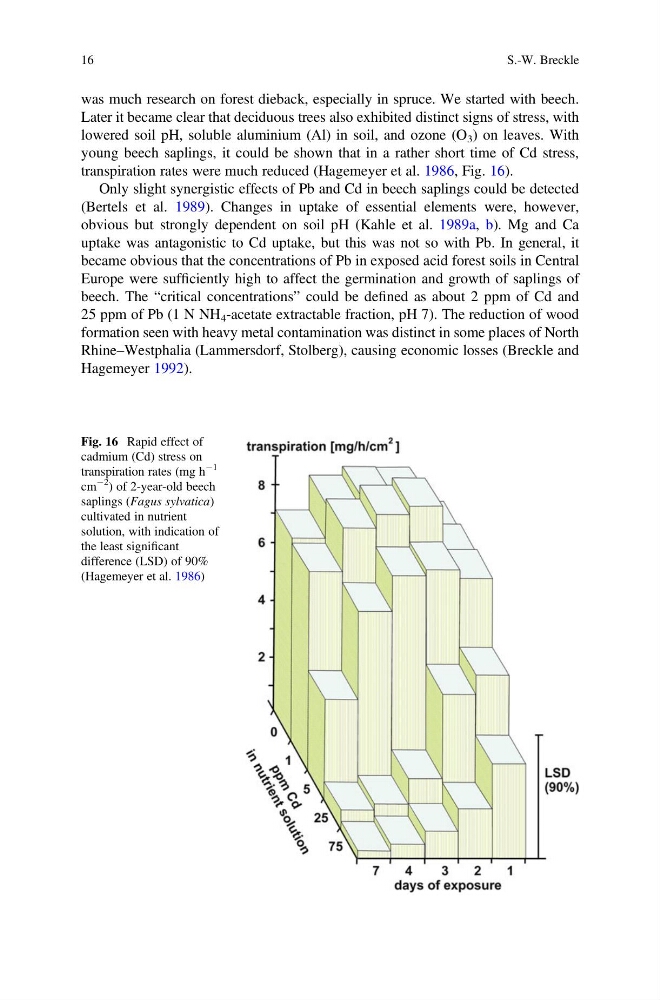
young beech saplings, it could be shown that in a rather short time of Cd stress,
transpiration rates were much reduced (Hagemeyer et al. 1986, Fig. 16).
Only slight synergistic effects of Pb and Cd in beech saplings could be detected
(Bertels et al. 1989). Changes in uptake of essential elements were, however,
obvious but strongly dependent on soil pH (Kahle et al. 1989a, b). Mg and Ca
uptake was antagonistic to Cd uptake, but this was not so with Pb. In general, it
became obvious that the concentrations of Pb in exposed acid forest soils in Central
Europe were sufficiently high to affect the germination and growth of saplings of
beech. The “critical concentrations” could be defined as about 2 ppm of Cd and
25 ppm of Pb (1 N NH 4 -acetate extractable fraction, pH 7). The reduction of wood
formation seen with heavy metal contamination was distinct in some places of North
Rhine–Westphalia (Lammersdorf, Stolberg), causing economic losses (Breckle and
Hagemeyer 1992).
Fig. 16 Rapid effect of
cadmium (Cd) stress on
transpiration rates (mg h
À1
cm
À2
) of 2-year-old beech
saplings (Fagus sylvatica)
cultivated in nutrient
solution, with indication of
the least significant
difference (LSD) of 90%
(Hagemeyer et al. 1986)
16
S.-W. Breckle
Later it became clear that deciduous trees also exhibited distinct signs of stress, with
lowered soil pH, soluble aluminium (Al) in soil, and ozone (O 3 ) on leaves. With
young beech saplings, it could be shown that in a rather short time of Cd stress,
transpiration rates were much reduced (Hagemeyer et al. 1986, Fig. 16).
Only slight synergistic effects of Pb and Cd in beech saplings could be detected
(Bertels et al. 1989). Changes in uptake of essential elements were, however,
obvious but strongly dependent on soil pH (Kahle et al. 1989a, b). Mg and Ca
uptake was antagonistic to Cd uptake, but this was not so with Pb. In general, it
became obvious that the concentrations of Pb in exposed acid forest soils in Central
Europe were sufficiently high to affect the germination and growth of saplings of
beech. The “critical concentrations” could be defined as about 2 ppm of Cd and
25 ppm of Pb (1 N NH 4 -acetate extractable fraction, pH 7). The reduction of wood
formation seen with heavy metal contamination was distinct in some places of North
Rhine–Westphalia (Lammersdorf, Stolberg), causing economic losses (Breckle and
Hagemeyer 1992).
Fig. 16 Rapid effect of
cadmium (Cd) stress on
transpiration rates (mg h
À1
cm
À2
) of 2-year-old beech
saplings (Fagus sylvatica)
cultivated in nutrient
solution, with indication of
the least significant
difference (LSD) of 90%
(Hagemeyer et al. 1986)
16
S.-W. Breckle