

trees? Along German highways, the Pb content in and on leaves exceeded the
background content in the adjacent forests by 20–40 times. Later, we checked the
accumulation of Pb, cadmium (Cd), zinc (Zn) and nickel (Ni) in the annual rings of
beech and fir trees; it revealed a rather complex picture. The distribution of heavy
metals in annual rings does not give a retrospective picture of the heavy metal stress
over time. The physiological mobility of heavy metals within wood along radial
pathways in most cases manifested in maximum concentrations of Pb and Cd along
the sapwood–heartwood border and the lowest concentrations in the outermost rings,
near the cambium (Hagemeyer and Breckle 1986; Hagemeyer et al. 1993; Brackhage
et al. 1996). The findings were similar for potassium (K) and calcium (Ca), in
contrast to Mg, Ni and Zn, for which the concentrations were lowest at the sapwood–
heartwood transition. But both the distribution pattern and the concentrations of
minerals in trunk wood were subject to seasonal variations.
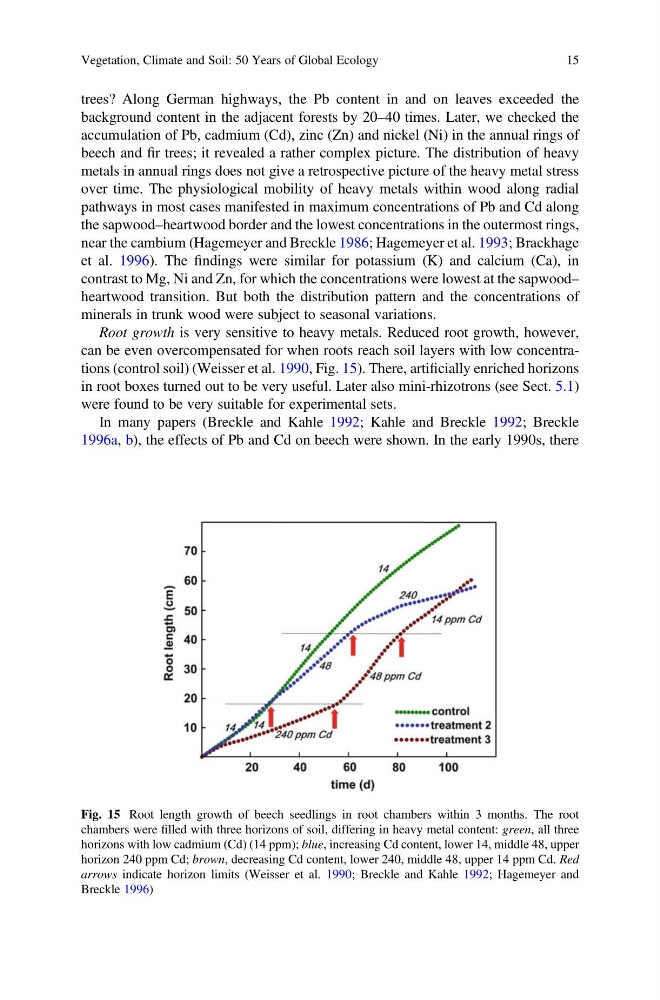
Root growth is very sensitive to heavy metals. Reduced root growth, however,
can be even overcompensated for when roots reach soil layers with low concentrations (control soil) (Weisser et al. 1990, Fig. 15). There, artificially enriched horizons
in root boxes turned out to be very useful. Later also mini-rhizotrons (see Sect. 5.1)
were found to be very suitable for experimental sets.
In many papers (Breckle and Kahle 1992; Kahle and Breckle 1992; Breckle
1996a, b), the effects of Pb and Cd on beech were shown. In the early 1990s, there
Fig. 15 Root length growth of beech seedlings in root chambers within 3 months. The root
chambers were filled with three horizons of soil, differing in heavy metal content: green, all three
horizons with low cadmium (Cd) (14 ppm); blue, increasing Cd content, lower 14, middle 48, upper
horizon 240 ppm Cd; brown, decreasing Cd content, lower 240, middle 48, upper 14 ppm Cd. Red
arrows indicate horizon limits (Weisser et al. 1990; Breckle and Kahle 1992; Hagemeyer and
Breckle 1996)
Vegetation, Climate and Soil: 50 Years of Global Ecology
15
background content in the adjacent forests by 20–40 times. Later, we checked the
accumulation of Pb, cadmium (Cd), zinc (Zn) and nickel (Ni) in the annual rings of
beech and fir trees; it revealed a rather complex picture. The distribution of heavy
metals in annual rings does not give a retrospective picture of the heavy metal stress
over time. The physiological mobility of heavy metals within wood along radial
pathways in most cases manifested in maximum concentrations of Pb and Cd along
the sapwood–heartwood border and the lowest concentrations in the outermost rings,
near the cambium (Hagemeyer and Breckle 1986; Hagemeyer et al. 1993; Brackhage
et al. 1996). The findings were similar for potassium (K) and calcium (Ca), in
contrast to Mg, Ni and Zn, for which the concentrations were lowest at the sapwood–
heartwood transition. But both the distribution pattern and the concentrations of
minerals in trunk wood were subject to seasonal variations.
Root growth is very sensitive to heavy metals. Reduced root growth, however,
can be even overcompensated for when roots reach soil layers with low concentrations (control soil) (Weisser et al. 1990, Fig. 15). There, artificially enriched horizons
in root boxes turned out to be very useful. Later also mini-rhizotrons (see Sect. 5.1)
were found to be very suitable for experimental sets.
In many papers (Breckle and Kahle 1992; Kahle and Breckle 1992; Breckle
1996a, b), the effects of Pb and Cd on beech were shown. In the early 1990s, there
Fig. 15 Root length growth of beech seedlings in root chambers within 3 months. The root
chambers were filled with three horizons of soil, differing in heavy metal content: green, all three
horizons with low cadmium (Cd) (14 ppm); blue, increasing Cd content, lower 14, middle 48, upper
horizon 240 ppm Cd; brown, decreasing Cd content, lower 240, middle 48, upper 14 ppm Cd. Red
arrows indicate horizon limits (Weisser et al. 1990; Breckle and Kahle 1992; Hagemeyer and
Breckle 1996)
Vegetation, Climate and Soil: 50 Years of Global Ecology
15