

the Eurasian mountains clearly indicates the need for small-scale inventories, especially for the orophytic belt (above the timberline). There endemics reach a high
proportion in the subalpine and alpine belts but are almost absent in the subnival and
nival belts, where some widespread boreal and even arctic species are present
(Agachanjanz and Breckle 2002; Breckle 2004). In contrast, in arid mountains
lacking a forest belt, endemics are more common in the lower belts. Concerning
the Hindu Kush, the main Afghan mountain range, see Sect. 7.2.
5 Desert Ecology
Stress ecology is certainly very relevant in deserts. Heat stress and drought stress are
the prominent ecological factors that organisms have to be adapted to or avoid. All of
those questions of desert research have also been part of desertification studies. Only
a few examples can be mentioned here. Desertification on a large scale has also been
seen in several parts of China (Veste et al. 2006; Gao et al. 2007), with a severe dust
situation in Beijing. Large-scale afforestation projects with millions of trees being
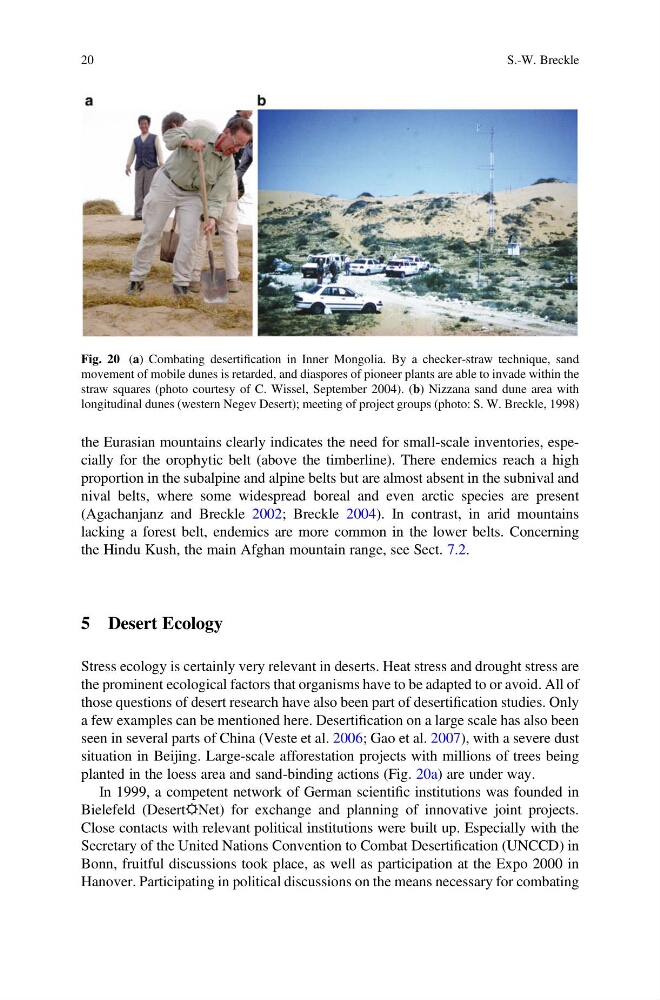
planted in the loess area and sand-binding actions (Fig. 20a) are under way.
In 1999, a competent network of German scientific institutions was founded in
Bielefeld (Desert☼Net) for exchange and planning of innovative joint projects.
Close contacts with relevant political institutions were built up. Especially with the
Secretary of the United Nations Convention to Combat Desertification (UNCCD) in
Bonn, fruitful discussions took place, as well as participation at the Expo 2000 in
Hanover. Participating in political discussions on the means necessary for combating
Fig. 20 (a) Combating desertification in Inner Mongolia. By a checker-straw technique, sand
movement of mobile dunes is retarded, and diaspores of pioneer plants are able to invade within the
straw squares (photo courtesy of C. Wissel, September 2004). (b) Nizzana sand dune area with
longitudinal dunes (western Negev Desert); meeting of project groups (photo: S. W. Breckle, 1998)
20
S.-W. Breckle
proportion in the subalpine and alpine belts but are almost absent in the subnival and
nival belts, where some widespread boreal and even arctic species are present
(Agachanjanz and Breckle 2002; Breckle 2004). In contrast, in arid mountains
lacking a forest belt, endemics are more common in the lower belts. Concerning
the Hindu Kush, the main Afghan mountain range, see Sect. 7.2.
5 Desert Ecology
Stress ecology is certainly very relevant in deserts. Heat stress and drought stress are
the prominent ecological factors that organisms have to be adapted to or avoid. All of
those questions of desert research have also been part of desertification studies. Only
a few examples can be mentioned here. Desertification on a large scale has also been
seen in several parts of China (Veste et al. 2006; Gao et al. 2007), with a severe dust
situation in Beijing. Large-scale afforestation projects with millions of trees being
planted in the loess area and sand-binding actions (Fig. 20a) are under way.
In 1999, a competent network of German scientific institutions was founded in
Bielefeld (Desert☼Net) for exchange and planning of innovative joint projects.
Close contacts with relevant political institutions were built up. Especially with the
Secretary of the United Nations Convention to Combat Desertification (UNCCD) in
Bonn, fruitful discussions took place, as well as participation at the Expo 2000 in
Hanover. Participating in political discussions on the means necessary for combating
Fig. 20 (a) Combating desertification in Inner Mongolia. By a checker-straw technique, sand
movement of mobile dunes is retarded, and diaspores of pioneer plants are able to invade within the
straw squares (photo courtesy of C. Wissel, September 2004). (b) Nizzana sand dune area with
longitudinal dunes (western Negev Desert); meeting of project groups (photo: S. W. Breckle, 1998)
20
S.-W. Breckle