

hosts, and the leaf volume increased four to five times in comparison with those on
non-halophytic hosts exhibiting typical halo-succulence. It behaves like a typical
facultative eu-halophyte (Veste et al. 2014).
Of the world’s land surface area, at least 6% is salt-affected land (Flowers and
Yeo 1995; Munns 2005). Large areas in drylands and along coasts are naturally salt
affected (Breckle 2002c), but with irrigation under arid climatic conditions, secondary salinization (Breckle 1989) is a big threat. Since the work of Boyko (1966), and
then Waisel (1972) and Gallagher (1985), the use of seawater for agriculture has very
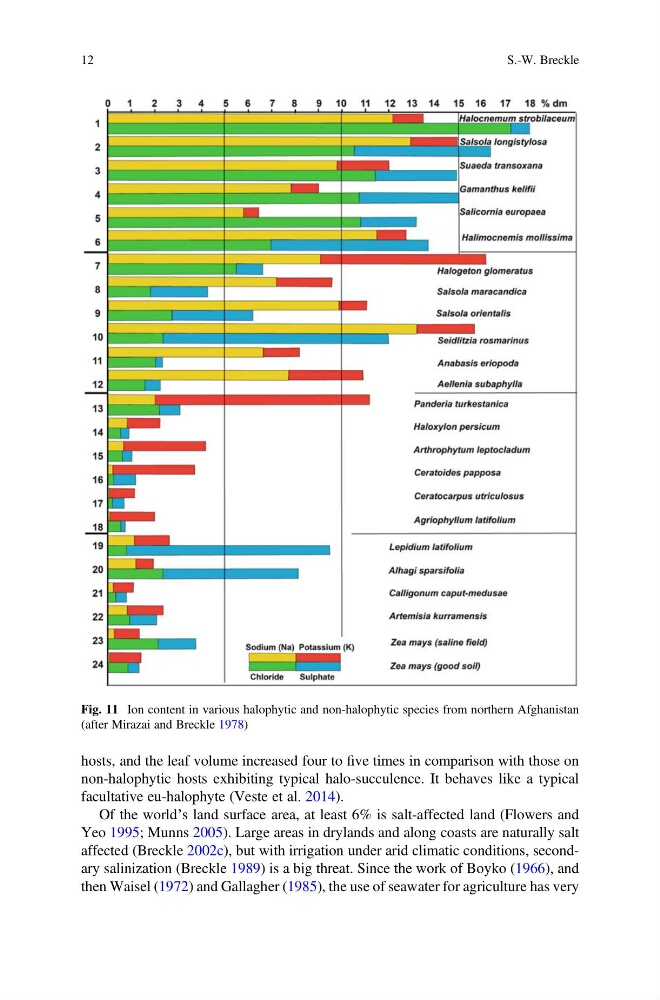
Fig. 11 Ion content in various halophytic and non-halophytic species from northern Afghanistan
(after Mirazai and Breckle 1978)
12
S.-W. Breckle
non-halophytic hosts exhibiting typical halo-succulence. It behaves like a typical
facultative eu-halophyte (Veste et al. 2014).
Of the world’s land surface area, at least 6% is salt-affected land (Flowers and
Yeo 1995; Munns 2005). Large areas in drylands and along coasts are naturally salt
affected (Breckle 2002c), but with irrigation under arid climatic conditions, secondary salinization (Breckle 1989) is a big threat. Since the work of Boyko (1966), and
then Waisel (1972) and Gallagher (1985), the use of seawater for agriculture has very
Fig. 11 Ion content in various halophytic and non-halophytic species from northern Afghanistan
(after Mirazai and Breckle 1978)
12
S.-W. Breckle