

to be rather similar at many saline sites. The most salt tolerant are in general the
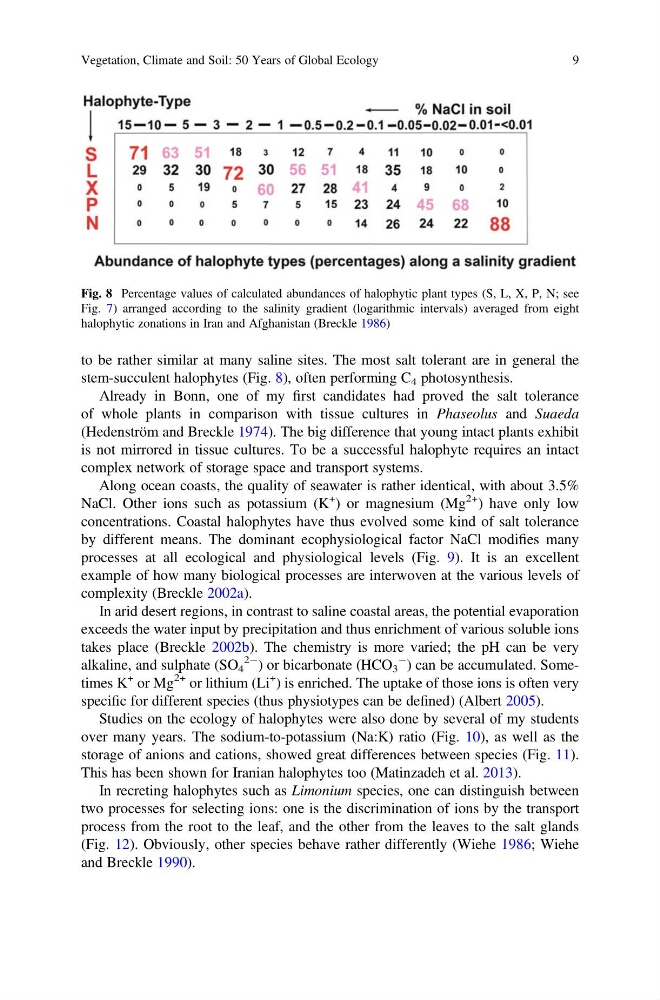
stem-succulent halophytes (Fig. 8), often performing C 4 photosynthesis.
Already in Bonn, one of my first candidates had proved the salt tolerance
of whole plants in comparison with tissue cultures in Phaseolus and Suaeda
(Hedenström and Breckle 1974). The big difference that young intact plants exhibit
is not mirrored in tissue cultures. To be a successful halophyte requires an intact
complex network of storage space and transport systems.
Along ocean coasts, the quality of seawater is rather identical, with about 3.5%
NaCl. Other ions such as potassium (K
+
) or magnesium (Mg
2+ ) have only low
concentrations. Coastal halophytes have thus evolved some kind of salt tolerance
by different means. The dominant ecophysiological factor NaCl modifies many
processes at all ecological and physiological levels (Fig. 9). It is an excellent
example of how many biological processes are interwoven at the various levels of
complexity (Breckle 2002a).
In arid desert regions, in contrast to saline coastal areas, the potential evaporation
exceeds the water input by precipitation and thus enrichment of various soluble ions
takes place (Breckle 2002b). The chemistry is more varied; the pH can be very
alkaline, and sulphate (SO 4
2À
) or bicarbonate (HCO 3
À ) can be accumulated. Sometimes K
+ or Mg
2+ or lithium (Li
+ ) is enriched. The uptake of those ions is often very
specific for different species (thus physiotypes can be defined) (Albert 2005).
Studies on the ecology of halophytes were also done by several of my students
over many years. The sodium-to-potassium (Na:K) ratio (Fig. 10), as well as the
storage of anions and cations, showed great differences between species (Fig. 11).
This has been shown for Iranian halophytes too (Matinzadeh et al. 2013).
In recreting halophytes such as Limonium species, one can distinguish between
two processes for selecting ions: one is the discrimination of ions by the transport
process from the root to the leaf, and the other from the leaves to the salt glands
(Fig. 12). Obviously, other species behave rather differently (Wiehe 1986; Wiehe
and Breckle 1990).
Fig. 8 Percentage values of calculated abundances of halophytic plant types (S, L, X, P, N; see
Fig. 7) arranged according to the salinity gradient (logarithmic intervals) averaged from eight
halophytic zonations in Iran and Afghanistan (Breckle 1986)
Vegetation, Climate and Soil: 50 Years of Global Ecology
9
stem-succulent halophytes (Fig. 8), often performing C 4 photosynthesis.
Already in Bonn, one of my first candidates had proved the salt tolerance
of whole plants in comparison with tissue cultures in Phaseolus and Suaeda
(Hedenström and Breckle 1974). The big difference that young intact plants exhibit
is not mirrored in tissue cultures. To be a successful halophyte requires an intact
complex network of storage space and transport systems.
Along ocean coasts, the quality of seawater is rather identical, with about 3.5%
NaCl. Other ions such as potassium (K
+
) or magnesium (Mg
2+ ) have only low
concentrations. Coastal halophytes have thus evolved some kind of salt tolerance
by different means. The dominant ecophysiological factor NaCl modifies many
processes at all ecological and physiological levels (Fig. 9). It is an excellent
example of how many biological processes are interwoven at the various levels of
complexity (Breckle 2002a).
In arid desert regions, in contrast to saline coastal areas, the potential evaporation
exceeds the water input by precipitation and thus enrichment of various soluble ions
takes place (Breckle 2002b). The chemistry is more varied; the pH can be very
alkaline, and sulphate (SO 4
2À
) or bicarbonate (HCO 3
À ) can be accumulated. Sometimes K
+ or Mg
2+ or lithium (Li
+ ) is enriched. The uptake of those ions is often very
specific for different species (thus physiotypes can be defined) (Albert 2005).
Studies on the ecology of halophytes were also done by several of my students
over many years. The sodium-to-potassium (Na:K) ratio (Fig. 10), as well as the
storage of anions and cations, showed great differences between species (Fig. 11).
This has been shown for Iranian halophytes too (Matinzadeh et al. 2013).
In recreting halophytes such as Limonium species, one can distinguish between
two processes for selecting ions: one is the discrimination of ions by the transport
process from the root to the leaf, and the other from the leaves to the salt glands
(Fig. 12). Obviously, other species behave rather differently (Wiehe 1986; Wiehe
and Breckle 1990).
Fig. 8 Percentage values of calculated abundances of halophytic plant types (S, L, X, P, N; see
Fig. 7) arranged according to the salinity gradient (logarithmic intervals) averaged from eight
halophytic zonations in Iran and Afghanistan (Breckle 1986)
Vegetation, Climate and Soil: 50 Years of Global Ecology
9