

with the permission of the Afghan King Mohammad Zahir Shah (deposed in 1973);
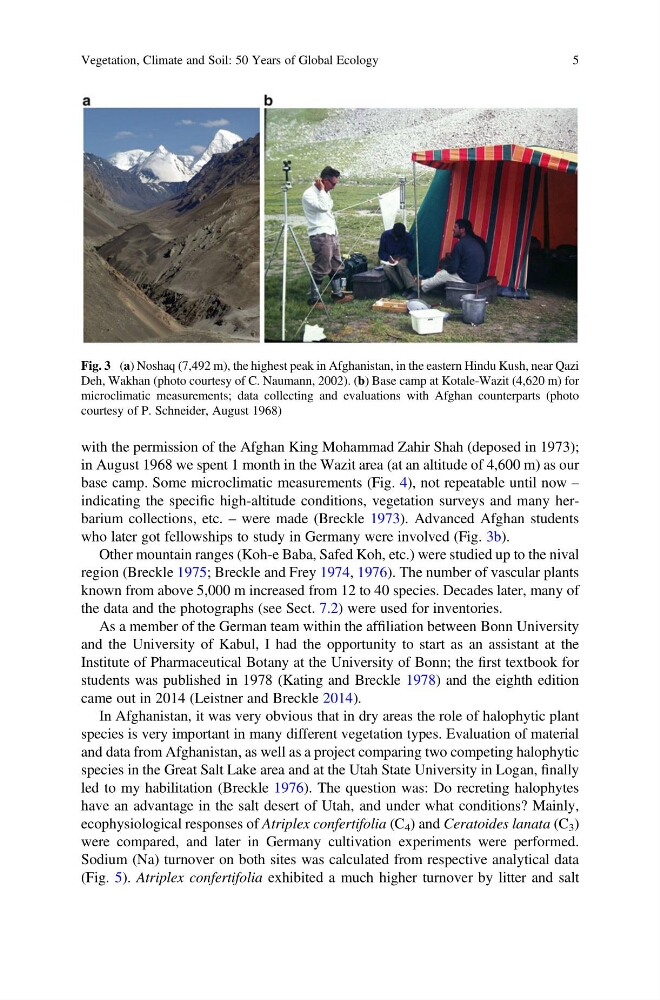
in August 1968 we spent 1 month in the Wazit area (at an altitude of 4,600 m) as our
base camp. Some microclimatic measurements (Fig. 4), not repeatable until now –
indicating the specific high-altitude conditions, vegetation surveys and many herbarium collections, etc. – were made (Breckle 1973). Advanced Afghan students
who later got fellowships to study in Germany were involved (Fig. 3b).
Other mountain ranges (Koh-e Baba, Safed Koh, etc.) were studied up to the nival
region (Breckle 1975; Breckle and Frey 1974, 1976). The number of vascular plants
known from above 5,000 m increased from 12 to 40 species. Decades later, many of
the data and the photographs (see Sect. 7.2) were used for inventories.
As a member of the German team within the affiliation between Bonn University
and the University of Kabul, I had the opportunity to start as an assistant at the
Institute of Pharmaceutical Botany at the University of Bonn; the first textbook for
students was published in 1978 (Kating and Breckle 1978) and the eighth edition
came out in 2014 (Leistner and Breckle 2014).
In Afghanistan, it was very obvious that in dry areas the role of halophytic plant
species is very important in many different vegetation types. Evaluation of material
and data from Afghanistan, as well as a project comparing two competing halophytic
species in the Great Salt Lake area and at the Utah State University in Logan, finally
led to my habilitation (Breckle 1976). The question was: Do recreting halophytes
have an advantage in the salt desert of Utah, and under what conditions? Mainly,
ecophysiological responses of Atriplex confertifolia (C 4 ) and Ceratoides lanata (C 3 )
were compared, and later in Germany cultivation experiments were performed.
Sodium (Na) turnover on both sites was calculated from respective analytical data
(Fig. 5). Atriplex confertifolia exhibited a much higher turnover by litter and salt
Fig. 3 (a) Noshaq (7,492 m), the highest peak in Afghanistan, in the eastern Hindu Kush, near Qazi
Deh, Wakhan (photo courtesy of C. Naumann, 2002). (b) Base camp at Kotale-Wazit (4,620 m) for
microclimatic measurements; data collecting and evaluations with Afghan counterparts (photo
courtesy of P. Schneider, August 1968)
Vegetation, Climate and Soil: 50 Years of Global Ecology
5
in August 1968 we spent 1 month in the Wazit area (at an altitude of 4,600 m) as our
base camp. Some microclimatic measurements (Fig. 4), not repeatable until now –
indicating the specific high-altitude conditions, vegetation surveys and many herbarium collections, etc. – were made (Breckle 1973). Advanced Afghan students
who later got fellowships to study in Germany were involved (Fig. 3b).
Other mountain ranges (Koh-e Baba, Safed Koh, etc.) were studied up to the nival
region (Breckle 1975; Breckle and Frey 1974, 1976). The number of vascular plants
known from above 5,000 m increased from 12 to 40 species. Decades later, many of
the data and the photographs (see Sect. 7.2) were used for inventories.
As a member of the German team within the affiliation between Bonn University
and the University of Kabul, I had the opportunity to start as an assistant at the
Institute of Pharmaceutical Botany at the University of Bonn; the first textbook for
students was published in 1978 (Kating and Breckle 1978) and the eighth edition
came out in 2014 (Leistner and Breckle 2014).
In Afghanistan, it was very obvious that in dry areas the role of halophytic plant
species is very important in many different vegetation types. Evaluation of material
and data from Afghanistan, as well as a project comparing two competing halophytic
species in the Great Salt Lake area and at the Utah State University in Logan, finally
led to my habilitation (Breckle 1976). The question was: Do recreting halophytes
have an advantage in the salt desert of Utah, and under what conditions? Mainly,
ecophysiological responses of Atriplex confertifolia (C 4 ) and Ceratoides lanata (C 3 )
were compared, and later in Germany cultivation experiments were performed.
Sodium (Na) turnover on both sites was calculated from respective analytical data
(Fig. 5). Atriplex confertifolia exhibited a much higher turnover by litter and salt
Fig. 3 (a) Noshaq (7,492 m), the highest peak in Afghanistan, in the eastern Hindu Kush, near Qazi
Deh, Wakhan (photo courtesy of C. Naumann, 2002). (b) Base camp at Kotale-Wazit (4,620 m) for
microclimatic measurements; data collecting and evaluations with Afghan counterparts (photo
courtesy of P. Schneider, August 1968)
Vegetation, Climate and Soil: 50 Years of Global Ecology
5