

measurements in nature proved to be more complicated; it took many replications to
understand diurnal and annual fluctuations.
Parallel to my stays in north-eastern Spain, Helmut Freitag used his Carlos Faust
Fellowship for research in the semi-desertic south-eastern Spain. He once mentioned
to me the affiliation between the universities of Bonn and Kabul and that there was
an existing German team of lecturers in Kabul at its Faculty of Science. We tried and
then succeeded in getting a new job in Afghanistan – for us an unknown country.
After Freitag’s habilitation and my doctorate, we started at the end of 1966 to build
up a curriculum for botany, giving lectures, courses, seminars and excursions, jointly
for male and female students at the Faculty of Science, Kabul. Uta Breckle organized
the lab work and the establishment of a herbarium.
Again, there were high mountains. During the summer vacation, when all of the
steppe and semi-deserts in the lowlands were dry and arid, the Hindu Kush was an
ideal place. One of the many highlights was an expedition to the Wakhan (Fig. 3a),
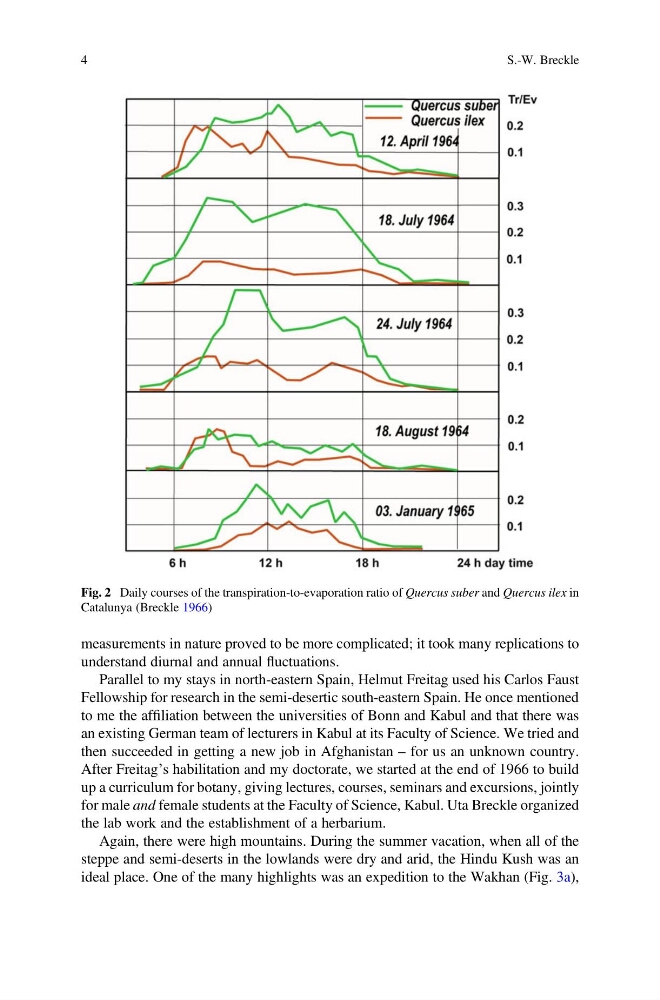
Fig. 2 Daily courses of the transpiration-to-evaporation ratio of Quercus suber and Quercus ilex in
Catalunya (Breckle 1966)
4
S.-W. Breckle
understand diurnal and annual fluctuations.
Parallel to my stays in north-eastern Spain, Helmut Freitag used his Carlos Faust
Fellowship for research in the semi-desertic south-eastern Spain. He once mentioned
to me the affiliation between the universities of Bonn and Kabul and that there was
an existing German team of lecturers in Kabul at its Faculty of Science. We tried and
then succeeded in getting a new job in Afghanistan – for us an unknown country.
After Freitag’s habilitation and my doctorate, we started at the end of 1966 to build
up a curriculum for botany, giving lectures, courses, seminars and excursions, jointly
for male and female students at the Faculty of Science, Kabul. Uta Breckle organized
the lab work and the establishment of a herbarium.
Again, there were high mountains. During the summer vacation, when all of the
steppe and semi-deserts in the lowlands were dry and arid, the Hindu Kush was an
ideal place. One of the many highlights was an expedition to the Wakhan (Fig. 3a),
Fig. 2 Daily courses of the transpiration-to-evaporation ratio of Quercus suber and Quercus ilex in
Catalunya (Breckle 1966)
4
S.-W. Breckle