

Quercus suber and Quercus ilex in Catalunya in north-eastern Spain? From the
University of Hohenheim with an old Volkswagen Beetle and a 1,000 DM fellowship from the Carlos Faust Foundation in Barcelona – the only external funding – I
started at the famous Mar I Murta Botanical Garden in Blanes, where they wanted
me at once as a gardener! Advice came by letters from my supervisor, Heinrich
Walter, in South America, where he was on his sabbatical. It turned out that the cork
oak, Quercus suber, uses twice as much water as Quercus ilex (Fig. 2), with a very
large root system (Breckle 1966). And, growing in Germany, young trees of Quercus
suber were more frost resistant than those of Quercus ilex – in contrast to many
observations in Spain or in Italy at Lake Maggiore (Sakai and Larcher 1987).
There was some pressure to publish the work, since Heinrich Walter was near
retirement. On the other hand, a doctoral thesis at that time was acknowledged as a
publication providing more details than a publication in a journal, as Beck (2017)
also indicated, and a cumulative dissertation was not known or allowed at that time.
The Rigorosum (viva) at the University of Stuttgart-Hohenheim was very comprehensive (one long oral of 90 min), covering botany, ecology and seed science.
My studies at Stuttgart and Hohenheim were a very helpful basis for future
research. Teaching at the Chemieschule and during practicals and field trips around
Hohenheim made me learn much about plants, their behaviour and ecology. Behind
that were chemistry and chemical reactions and pathways. But doing studies and
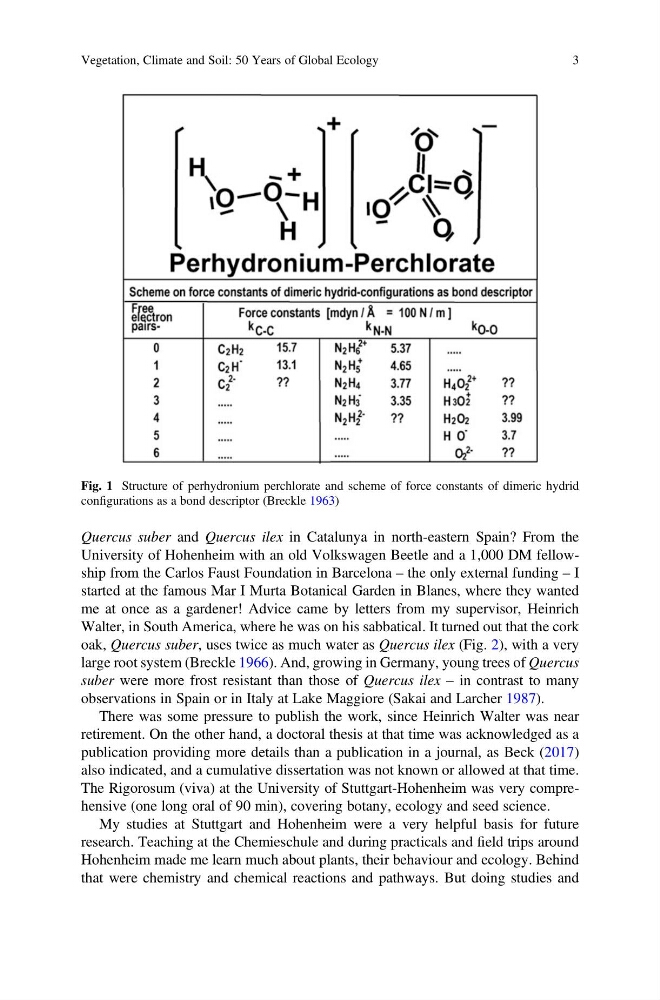
Fig. 1 Structure of perhydronium perchlorate and scheme of force constants of dimeric hydrid
configurations as a bond descriptor (Breckle 1963)
Vegetation, Climate and Soil: 50 Years of Global Ecology
3
University of Hohenheim with an old Volkswagen Beetle and a 1,000 DM fellowship from the Carlos Faust Foundation in Barcelona – the only external funding – I
started at the famous Mar I Murta Botanical Garden in Blanes, where they wanted
me at once as a gardener! Advice came by letters from my supervisor, Heinrich
Walter, in South America, where he was on his sabbatical. It turned out that the cork
oak, Quercus suber, uses twice as much water as Quercus ilex (Fig. 2), with a very
large root system (Breckle 1966). And, growing in Germany, young trees of Quercus
suber were more frost resistant than those of Quercus ilex – in contrast to many
observations in Spain or in Italy at Lake Maggiore (Sakai and Larcher 1987).
There was some pressure to publish the work, since Heinrich Walter was near
retirement. On the other hand, a doctoral thesis at that time was acknowledged as a
publication providing more details than a publication in a journal, as Beck (2017)
also indicated, and a cumulative dissertation was not known or allowed at that time.
The Rigorosum (viva) at the University of Stuttgart-Hohenheim was very comprehensive (one long oral of 90 min), covering botany, ecology and seed science.
My studies at Stuttgart and Hohenheim were a very helpful basis for future
research. Teaching at the Chemieschule and during practicals and field trips around
Hohenheim made me learn much about plants, their behaviour and ecology. Behind
that were chemistry and chemical reactions and pathways. But doing studies and
Fig. 1 Structure of perhydronium perchlorate and scheme of force constants of dimeric hydrid
configurations as a bond descriptor (Breckle 1963)
Vegetation, Climate and Soil: 50 Years of Global Ecology
3