

bladder hairs than Ceratoides, which, however, had a rather high salt content in its
roots. Salt is accumulated in the roots of Ceratoides; in Atriplex, it is in the shoot.
The dominant species of the salt deserts are shown in Fig. 6, according to their
ecological requirements.
In Nov. 1979, I went to Bielefeld and started to establish the new Department of
Plant Ecology. Together with a small team (some co-workers and a technician who
came from Bonn), we had plenty of room but almost no equipment at the new
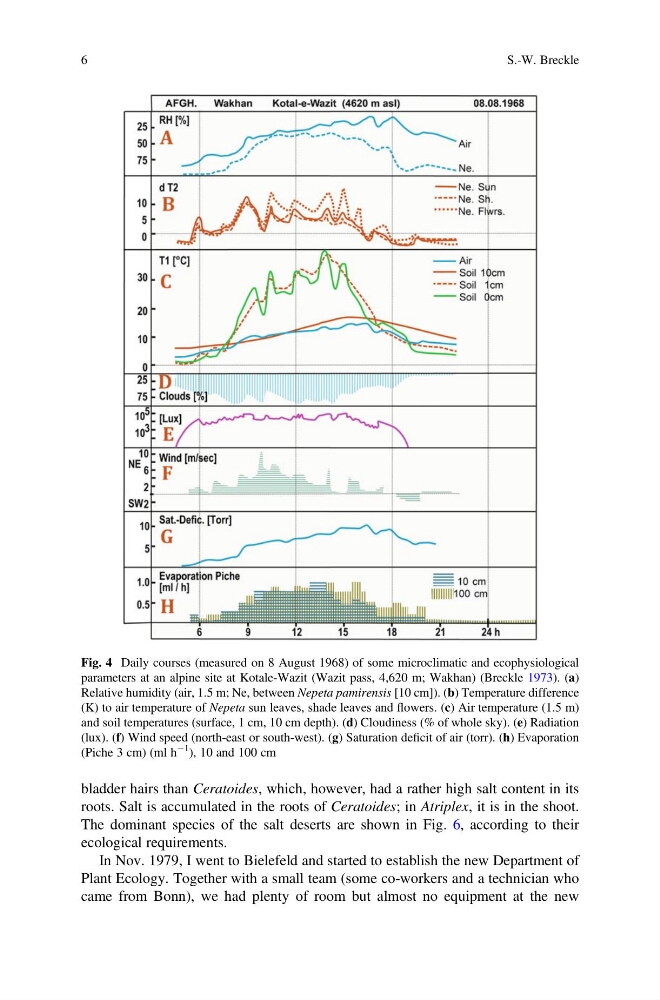
Fig. 4 Daily courses (measured on 8 August 1968) of some microclimatic and ecophysiological
parameters at an alpine site at Kotale-Wazit (Wazit pass, 4,620 m; Wakhan) (Breckle 1973). (a)
Relative humidity (air, 1.5 m; Ne, between Nepeta pamirensis [10 cm]). (b) Temperature difference
(K) to air temperature of Nepeta sun leaves, shade leaves and flowers. (c) Air temperature (1.5 m)
and soil temperatures (surface, 1 cm, 10 cm depth). (d) Cloudiness (% of whole sky). (e) Radiation
(lux). (f) Wind speed (north-east or south-west). (g) Saturation deficit of air (torr). (h) Evaporation
(Piche 3 cm) (ml h
À1
), 10 and 100 cm
6
S.-W. Breckle
roots. Salt is accumulated in the roots of Ceratoides; in Atriplex, it is in the shoot.
The dominant species of the salt deserts are shown in Fig. 6, according to their
ecological requirements.
In Nov. 1979, I went to Bielefeld and started to establish the new Department of
Plant Ecology. Together with a small team (some co-workers and a technician who
came from Bonn), we had plenty of room but almost no equipment at the new
Fig. 4 Daily courses (measured on 8 August 1968) of some microclimatic and ecophysiological
parameters at an alpine site at Kotale-Wazit (Wazit pass, 4,620 m; Wakhan) (Breckle 1973). (a)
Relative humidity (air, 1.5 m; Ne, between Nepeta pamirensis [10 cm]). (b) Temperature difference
(K) to air temperature of Nepeta sun leaves, shade leaves and flowers. (c) Air temperature (1.5 m)
and soil temperatures (surface, 1 cm, 10 cm depth). (d) Cloudiness (% of whole sky). (e) Radiation
(lux). (f) Wind speed (north-east or south-west). (g) Saturation deficit of air (torr). (h) Evaporation
(Piche 3 cm) (ml h
À1
), 10 and 100 cm
6
S.-W. Breckle