

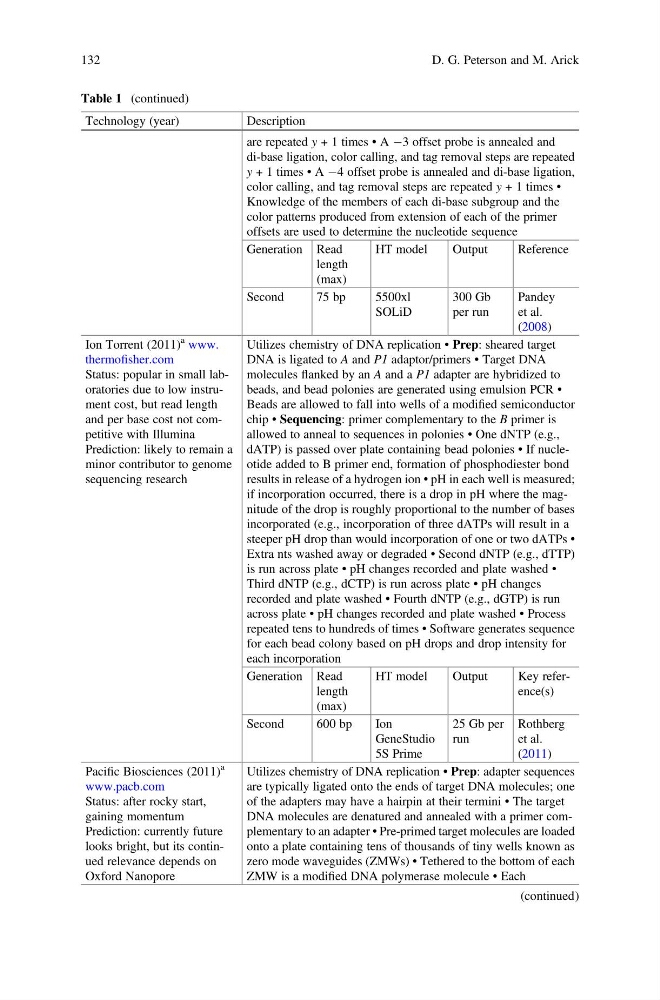
Table 1 (continued)
Technology (year)
Description
are repeated y + 1 times • A À3 offset probe is annealed and
di-base ligation, color calling, and tag removal steps are repeated
y + 1 times • A À4 offset probe is annealed and di-base ligation,
color calling, and tag removal steps are repeated y + 1 times •
Knowledge of the members of each di-base subgroup and the
color patterns produced from extension of each of the primer
offsets are used to determine the nucleotide sequence
Generation Read
length
(max)
HT model
Output
Reference
Second
75 bp
5500xl
SOLiD
300 Gb
per run
Pandey
et al.
(2008)
Ion Torrent (2011)
a www.
thermofisher.com
Status: popular in small laboratories due to low instrument cost, but read length
and per base cost not competitive with Illumina
Prediction: likely to remain a
minor contributor to genome
sequencing research
Utilizes chemistry of DNA replication • Prep: sheared target
DNA is ligated to A and P1 adaptor/primers • Target DNA
molecules flanked by an A and a P1 adapter are hybridized to
beads, and bead polonies are generated using emulsion PCR •
Beads are allowed to fall into wells of a modified semiconductor
chip • Sequencing: primer complementary to the B primer is
allowed to anneal to sequences in polonies • One dNTP (e.g.,
dATP) is passed over plate containing bead polonies • If nucleotide added to B primer end, formation of phosphodiester bond
results in release of a hydrogen ion • pH in each well is measured;
if incorporation occurred, there is a drop in pH where the magnitude of the drop is roughly proportional to the number of bases
incorporated (e.g., incorporation of three dATPs will result in a
steeper pH drop than would incorporation of one or two dATPs •
Extra nts washed away or degraded • Second dNTP (e.g., dTTP)
is run across plate • pH changes recorded and plate washed •
Third dNTP (e.g., dCTP) is run across plate • pH changes
recorded and plate washed • Fourth dNTP (e.g., dGTP) is run
across plate • pH changes recorded and plate washed • Process
repeated tens to hundreds of times • Software generates sequence
for each bead colony based on pH drops and drop intensity for
each incorporation
Generation Read
length
(max)
HT model
Output
Key reference(s)
Second
600 bp
Ion
GeneStudio
5S Prime
25 Gb per
run
Rothberg
et al.
(2011)
Pacific Biosciences (2011)
a
www.pacb.com
Status: after rocky start,
gaining momentum
Prediction: currently future
looks bright, but its continued relevance depends on
Oxford Nanopore
Utilizes chemistry of DNA replication • Prep: adapter sequences
are typically ligated onto the ends of target DNA molecules; one
of the adapters may have a hairpin at their termini • The target
DNA molecules are denatured and annealed with a primer complementary to an adapter • Pre-primed target molecules are loaded
onto a plate containing tens of thousands of tiny wells known as
zero mode waveguides (ZMWs) • Tethered to the bottom of each
ZMW is a modified DNA polymerase molecule • Each
(continued)
132
D. G. Peterson and M. Arick
Technology (year)
Description
are repeated y + 1 times • A À3 offset probe is annealed and
di-base ligation, color calling, and tag removal steps are repeated
y + 1 times • A À4 offset probe is annealed and di-base ligation,
color calling, and tag removal steps are repeated y + 1 times •
Knowledge of the members of each di-base subgroup and the
color patterns produced from extension of each of the primer
offsets are used to determine the nucleotide sequence
Generation Read
length
(max)
HT model
Output
Reference
Second
75 bp
5500xl
SOLiD
300 Gb
per run
Pandey
et al.
(2008)
Ion Torrent (2011)
a www.
thermofisher.com
Status: popular in small laboratories due to low instrument cost, but read length
and per base cost not competitive with Illumina
Prediction: likely to remain a
minor contributor to genome
sequencing research
Utilizes chemistry of DNA replication • Prep: sheared target
DNA is ligated to A and P1 adaptor/primers • Target DNA
molecules flanked by an A and a P1 adapter are hybridized to
beads, and bead polonies are generated using emulsion PCR •
Beads are allowed to fall into wells of a modified semiconductor
chip • Sequencing: primer complementary to the B primer is
allowed to anneal to sequences in polonies • One dNTP (e.g.,
dATP) is passed over plate containing bead polonies • If nucleotide added to B primer end, formation of phosphodiester bond
results in release of a hydrogen ion • pH in each well is measured;
if incorporation occurred, there is a drop in pH where the magnitude of the drop is roughly proportional to the number of bases
incorporated (e.g., incorporation of three dATPs will result in a
steeper pH drop than would incorporation of one or two dATPs •
Extra nts washed away or degraded • Second dNTP (e.g., dTTP)
is run across plate • pH changes recorded and plate washed •
Third dNTP (e.g., dCTP) is run across plate • pH changes
recorded and plate washed • Fourth dNTP (e.g., dGTP) is run
across plate • pH changes recorded and plate washed • Process
repeated tens to hundreds of times • Software generates sequence
for each bead colony based on pH drops and drop intensity for
each incorporation
Generation Read
length
(max)
HT model
Output
Key reference(s)
Second
600 bp
Ion
GeneStudio
5S Prime
25 Gb per
run
Rothberg
et al.
(2011)
Pacific Biosciences (2011)
a
www.pacb.com
Status: after rocky start,
gaining momentum
Prediction: currently future
looks bright, but its continued relevance depends on
Oxford Nanopore
Utilizes chemistry of DNA replication • Prep: adapter sequences
are typically ligated onto the ends of target DNA molecules; one
of the adapters may have a hairpin at their termini • The target
DNA molecules are denatured and annealed with a primer complementary to an adapter • Pre-primed target molecules are loaded
onto a plate containing tens of thousands of tiny wells known as
zero mode waveguides (ZMWs) • Tethered to the bottom of each
ZMW is a modified DNA polymerase molecule • Each
(continued)
132
D. G. Peterson and M. Arick