

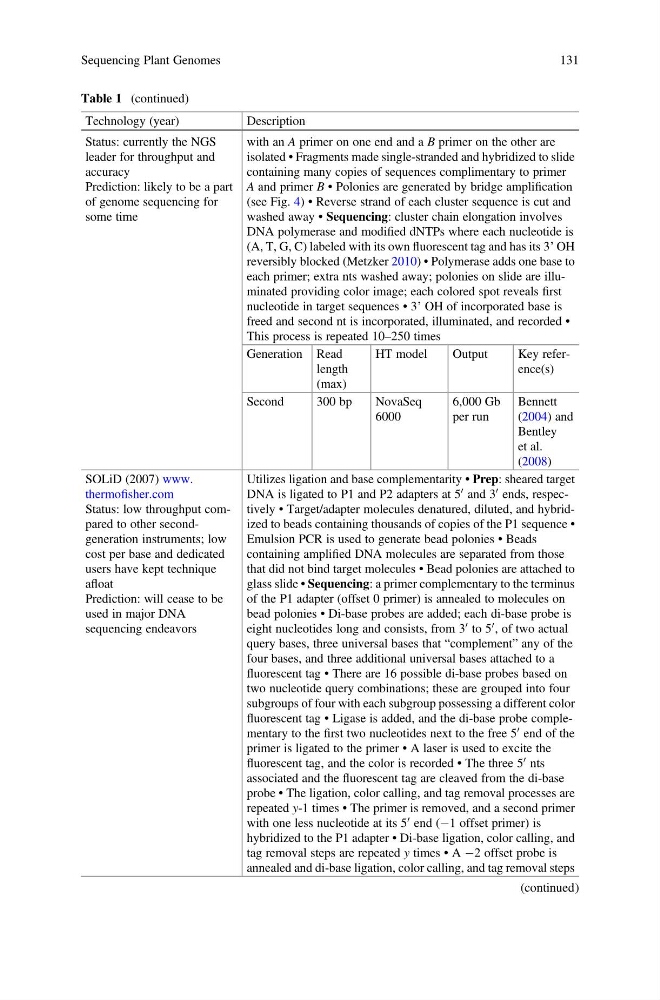
Table 1 (continued)
Technology (year)
Description
Status: currently the NGS
leader for throughput and
accuracy
Prediction: likely to be a part
of genome sequencing for
some time
with an A primer on one end and a B primer on the other are
isolated • Fragments made single-stranded and hybridized to slide
containing many copies of sequences complimentary to primer
A and primer B • Polonies are generated by bridge amplification
(see Fig. 4) • Reverse strand of each cluster sequence is cut and
washed away • Sequencing: cluster chain elongation involves
DNA polymerase and modified dNTPs where each nucleotide is
(A, T, G, C) labeled with its own fluorescent tag and has its 3’ OH
reversibly blocked (Metzker 2010) • Polymerase adds one base to
each primer; extra nts washed away; polonies on slide are illuminated providing color image; each colored spot reveals first
nucleotide in target sequences • 3’ OH of incorporated base is
freed and second nt is incorporated, illuminated, and recorded •
This process is repeated 10–250 times
Generation Read
length
(max)
HT model
Output
Key reference(s)
Second
300 bp
NovaSeq
6000
6,000 Gb
per run
Bennett
(2004) and
Bentley
et al.
(2008)
SOLiD (2007) www.
thermofisher.com
Status: low throughput compared to other secondgeneration instruments; low
cost per base and dedicated
users have kept technique
afloat
Prediction: will cease to be
used in major DNA
sequencing endeavors
Utilizes ligation and base complementarity • Prep: sheared target
DNA is ligated to P1 and P2 adapters at 5
0 and 3
0 ends, respectively • Target/adapter molecules denatured, diluted, and hybridized to beads containing thousands of copies of the P1 sequence •
Emulsion PCR is used to generate bead polonies • Beads
containing amplified DNA molecules are separated from those
that did not bind target molecules • Bead polonies are attached to
glass slide • Sequencing: a primer complementary to the terminus
of the P1 adapter (offset 0 primer) is annealed to molecules on
bead polonies • Di-base probes are added; each di-base probe is
eight nucleotides long and consists, from 3
0 to 5
0 , of two actual
query bases, three universal bases that “complement” any of the
four bases, and three additional universal bases attached to a
fluorescent tag • There are 16 possible di-base probes based on
two nucleotide query combinations; these are grouped into four
subgroups of four with each subgroup possessing a different color
fluorescent tag • Ligase is added, and the di-base probe complementary to the first two nucleotides next to the free 5
0 end of the
primer is ligated to the primer • A laser is used to excite the
fluorescent tag, and the color is recorded • The three 5
0 nts
associated and the fluorescent tag are cleaved from the di-base
probe • The ligation, color calling, and tag removal processes are
repeated y-1 times • The primer is removed, and a second primer
with one less nucleotide at its 5
0 end (À1 offset primer) is
hybridized to the P1 adapter • Di-base ligation, color calling, and
tag removal steps are repeated y times • A À2 offset probe is
annealed and di-base ligation, color calling, and tag removal steps
(continued)
Sequencing Plant Genomes
131
Technology (year)
Description
Status: currently the NGS
leader for throughput and
accuracy
Prediction: likely to be a part
of genome sequencing for
some time
with an A primer on one end and a B primer on the other are
isolated • Fragments made single-stranded and hybridized to slide
containing many copies of sequences complimentary to primer
A and primer B • Polonies are generated by bridge amplification
(see Fig. 4) • Reverse strand of each cluster sequence is cut and
washed away • Sequencing: cluster chain elongation involves
DNA polymerase and modified dNTPs where each nucleotide is
(A, T, G, C) labeled with its own fluorescent tag and has its 3’ OH
reversibly blocked (Metzker 2010) • Polymerase adds one base to
each primer; extra nts washed away; polonies on slide are illuminated providing color image; each colored spot reveals first
nucleotide in target sequences • 3’ OH of incorporated base is
freed and second nt is incorporated, illuminated, and recorded •
This process is repeated 10–250 times
Generation Read
length
(max)
HT model
Output
Key reference(s)
Second
300 bp
NovaSeq
6000
6,000 Gb
per run
Bennett
(2004) and
Bentley
et al.
(2008)
SOLiD (2007) www.
thermofisher.com
Status: low throughput compared to other secondgeneration instruments; low
cost per base and dedicated
users have kept technique
afloat
Prediction: will cease to be
used in major DNA
sequencing endeavors
Utilizes ligation and base complementarity • Prep: sheared target
DNA is ligated to P1 and P2 adapters at 5
0 and 3
0 ends, respectively • Target/adapter molecules denatured, diluted, and hybridized to beads containing thousands of copies of the P1 sequence •
Emulsion PCR is used to generate bead polonies • Beads
containing amplified DNA molecules are separated from those
that did not bind target molecules • Bead polonies are attached to
glass slide • Sequencing: a primer complementary to the terminus
of the P1 adapter (offset 0 primer) is annealed to molecules on
bead polonies • Di-base probes are added; each di-base probe is
eight nucleotides long and consists, from 3
0 to 5
0 , of two actual
query bases, three universal bases that “complement” any of the
four bases, and three additional universal bases attached to a
fluorescent tag • There are 16 possible di-base probes based on
two nucleotide query combinations; these are grouped into four
subgroups of four with each subgroup possessing a different color
fluorescent tag • Ligase is added, and the di-base probe complementary to the first two nucleotides next to the free 5
0 end of the
primer is ligated to the primer • A laser is used to excite the
fluorescent tag, and the color is recorded • The three 5
0 nts
associated and the fluorescent tag are cleaved from the di-base
probe • The ligation, color calling, and tag removal processes are
repeated y-1 times • The primer is removed, and a second primer
with one less nucleotide at its 5
0 end (À1 offset primer) is
hybridized to the P1 adapter • Di-base ligation, color calling, and
tag removal steps are repeated y times • A À2 offset probe is
annealed and di-base ligation, color calling, and tag removal steps
(continued)
Sequencing Plant Genomes
131