

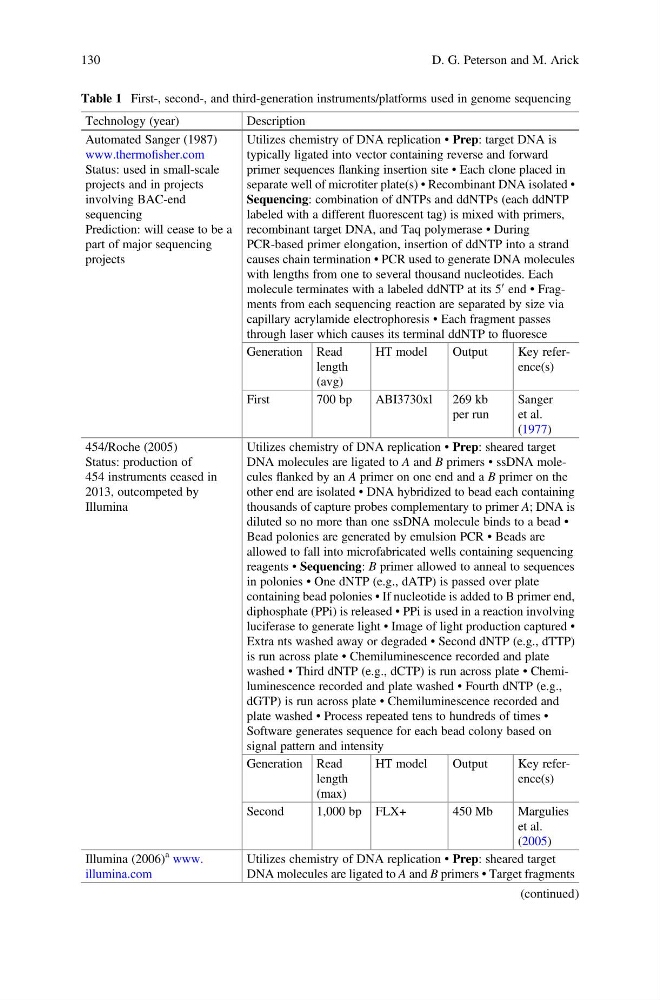
Table 1 First-, second-, and third-generation instruments/platforms used in genome sequencing
Technology (year)
Description
Automated Sanger (1987)
www.thermofisher.com
Status: used in small-scale
projects and in projects
involving BAC-end
sequencing
Prediction: will cease to be a
part of major sequencing
projects
Utilizes chemistry of DNA replication • Prep: target DNA is
typically ligated into vector containing reverse and forward
primer sequences flanking insertion site • Each clone placed in
separate well of microtiter plate(s) • Recombinant DNA isolated •
Sequencing: combination of dNTPs and ddNTPs (each ddNTP
labeled with a different fluorescent tag) is mixed with primers,
recombinant target DNA, and Taq polymerase • During
PCR-based primer elongation, insertion of ddNTP into a strand
causes chain termination • PCR used to generate DNA molecules
with lengths from one to several thousand nucleotides. Each
molecule terminates with a labeled ddNTP at its 5
0 end • Fragments from each sequencing reaction are separated by size via
capillary acrylamide electrophoresis • Each fragment passes
through laser which causes its terminal ddNTP to fluoresce
Generation Read
length
(avg)
HT model
Output
Key reference(s)
First
700 bp
ABI3730xl
269 kb
per run
Sanger
et al.
(1977)
454/Roche (2005)
Status: production of
454 instruments ceased in
2013, outcompeted by
Illumina
Utilizes chemistry of DNA replication • Prep: sheared target
DNA molecules are ligated to A and B primers • ssDNA molecules flanked by an A primer on one end and a B primer on the
other end are isolated • DNA hybridized to bead each containing
thousands of capture probes complementary to primer A; DNA is
diluted so no more than one ssDNA molecule binds to a bead •
Bead polonies are generated by emulsion PCR • Beads are
allowed to fall into microfabricated wells containing sequencing
reagents • Sequencing: B primer allowed to anneal to sequences
in polonies • One dNTP (e.g., dATP) is passed over plate
containing bead polonies • If nucleotide is added to B primer end,
diphosphate (PPi) is released • PPi is used in a reaction involving
luciferase to generate light • Image of light production captured •
Extra nts washed away or degraded • Second dNTP (e.g., dTTP)
is run across plate • Chemiluminescence recorded and plate
washed • Third dNTP (e.g., dCTP) is run across plate • Chemiluminescence recorded and plate washed • Fourth dNTP (e.g.,
dGTP) is run across plate • Chemiluminescence recorded and
plate washed • Process repeated tens to hundreds of times •
Software generates sequence for each bead colony based on
signal pattern and intensity
Generation Read
length
(max)
HT model
Output
Key reference(s)
Second
1,000 bp FLX+
450 Mb
Margulies
et al.
(2005)
Illumina (2006)
a www.
illumina.com
Utilizes chemistry of DNA replication • Prep: sheared target
DNA molecules are ligated to A and B primers • Target fragments
(continued)
130
D. G. Peterson and M. Arick
Technology (year)
Description
Automated Sanger (1987)
www.thermofisher.com
Status: used in small-scale
projects and in projects
involving BAC-end
sequencing
Prediction: will cease to be a
part of major sequencing
projects
Utilizes chemistry of DNA replication • Prep: target DNA is
typically ligated into vector containing reverse and forward
primer sequences flanking insertion site • Each clone placed in
separate well of microtiter plate(s) • Recombinant DNA isolated •
Sequencing: combination of dNTPs and ddNTPs (each ddNTP
labeled with a different fluorescent tag) is mixed with primers,
recombinant target DNA, and Taq polymerase • During
PCR-based primer elongation, insertion of ddNTP into a strand
causes chain termination • PCR used to generate DNA molecules
with lengths from one to several thousand nucleotides. Each
molecule terminates with a labeled ddNTP at its 5
0 end • Fragments from each sequencing reaction are separated by size via
capillary acrylamide electrophoresis • Each fragment passes
through laser which causes its terminal ddNTP to fluoresce
Generation Read
length
(avg)
HT model
Output
Key reference(s)
First
700 bp
ABI3730xl
269 kb
per run
Sanger
et al.
(1977)
454/Roche (2005)
Status: production of
454 instruments ceased in
2013, outcompeted by
Illumina
Utilizes chemistry of DNA replication • Prep: sheared target
DNA molecules are ligated to A and B primers • ssDNA molecules flanked by an A primer on one end and a B primer on the
other end are isolated • DNA hybridized to bead each containing
thousands of capture probes complementary to primer A; DNA is
diluted so no more than one ssDNA molecule binds to a bead •
Bead polonies are generated by emulsion PCR • Beads are
allowed to fall into microfabricated wells containing sequencing
reagents • Sequencing: B primer allowed to anneal to sequences
in polonies • One dNTP (e.g., dATP) is passed over plate
containing bead polonies • If nucleotide is added to B primer end,
diphosphate (PPi) is released • PPi is used in a reaction involving
luciferase to generate light • Image of light production captured •
Extra nts washed away or degraded • Second dNTP (e.g., dTTP)
is run across plate • Chemiluminescence recorded and plate
washed • Third dNTP (e.g., dCTP) is run across plate • Chemiluminescence recorded and plate washed • Fourth dNTP (e.g.,
dGTP) is run across plate • Chemiluminescence recorded and
plate washed • Process repeated tens to hundreds of times •
Software generates sequence for each bead colony based on
signal pattern and intensity
Generation Read
length
(max)
HT model
Output
Key reference(s)
Second
1,000 bp FLX+
450 Mb
Margulies
et al.
(2005)
Illumina (2006)
a www.
illumina.com
Utilizes chemistry of DNA replication • Prep: sheared target
DNA molecules are ligated to A and B primers • Target fragments
(continued)
130
D. G. Peterson and M. Arick