

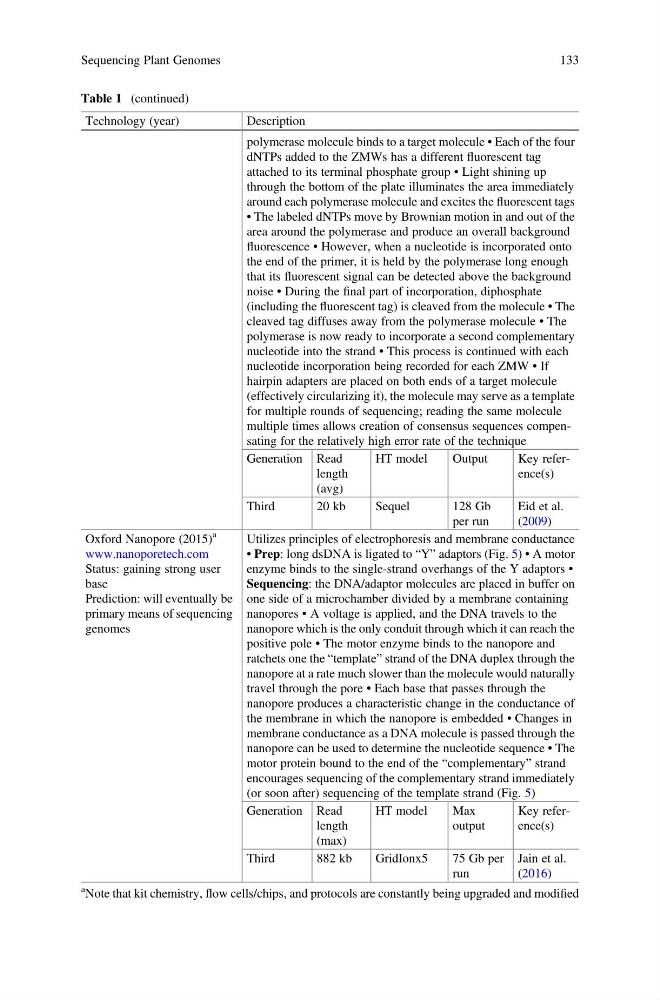
Table 1 (continued)
Technology (year)
Description
polymerase molecule binds to a target molecule • Each of the four
dNTPs added to the ZMWs has a different fluorescent tag
attached to its terminal phosphate group • Light shining up
through the bottom of the plate illuminates the area immediately
around each polymerase molecule and excites the fluorescent tags
• The labeled dNTPs move by Brownian motion in and out of the
area around the polymerase and produce an overall background
fluorescence • However, when a nucleotide is incorporated onto
the end of the primer, it is held by the polymerase long enough
that its fluorescent signal can be detected above the background
noise • During the final part of incorporation, diphosphate
(including the fluorescent tag) is cleaved from the molecule • The
cleaved tag diffuses away from the polymerase molecule • The
polymerase is now ready to incorporate a second complementary
nucleotide into the strand • This process is continued with each
nucleotide incorporation being recorded for each ZMW • If
hairpin adapters are placed on both ends of a target molecule
(effectively circularizing it), the molecule may serve as a template
for multiple rounds of sequencing; reading the same molecule
multiple times allows creation of consensus sequences compensating for the relatively high error rate of the technique
Generation Read
length
(avg)
HT model
Output
Key reference(s)
Third
20 kb
Sequel
128 Gb
per run
Eid et al.
(2009)
Oxford Nanopore (2015)
a
www.nanoporetech.com
Status: gaining strong user
base
Prediction: will eventually be
primary means of sequencing
genomes
Utilizes principles of electrophoresis and membrane conductance
• Prep: long dsDNA is ligated to “Y” adaptors (Fig. 5) • A motor
enzyme binds to the single-strand overhangs of the Y adaptors •
Sequencing: the DNA/adaptor molecules are placed in buffer on
one side of a microchamber divided by a membrane containing
nanopores • A voltage is applied, and the DNA travels to the
nanopore which is the only conduit through which it can reach the
positive pole • The motor enzyme binds to the nanopore and
ratchets one the “template” strand of the DNA duplex through the
nanopore at a rate much slower than the molecule would naturally
travel through the pore • Each base that passes through the
nanopore produces a characteristic change in the conductance of
the membrane in which the nanopore is embedded • Changes in
membrane conductance as a DNA molecule is passed through the
nanopore can be used to determine the nucleotide sequence • The
motor protein bound to the end of the “complementary” strand
encourages sequencing of the complementary strand immediately
(or soon after) sequencing of the template strand (Fig. 5)
Generation Read
length
(max)
HT model
Max
output
Key reference(s)
Third
882 kb
GridIonx5
75 Gb per
run
Jain et al.
(2016)
a Note that kit chemistry, flow cells/chips, and protocols are constantly being upgraded and modified
Sequencing Plant Genomes
133
Technology (year)
Description
polymerase molecule binds to a target molecule • Each of the four
dNTPs added to the ZMWs has a different fluorescent tag
attached to its terminal phosphate group • Light shining up
through the bottom of the plate illuminates the area immediately
around each polymerase molecule and excites the fluorescent tags
• The labeled dNTPs move by Brownian motion in and out of the
area around the polymerase and produce an overall background
fluorescence • However, when a nucleotide is incorporated onto
the end of the primer, it is held by the polymerase long enough
that its fluorescent signal can be detected above the background
noise • During the final part of incorporation, diphosphate
(including the fluorescent tag) is cleaved from the molecule • The
cleaved tag diffuses away from the polymerase molecule • The
polymerase is now ready to incorporate a second complementary
nucleotide into the strand • This process is continued with each
nucleotide incorporation being recorded for each ZMW • If
hairpin adapters are placed on both ends of a target molecule
(effectively circularizing it), the molecule may serve as a template
for multiple rounds of sequencing; reading the same molecule
multiple times allows creation of consensus sequences compensating for the relatively high error rate of the technique
Generation Read
length
(avg)
HT model
Output
Key reference(s)
Third
20 kb
Sequel
128 Gb
per run
Eid et al.
(2009)
Oxford Nanopore (2015)
a
www.nanoporetech.com
Status: gaining strong user
base
Prediction: will eventually be
primary means of sequencing
genomes
Utilizes principles of electrophoresis and membrane conductance
• Prep: long dsDNA is ligated to “Y” adaptors (Fig. 5) • A motor
enzyme binds to the single-strand overhangs of the Y adaptors •
Sequencing: the DNA/adaptor molecules are placed in buffer on
one side of a microchamber divided by a membrane containing
nanopores • A voltage is applied, and the DNA travels to the
nanopore which is the only conduit through which it can reach the
positive pole • The motor enzyme binds to the nanopore and
ratchets one the “template” strand of the DNA duplex through the
nanopore at a rate much slower than the molecule would naturally
travel through the pore • Each base that passes through the
nanopore produces a characteristic change in the conductance of
the membrane in which the nanopore is embedded • Changes in
membrane conductance as a DNA molecule is passed through the
nanopore can be used to determine the nucleotide sequence • The
motor protein bound to the end of the “complementary” strand
encourages sequencing of the complementary strand immediately
(or soon after) sequencing of the template strand (Fig. 5)
Generation Read
length
(max)
HT model
Max
output
Key reference(s)
Third
882 kb
GridIonx5
75 Gb per
run
Jain et al.
(2016)
a Note that kit chemistry, flow cells/chips, and protocols are constantly being upgraded and modified
Sequencing Plant Genomes
133