

a
b
c
d
Alligator gar
Largemouth bass
Carp
Bluegill
Smallmouth bass
Yellow perch
White crappie
HAROLD
Largemouth bass
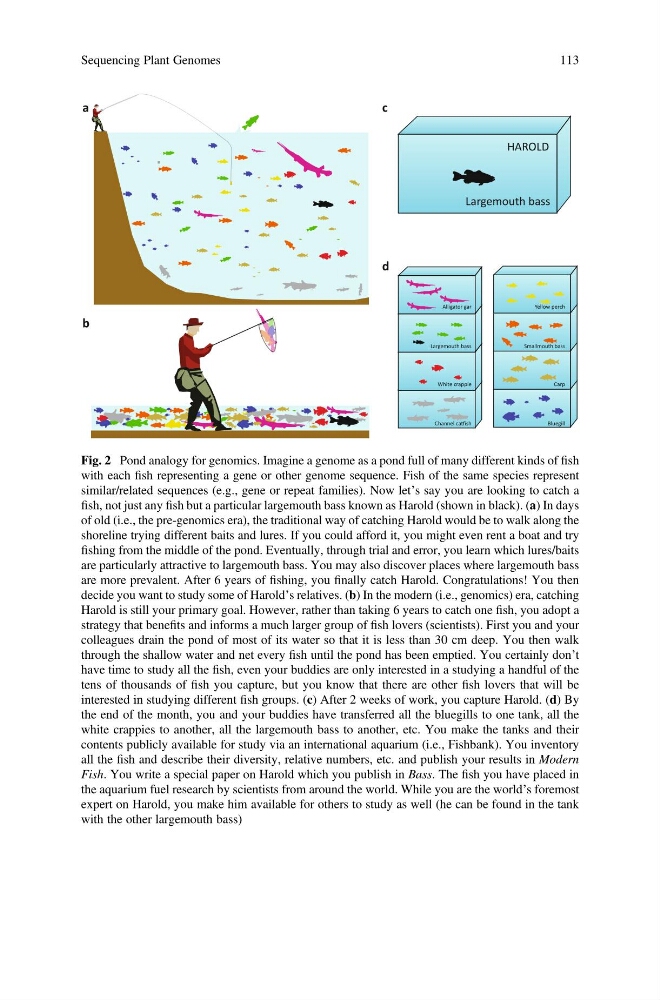
Fig. 2 Pond analogy for genomics. Imagine a genome as a pond full of many different kinds of fish
with each fish representing a gene or other genome sequence. Fish of the same species represent
similar/related sequences (e.g., gene or repeat families). Now let’s say you are looking to catch a
fish, not just any fish but a particular largemouth bass known as Harold (shown in black). (a) In days
of old (i.e., the pre-genomics era), the traditional way of catching Harold would be to walk along the
shoreline trying different baits and lures. If you could afford it, you might even rent a boat and try
fishing from the middle of the pond. Eventually, through trial and error, you learn which lures/baits
are particularly attractive to largemouth bass. You may also discover places where largemouth bass
are more prevalent. After 6 years of fishing, you finally catch Harold. Congratulations! You then
decide you want to study some of Harold’s relatives. (b) In the modern (i.e., genomics) era, catching
Harold is still your primary goal. However, rather than taking 6 years to catch one fish, you adopt a
strategy that benefits and informs a much larger group of fish lovers (scientists). First you and your
colleagues drain the pond of most of its water so that it is less than 30 cm deep. You then walk
through the shallow water and net every fish until the pond has been emptied. You certainly don’t
have time to study all the fish, even your buddies are only interested in a studying a handful of the
tens of thousands of fish you capture, but you know that there are other fish lovers that will be
interested in studying different fish groups. (c) After 2 weeks of work, you capture Harold. (d) By
the end of the month, you and your buddies have transferred all the bluegills to one tank, all the
white crappies to another, all the largemouth bass to another, etc. You make the tanks and their
contents publicly available for study via an international aquarium (i.e., Fishbank). You inventory
all the fish and describe their diversity, relative numbers, etc. and publish your results in Modern
Fish. You write a special paper on Harold which you publish in Bass. The fish you have placed in
the aquarium fuel research by scientists from around the world. While you are the world’s foremost
expert on Harold, you make him available for others to study as well (he can be found in the tank
with the other largemouth bass)
Sequencing Plant Genomes
113
b
c
d
Alligator gar
Largemouth bass
Carp
Bluegill
Smallmouth bass
Yellow perch
White crappie
HAROLD
Largemouth bass
Fig. 2 Pond analogy for genomics. Imagine a genome as a pond full of many different kinds of fish
with each fish representing a gene or other genome sequence. Fish of the same species represent
similar/related sequences (e.g., gene or repeat families). Now let’s say you are looking to catch a
fish, not just any fish but a particular largemouth bass known as Harold (shown in black). (a) In days
of old (i.e., the pre-genomics era), the traditional way of catching Harold would be to walk along the
shoreline trying different baits and lures. If you could afford it, you might even rent a boat and try
fishing from the middle of the pond. Eventually, through trial and error, you learn which lures/baits
are particularly attractive to largemouth bass. You may also discover places where largemouth bass
are more prevalent. After 6 years of fishing, you finally catch Harold. Congratulations! You then
decide you want to study some of Harold’s relatives. (b) In the modern (i.e., genomics) era, catching
Harold is still your primary goal. However, rather than taking 6 years to catch one fish, you adopt a
strategy that benefits and informs a much larger group of fish lovers (scientists). First you and your
colleagues drain the pond of most of its water so that it is less than 30 cm deep. You then walk
through the shallow water and net every fish until the pond has been emptied. You certainly don’t
have time to study all the fish, even your buddies are only interested in a studying a handful of the
tens of thousands of fish you capture, but you know that there are other fish lovers that will be
interested in studying different fish groups. (c) After 2 weeks of work, you capture Harold. (d) By
the end of the month, you and your buddies have transferred all the bluegills to one tank, all the
white crappies to another, all the largemouth bass to another, etc. You make the tanks and their
contents publicly available for study via an international aquarium (i.e., Fishbank). You inventory
all the fish and describe their diversity, relative numbers, etc. and publish your results in Modern
Fish. You write a special paper on Harold which you publish in Bass. The fish you have placed in
the aquarium fuel research by scientists from around the world. While you are the world’s foremost
expert on Harold, you make him available for others to study as well (he can be found in the tank
with the other largemouth bass)
Sequencing Plant Genomes
113