

endosymbiotic cyanobacteria.
3 The Viridiplantae contains 350,000–500,000 species
(Chapman 2009; Smith et al. 2009; Ruhfel et al. 2014). The vast majority of these
species are angiosperms.
The importance of plants to the evolution of life on earth is difficult to overstate.
Due to their ability to convert light energy into chemical energy, plants are the
primary source of food for most of the world’s terrestrial heterotrophs (notably
animals and fungi). Colonization of land by animals would have been unlikely
without prior and concomitant colonization of land by plants. The majority of
human calories come directly from plants; the remainder comes from other animals
that get their food from consuming plants or plant-eating organisms. Humans use
plant materials to build shelters/houses, to make clothing, to heat their homes, as a
source of medicinal compounds, and to add beauty to the places in which they live
and work. In brief, humans owe everything to plants.
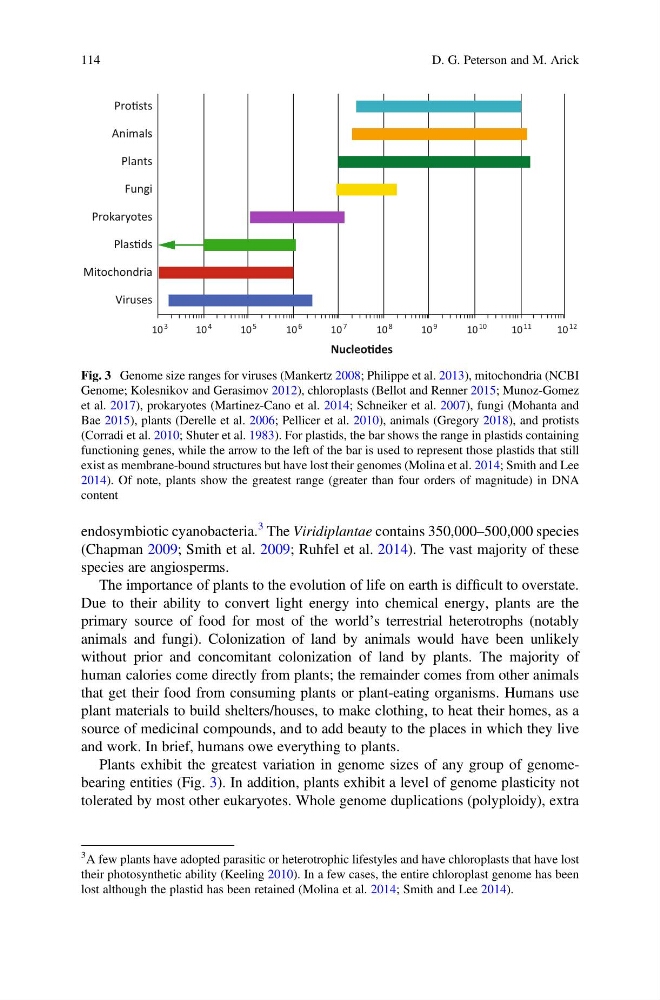
Plants exhibit the greatest variation in genome sizes of any group of genomebearing entities (Fig. 3). In addition, plants exhibit a level of genome plasticity not
tolerated by most other eukaryotes. Whole genome duplications (polyploidy), extra
10
3
10
4
10
5
10
6
10
7
10
8
10
9
10
10
10
11
10
12
Animals
Plants
Fungi
Prokaryotes
Mitochondria
Viruses
Fig. 3 Genome size ranges for viruses (Mankertz 2008; Philippe et al. 2013), mitochondria (NCBI
Genome; Kolesnikov and Gerasimov 2012), chloroplasts (Bellot and Renner 2015; Munoz-Gomez
et al. 2017), prokaryotes (Martinez-Cano et al. 2014; Schneiker et al. 2007), fungi (Mohanta and
Bae 2015), plants (Derelle et al. 2006; Pellicer et al. 2010), animals (Gregory 2018), and protists
(Corradi et al. 2010; Shuter et al. 1983). For plastids, the bar shows the range in plastids containing
functioning genes, while the arrow to the left of the bar is used to represent those plastids that still
exist as membrane-bound structures but have lost their genomes (Molina et al. 2014; Smith and Lee
2014). Of note, plants show the greatest range (greater than four orders of magnitude) in DNA
content
3 A few plants have adopted parasitic or heterotrophic lifestyles and have chloroplasts that have lost
their photosynthetic ability (Keeling 2010). In a few cases, the entire chloroplast genome has been
lost although the plastid has been retained (Molina et al. 2014; Smith and Lee 2014).
114
D. G. Peterson and M. Arick
3 The Viridiplantae contains 350,000–500,000 species
(Chapman 2009; Smith et al. 2009; Ruhfel et al. 2014). The vast majority of these
species are angiosperms.
The importance of plants to the evolution of life on earth is difficult to overstate.
Due to their ability to convert light energy into chemical energy, plants are the
primary source of food for most of the world’s terrestrial heterotrophs (notably
animals and fungi). Colonization of land by animals would have been unlikely
without prior and concomitant colonization of land by plants. The majority of
human calories come directly from plants; the remainder comes from other animals
that get their food from consuming plants or plant-eating organisms. Humans use
plant materials to build shelters/houses, to make clothing, to heat their homes, as a
source of medicinal compounds, and to add beauty to the places in which they live
and work. In brief, humans owe everything to plants.
Plants exhibit the greatest variation in genome sizes of any group of genomebearing entities (Fig. 3). In addition, plants exhibit a level of genome plasticity not
tolerated by most other eukaryotes. Whole genome duplications (polyploidy), extra
10
3
10
4
10
5
10
6
10
7
10
8
10
9
10
10
10
11
10
12
Animals
Plants
Fungi
Prokaryotes
Mitochondria
Viruses
Fig. 3 Genome size ranges for viruses (Mankertz 2008; Philippe et al. 2013), mitochondria (NCBI
Genome; Kolesnikov and Gerasimov 2012), chloroplasts (Bellot and Renner 2015; Munoz-Gomez
et al. 2017), prokaryotes (Martinez-Cano et al. 2014; Schneiker et al. 2007), fungi (Mohanta and
Bae 2015), plants (Derelle et al. 2006; Pellicer et al. 2010), animals (Gregory 2018), and protists
(Corradi et al. 2010; Shuter et al. 1983). For plastids, the bar shows the range in plastids containing
functioning genes, while the arrow to the left of the bar is used to represent those plastids that still
exist as membrane-bound structures but have lost their genomes (Molina et al. 2014; Smith and Lee
2014). Of note, plants show the greatest range (greater than four orders of magnitude) in DNA
content
3 A few plants have adopted parasitic or heterotrophic lifestyles and have chloroplasts that have lost
their photosynthetic ability (Keeling 2010). In a few cases, the entire chloroplast genome has been
lost although the plastid has been retained (Molina et al. 2014; Smith and Lee 2014).
114
D. G. Peterson and M. Arick