

dissolved phase by sand filters and activated carbon filters), water pumps, and
pneumatic skimmers.
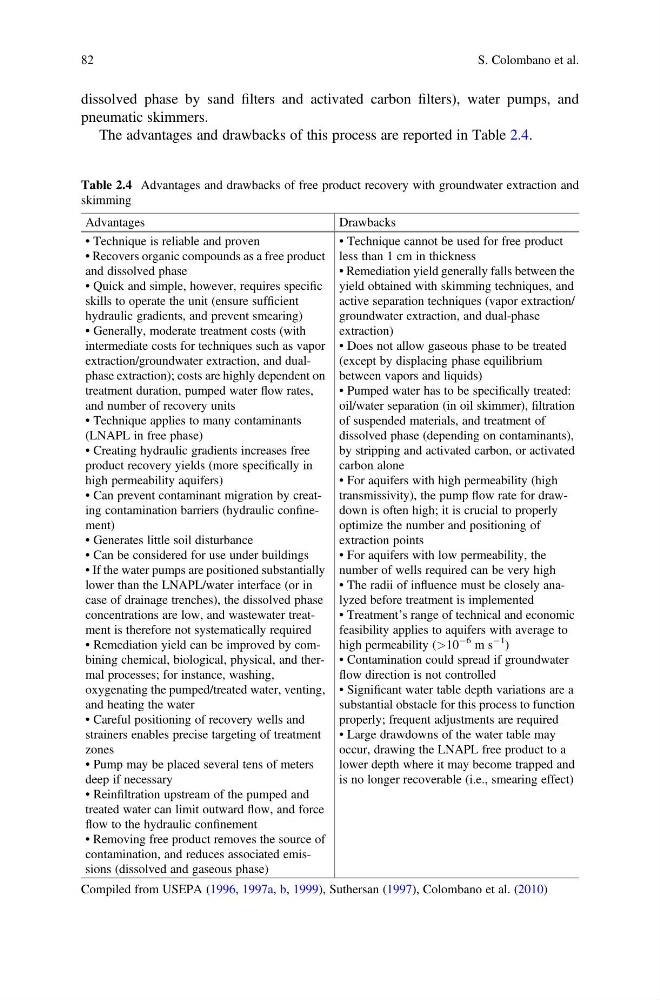
The advantages and drawbacks of this process are reported in Table 2.4.
Table 2.4 Advantages and drawbacks of free product recovery with groundwater extraction and
skimming
Advantages
Drawbacks
• Technique is reliable and proven
• Recovers organic compounds as a free product
and dissolved phase
• Quick and simple, however, requires specific
skills to operate the unit (ensure sufficient
hydraulic gradients, and prevent smearing)
• Generally, moderate treatment costs (with
intermediate costs for techniques such as vapor
extraction/groundwater extraction, and dualphase extraction); costs are highly dependent on
treatment duration, pumped water flow rates,
and number of recovery units
• Technique applies to many contaminants
(LNAPL in free phase)
• Creating hydraulic gradients increases free
product recovery yields (more specifically in
high permeability aquifers)
• Can prevent contaminant migration by creating contamination barriers (hydraulic confinement)
• Generates little soil disturbance
• Can be considered for use under buildings
• If the water pumps are positioned substantially
lower than the LNAPL/water interface (or in
case of drainage trenches), the dissolved phase
concentrations are low, and wastewater treatment is therefore not systematically required
• Remediation yield can be improved by combining chemical, biological, physical, and thermal processes; for instance, washing,
oxygenating the pumped/treated water, venting,
and heating the water
• Careful positioning of recovery wells and
strainers enables precise targeting of treatment
zones
• Pump may be placed several tens of meters
deep if necessary
• Reinfiltration upstream of the pumped and
treated water can limit outward flow, and force
flow to the hydraulic confinement
• Removing free product removes the source of
contamination, and reduces associated emissions (dissolved and gaseous phase)
• Technique cannot be used for free product
less than 1 cm in thickness
• Remediation yield generally falls between the
yield obtained with skimming techniques, and
active separation techniques (vapor extraction/
groundwater extraction, and dual-phase
extraction)
• Does not allow gaseous phase to be treated
(except by displacing phase equilibrium
between vapors and liquids)
• Pumped water has to be specifically treated:
oil/water separation (in oil skimmer), filtration
of suspended materials, and treatment of
dissolved phase (depending on contaminants),
by stripping and activated carbon, or activated
carbon alone
• For aquifers with high permeability (high
transmissivity), the pump flow rate for drawdown is often high; it is crucial to properly
optimize the number and positioning of
extraction points
• For aquifers with low permeability, the
number of wells required can be very high
• The radii of influence must be closely analyzed before treatment is implemented
• Treatment’s range of technical and economic
feasibility applies to aquifers with average to
high permeability (>10
À6 m s
À1
)
• Contamination could spread if groundwater
flow direction is not controlled
• Significant water table depth variations are a
substantial obstacle for this process to function
properly; frequent adjustments are required
• Large drawdowns of the water table may
occur, drawing the LNAPL free product to a
lower depth where it may become trapped and
is no longer recoverable (i.e., smearing effect)
Compiled from USEPA (1996, 1997a, b, 1999), Suthersan (1997), Colombano et al. (2010)
82
S. Colombano et al.
pneumatic skimmers.
The advantages and drawbacks of this process are reported in Table 2.4.
Table 2.4 Advantages and drawbacks of free product recovery with groundwater extraction and
skimming
Advantages
Drawbacks
• Technique is reliable and proven
• Recovers organic compounds as a free product
and dissolved phase
• Quick and simple, however, requires specific
skills to operate the unit (ensure sufficient
hydraulic gradients, and prevent smearing)
• Generally, moderate treatment costs (with
intermediate costs for techniques such as vapor
extraction/groundwater extraction, and dualphase extraction); costs are highly dependent on
treatment duration, pumped water flow rates,
and number of recovery units
• Technique applies to many contaminants
(LNAPL in free phase)
• Creating hydraulic gradients increases free
product recovery yields (more specifically in
high permeability aquifers)
• Can prevent contaminant migration by creating contamination barriers (hydraulic confinement)
• Generates little soil disturbance
• Can be considered for use under buildings
• If the water pumps are positioned substantially
lower than the LNAPL/water interface (or in
case of drainage trenches), the dissolved phase
concentrations are low, and wastewater treatment is therefore not systematically required
• Remediation yield can be improved by combining chemical, biological, physical, and thermal processes; for instance, washing,
oxygenating the pumped/treated water, venting,
and heating the water
• Careful positioning of recovery wells and
strainers enables precise targeting of treatment
zones
• Pump may be placed several tens of meters
deep if necessary
• Reinfiltration upstream of the pumped and
treated water can limit outward flow, and force
flow to the hydraulic confinement
• Removing free product removes the source of
contamination, and reduces associated emissions (dissolved and gaseous phase)
• Technique cannot be used for free product
less than 1 cm in thickness
• Remediation yield generally falls between the
yield obtained with skimming techniques, and
active separation techniques (vapor extraction/
groundwater extraction, and dual-phase
extraction)
• Does not allow gaseous phase to be treated
(except by displacing phase equilibrium
between vapors and liquids)
• Pumped water has to be specifically treated:
oil/water separation (in oil skimmer), filtration
of suspended materials, and treatment of
dissolved phase (depending on contaminants),
by stripping and activated carbon, or activated
carbon alone
• For aquifers with high permeability (high
transmissivity), the pump flow rate for drawdown is often high; it is crucial to properly
optimize the number and positioning of
extraction points
• For aquifers with low permeability, the
number of wells required can be very high
• The radii of influence must be closely analyzed before treatment is implemented
• Treatment’s range of technical and economic
feasibility applies to aquifers with average to
high permeability (>10
À6 m s
À1
)
• Contamination could spread if groundwater
flow direction is not controlled
• Significant water table depth variations are a
substantial obstacle for this process to function
properly; frequent adjustments are required
• Large drawdowns of the water table may
occur, drawing the LNAPL free product to a
lower depth where it may become trapped and
is no longer recoverable (i.e., smearing effect)
Compiled from USEPA (1996, 1997a, b, 1999), Suthersan (1997), Colombano et al. (2010)
82
S. Colombano et al.