

2.3.2 Free Product Recovery with Skimming
Free product is recovered in a well or trench using skimmers, without recovering
groundwater from pumping to avoid the formation of a depression cone. The
volumes of recovered free product are therefore limited. This process is often used
over a very short period of time, during emergency or short-term remedial actions,
for example, when the LNAPL volumes are low (for small contamination cases or at
the end of treatments) (USEPA 1996; Hyman and Dupont 2001; Sale 2001;
U.S. Army Corps of Engineers 2003; Charbeneau 2007; Charbeneau and Beckett
2007).
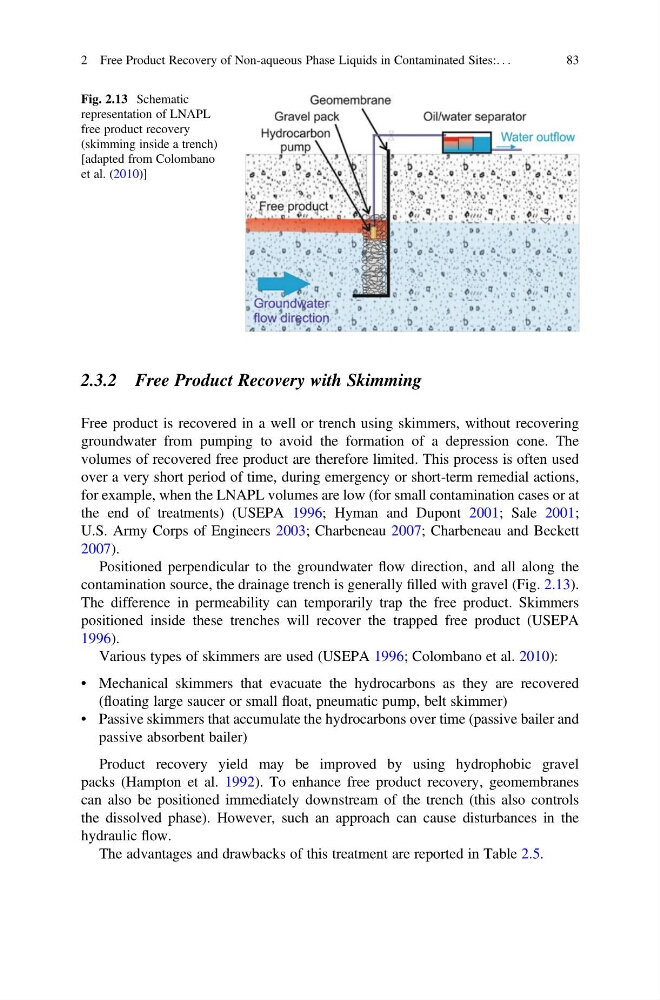
Positioned perpendicular to the groundwater flow direction, and all along the
contamination source, the drainage trench is generally filled with gravel (Fig. 2.13).
The difference in permeability can temporarily trap the free product. Skimmers
positioned inside these trenches will recover the trapped free product (USEPA
1996).
Various types of skimmers are used (USEPA 1996; Colombano et al. 2010):
• Mechanical skimmers that evacuate the hydrocarbons as they are recovered
(floating large saucer or small float, pneumatic pump, belt skimmer)
• Passive skimmers that accumulate the hydrocarbons over time (passive bailer and
passive absorbent bailer)
Product recovery yield may be improved by using hydrophobic gravel
packs (Hampton et al. 1992). To enhance free product recovery, geomembranes
can also be positioned immediately downstream of the trench (this also controls
the dissolved phase). However, such an approach can cause disturbances in the
hydraulic flow.
The advantages and drawbacks of this treatment are reported in Table 2.5.
Fig. 2.13 Schematic
representation of LNAPL
free product recovery
(skimming inside a trench)
[adapted from Colombano
et al. (2010)]
2 Free Product Recovery of Non-aqueous Phase Liquids in Contaminated Sites:. . .
83
Free product is recovered in a well or trench using skimmers, without recovering
groundwater from pumping to avoid the formation of a depression cone. The
volumes of recovered free product are therefore limited. This process is often used
over a very short period of time, during emergency or short-term remedial actions,
for example, when the LNAPL volumes are low (for small contamination cases or at
the end of treatments) (USEPA 1996; Hyman and Dupont 2001; Sale 2001;
U.S. Army Corps of Engineers 2003; Charbeneau 2007; Charbeneau and Beckett
2007).
Positioned perpendicular to the groundwater flow direction, and all along the
contamination source, the drainage trench is generally filled with gravel (Fig. 2.13).
The difference in permeability can temporarily trap the free product. Skimmers
positioned inside these trenches will recover the trapped free product (USEPA
1996).
Various types of skimmers are used (USEPA 1996; Colombano et al. 2010):
• Mechanical skimmers that evacuate the hydrocarbons as they are recovered
(floating large saucer or small float, pneumatic pump, belt skimmer)
• Passive skimmers that accumulate the hydrocarbons over time (passive bailer and
passive absorbent bailer)
Product recovery yield may be improved by using hydrophobic gravel
packs (Hampton et al. 1992). To enhance free product recovery, geomembranes
can also be positioned immediately downstream of the trench (this also controls
the dissolved phase). However, such an approach can cause disturbances in the
hydraulic flow.
The advantages and drawbacks of this treatment are reported in Table 2.5.
Fig. 2.13 Schematic
representation of LNAPL
free product recovery
(skimming inside a trench)
[adapted from Colombano
et al. (2010)]
2 Free Product Recovery of Non-aqueous Phase Liquids in Contaminated Sites:. . .
83