

Khan et al. 2004). If the water table level varies significantly, the water pump
flow rates can be set to move up and down as the water level changes (low and
high-level detectors).
Monitoring the volume of recovered free products is crucial. After a certain
amount of recovery time, a hydrocarbon recovery plateau is observed. If the thickness of free product is less than 1 cm, selective hydrocarbon pumping is practically
impossible. At this stage, the water pumps operate intermittently, which means the
water table level can also vary (i.e., rise and fall), and the hydrocarbons can be made
partially mobile again (Colombano et al. 2010).
During the recovery phase, the water pumps are generally first positioned clearly
below the LNAPL/water interface, when possible. As soon as pumping of hydrocarbons becomes impossible, the water pumps are positioned higher (i.e., closer to
the LNAPL/water interface) so that the groundwater and remaining free products can
continue to be treated.
The groundwater effluent generated by the pumping process must be managed
appropriately, taking into account legislation on emissions and effluent waste (oil
skimmer, stripping, activated carbon, etc.) (Lecomte 1998; Hyman and Dupont
2001; Marseille and Le Hecho 2004).
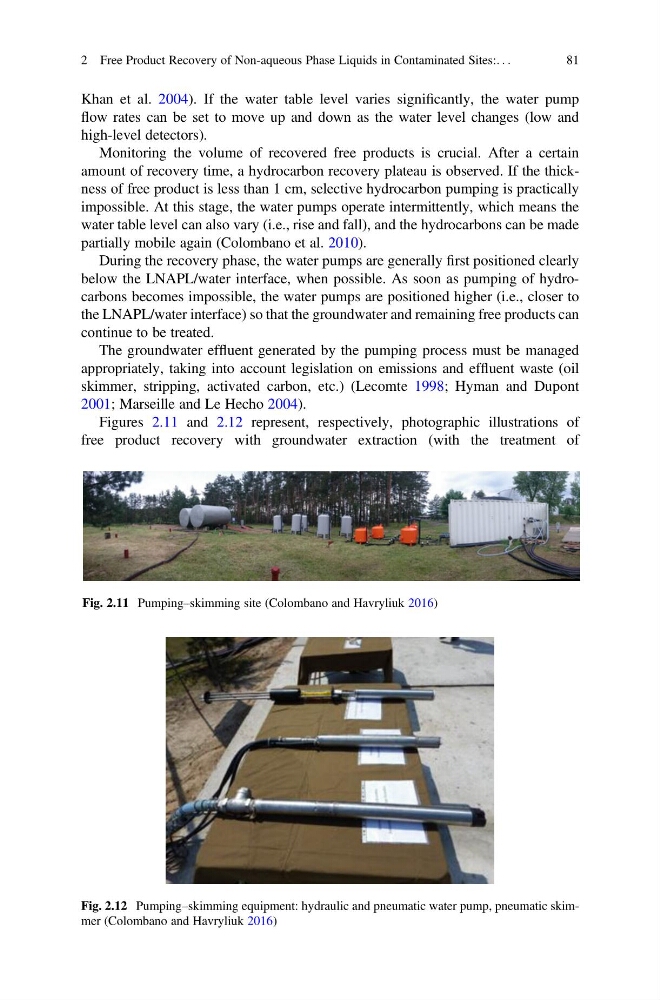
Figures 2.11 and 2.12 represent, respectively, photographic illustrations of
free product recovery with groundwater extraction (with the treatment of
Fig. 2.11 Pumping–skimming site (Colombano and Havryliuk 2016)
Fig. 2.12 Pumping–skimming equipment: hydraulic and pneumatic water pump, pneumatic skimmer (Colombano and Havryliuk 2016)
2 Free Product Recovery of Non-aqueous Phase Liquids in Contaminated Sites:. . .
81
flow rates can be set to move up and down as the water level changes (low and
high-level detectors).
Monitoring the volume of recovered free products is crucial. After a certain
amount of recovery time, a hydrocarbon recovery plateau is observed. If the thickness of free product is less than 1 cm, selective hydrocarbon pumping is practically
impossible. At this stage, the water pumps operate intermittently, which means the
water table level can also vary (i.e., rise and fall), and the hydrocarbons can be made
partially mobile again (Colombano et al. 2010).
During the recovery phase, the water pumps are generally first positioned clearly
below the LNAPL/water interface, when possible. As soon as pumping of hydrocarbons becomes impossible, the water pumps are positioned higher (i.e., closer to
the LNAPL/water interface) so that the groundwater and remaining free products can
continue to be treated.
The groundwater effluent generated by the pumping process must be managed
appropriately, taking into account legislation on emissions and effluent waste (oil
skimmer, stripping, activated carbon, etc.) (Lecomte 1998; Hyman and Dupont
2001; Marseille and Le Hecho 2004).
Figures 2.11 and 2.12 represent, respectively, photographic illustrations of
free product recovery with groundwater extraction (with the treatment of
Fig. 2.11 Pumping–skimming site (Colombano and Havryliuk 2016)
Fig. 2.12 Pumping–skimming equipment: hydraulic and pneumatic water pump, pneumatic skimmer (Colombano and Havryliuk 2016)
2 Free Product Recovery of Non-aqueous Phase Liquids in Contaminated Sites:. . .
81