

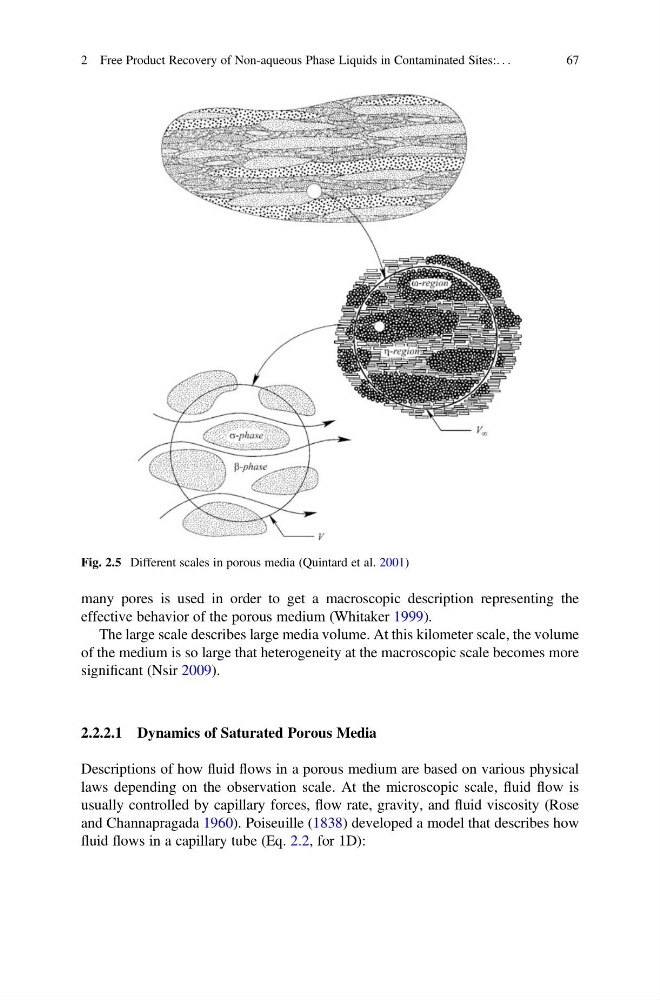
many pores is used in order to get a macroscopic description representing the
effective behavior of the porous medium (Whitaker 1999).
The large scale describes large media volume. At this kilometer scale, the volume
of the medium is so large that heterogeneity at the macroscopic scale becomes more
significant (Nsir 2009).
2.2.2.1 Dynamics of Saturated Porous Media
Descriptions of how fluid flows in a porous medium are based on various physical
laws depending on the observation scale. At the microscopic scale, fluid flow is
usually controlled by capillary forces, flow rate, gravity, and fluid viscosity (Rose
and Channapragada 1960). Poiseuille (1838) developed a model that describes how
fluid flows in a capillary tube (Eq. 2.2, for 1D):
Fig. 2.5 Different scales in porous media (Quintard et al. 2001)
2 Free Product Recovery of Non-aqueous Phase Liquids in Contaminated Sites:. . .
67
effective behavior of the porous medium (Whitaker 1999).
The large scale describes large media volume. At this kilometer scale, the volume
of the medium is so large that heterogeneity at the macroscopic scale becomes more
significant (Nsir 2009).
2.2.2.1 Dynamics of Saturated Porous Media
Descriptions of how fluid flows in a porous medium are based on various physical
laws depending on the observation scale. At the microscopic scale, fluid flow is
usually controlled by capillary forces, flow rate, gravity, and fluid viscosity (Rose
and Channapragada 1960). Poiseuille (1838) developed a model that describes how
fluid flows in a capillary tube (Eq. 2.2, for 1D):
Fig. 2.5 Different scales in porous media (Quintard et al. 2001)
2 Free Product Recovery of Non-aqueous Phase Liquids in Contaminated Sites:. . .
67