

the residual saturation, the organic phase is mobile while below that saturation, it is
immobile.
Relative permeability with respect to water flow in a saturated zone penetrated by
free product is affected by a perturbation of local flow conditions. Consequently, the
streamline flow tends to go around the contaminated domains (Fig. 2.4).
The presence of capillary forces from the porous medium causes hysteresis: the
drainage curve of NAPL phase in a porous medium does not follow the same path as
the imbibition curve. Imbibition is therefore not reversible (Fig. 2.9).
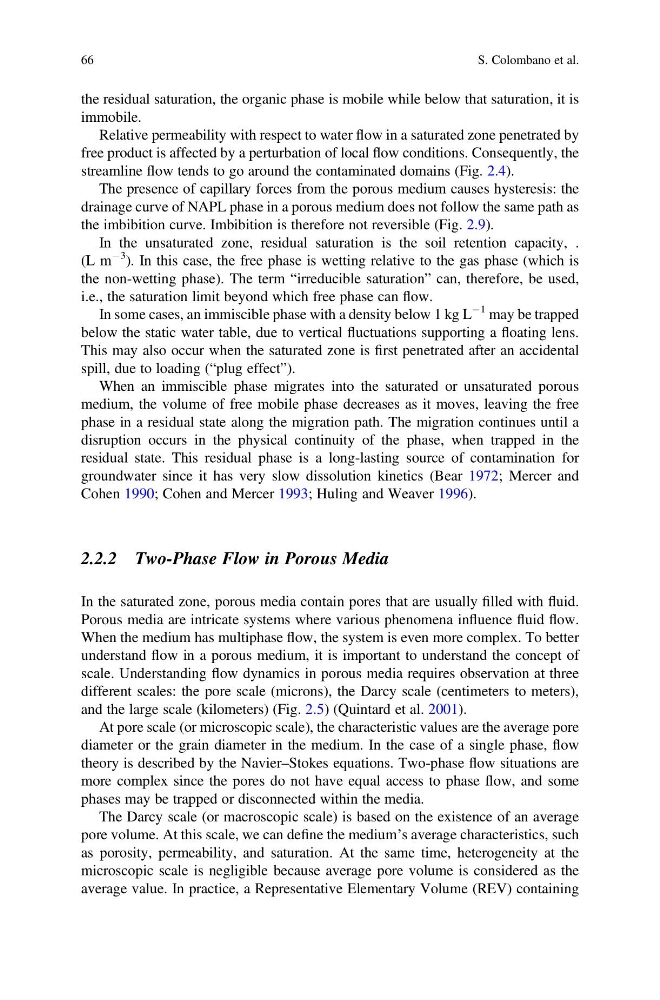
In the unsaturated zone, residual saturation is the soil retention capacity, .
(L m
À3 ). In this case, the free phase is wetting relative to the gas phase (which is
the non-wetting phase). The term “irreducible saturation” can, therefore, be used,
i.e., the saturation limit beyond which free phase can flow.
In some cases, an immiscible phase with a density below 1 kg L
À1 may be trapped
below the static water table, due to vertical fluctuations supporting a floating lens.
This may also occur when the saturated zone is first penetrated after an accidental
spill, due to loading (“plug effect”).
When an immiscible phase migrates into the saturated or unsaturated porous
medium, the volume of free mobile phase decreases as it moves, leaving the free
phase in a residual state along the migration path. The migration continues until a
disruption occurs in the physical continuity of the phase, when trapped in the
residual state. This residual phase is a long-lasting source of contamination for
groundwater since it has very slow dissolution kinetics (Bear 1972; Mercer and
Cohen 1990; Cohen and Mercer 1993; Huling and Weaver 1996).
2.2.2 Two-Phase Flow in Porous Media
In the saturated zone, porous media contain pores that are usually filled with fluid.
Porous media are intricate systems where various phenomena influence fluid flow.
When the medium has multiphase flow, the system is even more complex. To better
understand flow in a porous medium, it is important to understand the concept of
scale. Understanding flow dynamics in porous media requires observation at three
different scales: the pore scale (microns), the Darcy scale (centimeters to meters),
and the large scale (kilometers) (Fig. 2.5) (Quintard et al. 2001).
At pore scale (or microscopic scale), the characteristic values are the average pore
diameter or the grain diameter in the medium. In the case of a single phase, flow
theory is described by the Navier–Stokes equations. Two-phase flow situations are
more complex since the pores do not have equal access to phase flow, and some
phases may be trapped or disconnected within the media.
The Darcy scale (or macroscopic scale) is based on the existence of an average
pore volume. At this scale, we can define the medium’s average characteristics, such
as porosity, permeability, and saturation. At the same time, heterogeneity at the
microscopic scale is negligible because average pore volume is considered as the
average value. In practice, a Representative Elementary Volume (REV) containing
66
S. Colombano et al.
immobile.
Relative permeability with respect to water flow in a saturated zone penetrated by
free product is affected by a perturbation of local flow conditions. Consequently, the
streamline flow tends to go around the contaminated domains (Fig. 2.4).
The presence of capillary forces from the porous medium causes hysteresis: the
drainage curve of NAPL phase in a porous medium does not follow the same path as
the imbibition curve. Imbibition is therefore not reversible (Fig. 2.9).
In the unsaturated zone, residual saturation is the soil retention capacity, .
(L m
À3 ). In this case, the free phase is wetting relative to the gas phase (which is
the non-wetting phase). The term “irreducible saturation” can, therefore, be used,
i.e., the saturation limit beyond which free phase can flow.
In some cases, an immiscible phase with a density below 1 kg L
À1 may be trapped
below the static water table, due to vertical fluctuations supporting a floating lens.
This may also occur when the saturated zone is first penetrated after an accidental
spill, due to loading (“plug effect”).
When an immiscible phase migrates into the saturated or unsaturated porous
medium, the volume of free mobile phase decreases as it moves, leaving the free
phase in a residual state along the migration path. The migration continues until a
disruption occurs in the physical continuity of the phase, when trapped in the
residual state. This residual phase is a long-lasting source of contamination for
groundwater since it has very slow dissolution kinetics (Bear 1972; Mercer and
Cohen 1990; Cohen and Mercer 1993; Huling and Weaver 1996).
2.2.2 Two-Phase Flow in Porous Media
In the saturated zone, porous media contain pores that are usually filled with fluid.
Porous media are intricate systems where various phenomena influence fluid flow.
When the medium has multiphase flow, the system is even more complex. To better
understand flow in a porous medium, it is important to understand the concept of
scale. Understanding flow dynamics in porous media requires observation at three
different scales: the pore scale (microns), the Darcy scale (centimeters to meters),
and the large scale (kilometers) (Fig. 2.5) (Quintard et al. 2001).
At pore scale (or microscopic scale), the characteristic values are the average pore
diameter or the grain diameter in the medium. In the case of a single phase, flow
theory is described by the Navier–Stokes equations. Two-phase flow situations are
more complex since the pores do not have equal access to phase flow, and some
phases may be trapped or disconnected within the media.
The Darcy scale (or macroscopic scale) is based on the existence of an average
pore volume. At this scale, we can define the medium’s average characteristics, such
as porosity, permeability, and saturation. At the same time, heterogeneity at the
microscopic scale is negligible because average pore volume is considered as the
average value. In practice, a Representative Elementary Volume (REV) containing
66
S. Colombano et al.