

A phase’s relative permeability (wetting or non-wetting) depends, in particular,
on the percentage of each phase present in the soil pores. The NAPL and watersaturated domain, where both the NAPL and water phases are mobile, is called
funicular saturation state (Williams and Wilder 1971). Beyond a certain level of
water saturation, the NAPL phase becomes discontinuous. The NAPL phase is then
trapped in the residual state, in the form of isolated droplets. This state is called
insular saturation state. The water phase, however, remains mobile (Bear 1972;
Mercer and Cohen 1990; Cohen and Mercer 1993; Huling and Weaver 1996).
To quantify this phenomenon, if the contaminant is non-wetting with respect to
another phase (organic phase/water in the saturated zone), the residual saturation (. r )
can be calculated as follows (Eq. 2.1):
S r ¼
V p
V por
ð2:1Þ
where,
. r : residual saturation (%)
. p : volume of residual product (m
3 )
. por : effective soil pore volume (m
3 )
The residual saturation depends on soil permeability, pore-size distribution, solid
wettability, fluid viscosity and density, interfacial tension, gravity, and hydraulic
gradient (see Sect. 2.2.2.2).
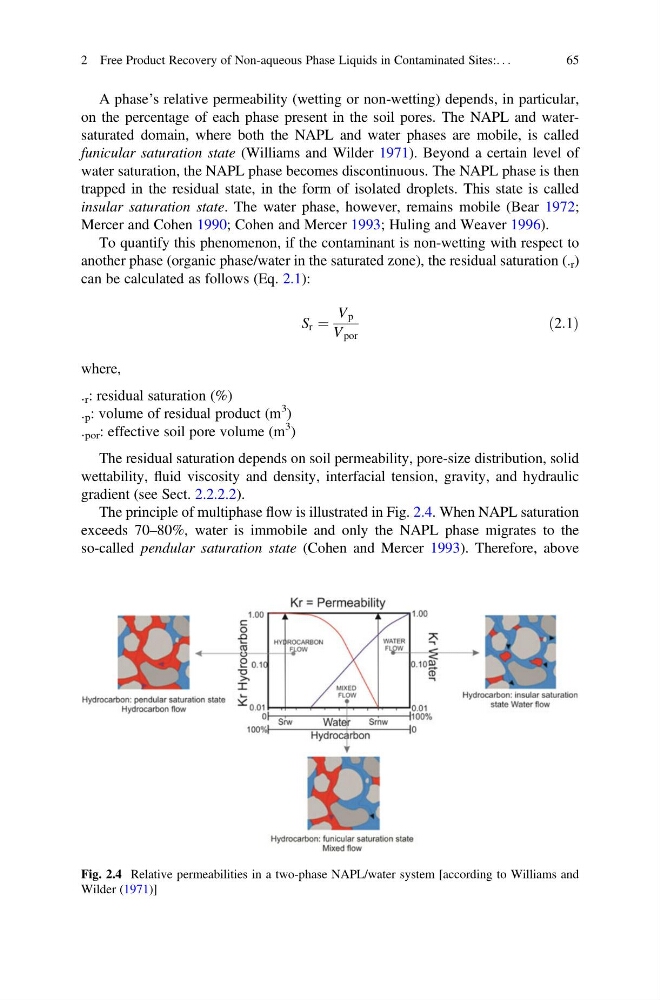
The principle of multiphase flow is illustrated in Fig. 2.4. When NAPL saturation
exceeds 70–80%, water is immobile and only the NAPL phase migrates to the
so-called pendular saturation state (Cohen and Mercer 1993). Therefore, above
Fig. 2.4 Relative permeabilities in a two-phase NAPL/water system [according to Williams and
Wilder (1971)]
2 Free Product Recovery of Non-aqueous Phase Liquids in Contaminated Sites:. . .
65
on the percentage of each phase present in the soil pores. The NAPL and watersaturated domain, where both the NAPL and water phases are mobile, is called
funicular saturation state (Williams and Wilder 1971). Beyond a certain level of
water saturation, the NAPL phase becomes discontinuous. The NAPL phase is then
trapped in the residual state, in the form of isolated droplets. This state is called
insular saturation state. The water phase, however, remains mobile (Bear 1972;
Mercer and Cohen 1990; Cohen and Mercer 1993; Huling and Weaver 1996).
To quantify this phenomenon, if the contaminant is non-wetting with respect to
another phase (organic phase/water in the saturated zone), the residual saturation (. r )
can be calculated as follows (Eq. 2.1):
S r ¼
V p
V por
ð2:1Þ
where,
. r : residual saturation (%)
. p : volume of residual product (m
3 )
. por : effective soil pore volume (m
3 )
The residual saturation depends on soil permeability, pore-size distribution, solid
wettability, fluid viscosity and density, interfacial tension, gravity, and hydraulic
gradient (see Sect. 2.2.2.2).
The principle of multiphase flow is illustrated in Fig. 2.4. When NAPL saturation
exceeds 70–80%, water is immobile and only the NAPL phase migrates to the
so-called pendular saturation state (Cohen and Mercer 1993). Therefore, above
Fig. 2.4 Relative permeabilities in a two-phase NAPL/water system [according to Williams and
Wilder (1971)]
2 Free Product Recovery of Non-aqueous Phase Liquids in Contaminated Sites:. . .
65