

2.2.1 Release of Contamination Sources and Behavior
of Global Contaminants
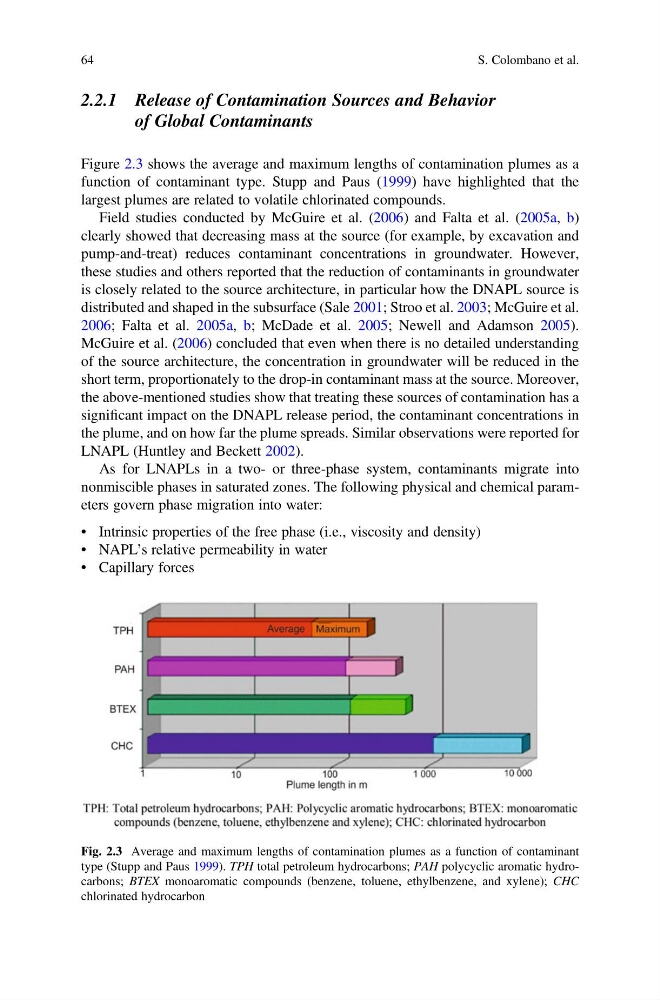
Figure 2.3 shows the average and maximum lengths of contamination plumes as a
function of contaminant type. Stupp and Paus (1999) have highlighted that the
largest plumes are related to volatile chlorinated compounds.
Field studies conducted by McGuire et al. (2006) and Falta et al. (2005a, b)
clearly showed that decreasing mass at the source (for example, by excavation and
pump-and-treat) reduces contaminant concentrations in groundwater. However,
these studies and others reported that the reduction of contaminants in groundwater
is closely related to the source architecture, in particular how the DNAPL source is
distributed and shaped in the subsurface (Sale 2001; Stroo et al. 2003; McGuire et al.
2006; Falta et al. 2005a, b; McDade et al. 2005; Newell and Adamson 2005).
McGuire et al. (2006) concluded that even when there is no detailed understanding
of the source architecture, the concentration in groundwater will be reduced in the
short term, proportionately to the drop-in contaminant mass at the source. Moreover,
the above-mentioned studies show that treating these sources of contamination has a
significant impact on the DNAPL release period, the contaminant concentrations in
the plume, and on how far the plume spreads. Similar observations were reported for
LNAPL (Huntley and Beckett 2002).
As for LNAPLs in a two- or three-phase system, contaminants migrate into
nonmiscible phases in saturated zones. The following physical and chemical parameters govern phase migration into water:
• Intrinsic properties of the free phase (i.e., viscosity and density)
• NAPL’s relative permeability in water
• Capillary forces
Fig. 2.3 Average and maximum lengths of contamination plumes as a function of contaminant
type (Stupp and Paus 1999). TPH total petroleum hydrocarbons; PAH polycyclic aromatic hydrocarbons; BTEX monoaromatic compounds (benzene, toluene, ethylbenzene, and xylene); CHC
chlorinated hydrocarbon
64
S. Colombano et al.
of Global Contaminants
Figure 2.3 shows the average and maximum lengths of contamination plumes as a
function of contaminant type. Stupp and Paus (1999) have highlighted that the
largest plumes are related to volatile chlorinated compounds.
Field studies conducted by McGuire et al. (2006) and Falta et al. (2005a, b)
clearly showed that decreasing mass at the source (for example, by excavation and
pump-and-treat) reduces contaminant concentrations in groundwater. However,
these studies and others reported that the reduction of contaminants in groundwater
is closely related to the source architecture, in particular how the DNAPL source is
distributed and shaped in the subsurface (Sale 2001; Stroo et al. 2003; McGuire et al.
2006; Falta et al. 2005a, b; McDade et al. 2005; Newell and Adamson 2005).
McGuire et al. (2006) concluded that even when there is no detailed understanding
of the source architecture, the concentration in groundwater will be reduced in the
short term, proportionately to the drop-in contaminant mass at the source. Moreover,
the above-mentioned studies show that treating these sources of contamination has a
significant impact on the DNAPL release period, the contaminant concentrations in
the plume, and on how far the plume spreads. Similar observations were reported for
LNAPL (Huntley and Beckett 2002).
As for LNAPLs in a two- or three-phase system, contaminants migrate into
nonmiscible phases in saturated zones. The following physical and chemical parameters govern phase migration into water:
• Intrinsic properties of the free phase (i.e., viscosity and density)
• NAPL’s relative permeability in water
• Capillary forces
Fig. 2.3 Average and maximum lengths of contamination plumes as a function of contaminant
type (Stupp and Paus 1999). TPH total petroleum hydrocarbons; PAH polycyclic aromatic hydrocarbons; BTEX monoaromatic compounds (benzene, toluene, ethylbenzene, and xylene); CHC
chlorinated hydrocarbon
64
S. Colombano et al.