

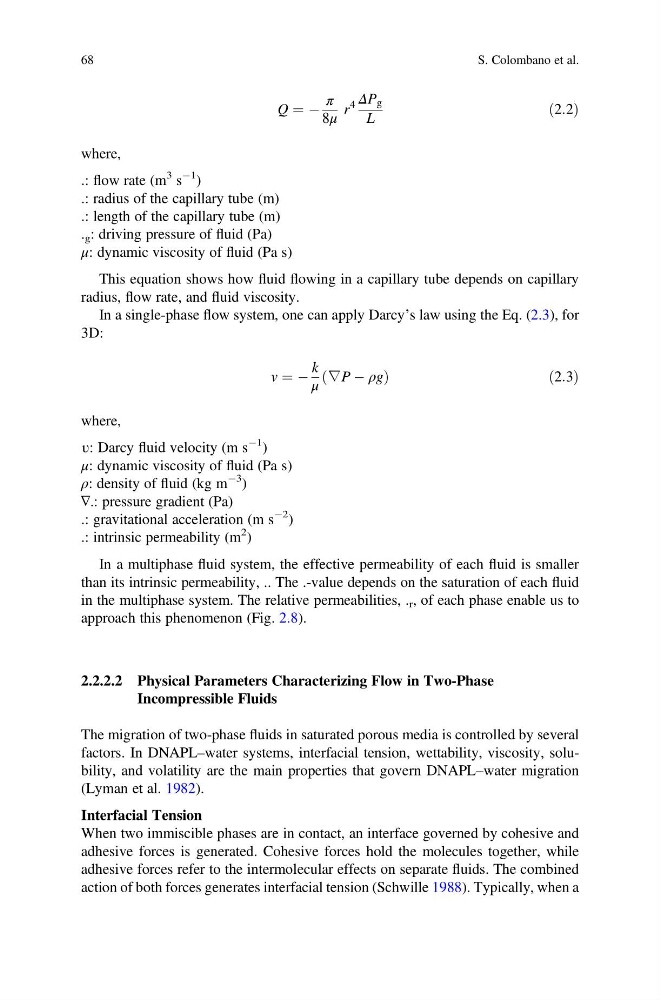
Q ¼ À
π
8μ
r
4 ΔP g
L
ð2:2Þ
where,
.: flow rate (m
3 s
À1 )
.: radius of the capillary tube (m)
.: length of the capillary tube (m)
. g : driving pressure of fluid (Pa)
μ: dynamic viscosity of fluid (Pa s)
This equation shows how fluid flowing in a capillary tube depends on capillary
radius, flow rate, and fluid viscosity.
In a single-phase flow system, one can apply Darcy’s law using the Eq. (2.3), for
3D:
v ¼ À
k
μ
∇P À ρg
ð
Þ
ð 2:3Þ
where,
ʋ: Darcy fluid velocity (m s
À1 )
μ: dynamic viscosity of fluid (Pa s)
ρ: density of fluid (kg m
À3 )
∇.: pressure gradient (Pa)
.: gravitational acceleration (m s
À2 )
.: intrinsic permeability (m
2 )
In a multiphase fluid system, the effective permeability of each fluid is smaller
than its intrinsic permeability, .. The .-value depends on the saturation of each fluid
in the multiphase system. The relative permeabilities, . r , of each phase enable us to
approach this phenomenon (Fig. 2.8).
2.2.2.2 Physical Parameters Characterizing Flow in Two-Phase
Incompressible Fluids
The migration of two-phase fluids in saturated porous media is controlled by several
factors. In DNAPL–water systems, interfacial tension, wettability, viscosity, solubility, and volatility are the main properties that govern DNAPL–water migration
(Lyman et al. 1982).
Interfacial Tension
When two immiscible phases are in contact, an interface governed by cohesive and
adhesive forces is generated. Cohesive forces hold the molecules together, while
adhesive forces refer to the intermolecular effects on separate fluids. The combined
action of both forces generates interfacial tension (Schwille 1988). Typically, when a
68
S. Colombano et al.
π
8μ
r
4 ΔP g
L
ð2:2Þ
where,
.: flow rate (m
3 s
À1 )
.: radius of the capillary tube (m)
.: length of the capillary tube (m)
. g : driving pressure of fluid (Pa)
μ: dynamic viscosity of fluid (Pa s)
This equation shows how fluid flowing in a capillary tube depends on capillary
radius, flow rate, and fluid viscosity.
In a single-phase flow system, one can apply Darcy’s law using the Eq. (2.3), for
3D:
v ¼ À
k
μ
∇P À ρg
ð
Þ
ð 2:3Þ
where,
ʋ: Darcy fluid velocity (m s
À1 )
μ: dynamic viscosity of fluid (Pa s)
ρ: density of fluid (kg m
À3 )
∇.: pressure gradient (Pa)
.: gravitational acceleration (m s
À2 )
.: intrinsic permeability (m
2 )
In a multiphase fluid system, the effective permeability of each fluid is smaller
than its intrinsic permeability, .. The .-value depends on the saturation of each fluid
in the multiphase system. The relative permeabilities, . r , of each phase enable us to
approach this phenomenon (Fig. 2.8).
2.2.2.2 Physical Parameters Characterizing Flow in Two-Phase
Incompressible Fluids
The migration of two-phase fluids in saturated porous media is controlled by several
factors. In DNAPL–water systems, interfacial tension, wettability, viscosity, solubility, and volatility are the main properties that govern DNAPL–water migration
(Lyman et al. 1982).
Interfacial Tension
When two immiscible phases are in contact, an interface governed by cohesive and
adhesive forces is generated. Cohesive forces hold the molecules together, while
adhesive forces refer to the intermolecular effects on separate fluids. The combined
action of both forces generates interfacial tension (Schwille 1988). Typically, when a
68
S. Colombano et al.