

affect phyllomanganates layer is the presence of vacancies (i.e., a layer Mn atom is
punctually missing). This induces a charge deficit of typically 4 v.u. per layer
octahedron, most frequently compensated for by the sorption of a cation above the
vacancy, in a triple-corner sharing configuration (Lanson et al. 2000). A particular
structure of this type is chalcophanite, which has 1/7 vacant site per layer octahedron, regularly distributed within the layer and capped on both sides by interlayer Zn
(II). However, this type of structure is most often termed birnessite or vernadite
whatever the density of isomorphic substitutions and vacancies. The main difference
between birnessite and vernadite lies in the layer stacking mode: birnessite has little
or no random stacking faults, whereas vernadite, which is systematically nanosized,
is turbostratic, which means that it suffers from the systematic presence of random
stacking faults between adjacent layers that remain parallel to each other. It may also
occur as exfoliated structure, with the layer-to-layer parallelism being disrupted due,
for example, to the presence of organics (in particular when the structure is of
biogenic origin) or to the presence of foreign minerals epitaxially intergrown. This
is typically the case of “Fe-vernadite,” which is a vernadite with feroxyhite
intergrown. Note that when birnessite has a 10 Å layer-to-layer distance, it is
sometimes termed buserite, although this normally refers to a specific composition,
and in particular to a ratio of trace metal to Mn varying between 1/7 and 1/6 (Usui
and Mita 1995).
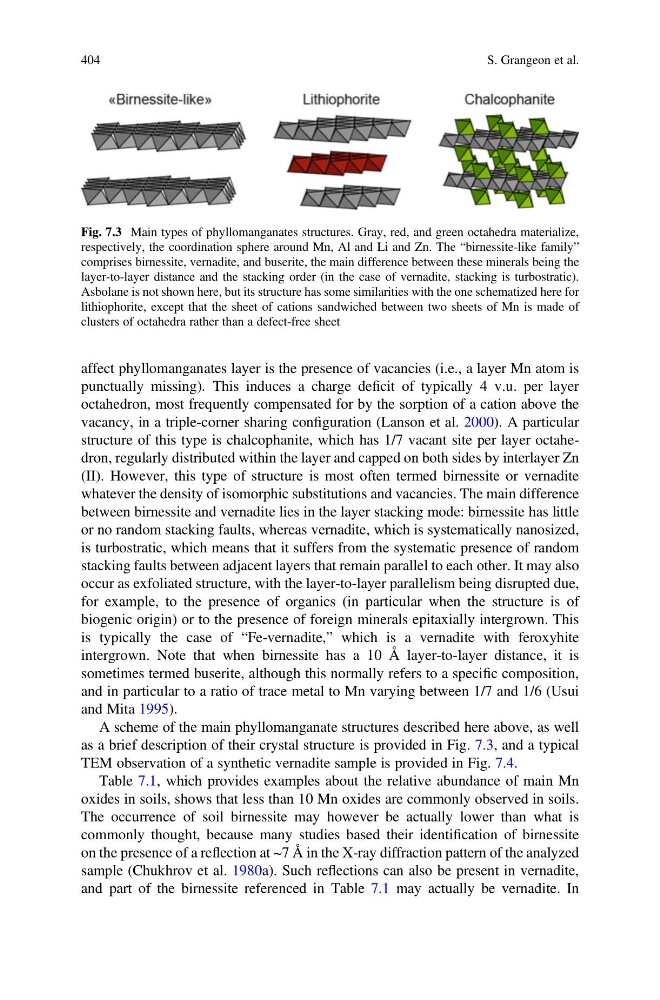
A scheme of the main phyllomanganate structures described here above, as well
as a brief description of their crystal structure is provided in Fig. 7.3, and a typical
TEM observation of a synthetic vernadite sample is provided in Fig. 7.4.
Table 7.1, which provides examples about the relative abundance of main Mn
oxides in soils, shows that less than 10 Mn oxides are commonly observed in soils.
The occurrence of soil birnessite may however be actually lower than what is
commonly thought, because many studies based their identification of birnessite
on the presence of a reflection at ~7 Å in the X-ray diffraction pattern of the analyzed
sample (Chukhrov et al. 1980a). Such reflections can also be present in vernadite,
and part of the birnessite referenced in Table 7.1 may actually be vernadite. In
Fig. 7.3 Main types of phyllomanganates structures. Gray, red, and green octahedra materialize,
respectively, the coordination sphere around Mn, Al and Li and Zn. The “birnessite-like family”
comprises birnessite, vernadite, and buserite, the main difference between these minerals being the
layer-to-layer distance and the stacking order (in the case of vernadite, stacking is turbostratic).
Asbolane is not shown here, but its structure has some similarities with the one schematized here for
lithiophorite, except that the sheet of cations sandwiched between two sheets of Mn is made of
clusters of octahedra rather than a defect-free sheet
404
S. Grangeon et al.
punctually missing). This induces a charge deficit of typically 4 v.u. per layer
octahedron, most frequently compensated for by the sorption of a cation above the
vacancy, in a triple-corner sharing configuration (Lanson et al. 2000). A particular
structure of this type is chalcophanite, which has 1/7 vacant site per layer octahedron, regularly distributed within the layer and capped on both sides by interlayer Zn
(II). However, this type of structure is most often termed birnessite or vernadite
whatever the density of isomorphic substitutions and vacancies. The main difference
between birnessite and vernadite lies in the layer stacking mode: birnessite has little
or no random stacking faults, whereas vernadite, which is systematically nanosized,
is turbostratic, which means that it suffers from the systematic presence of random
stacking faults between adjacent layers that remain parallel to each other. It may also
occur as exfoliated structure, with the layer-to-layer parallelism being disrupted due,
for example, to the presence of organics (in particular when the structure is of
biogenic origin) or to the presence of foreign minerals epitaxially intergrown. This
is typically the case of “Fe-vernadite,” which is a vernadite with feroxyhite
intergrown. Note that when birnessite has a 10 Å layer-to-layer distance, it is
sometimes termed buserite, although this normally refers to a specific composition,
and in particular to a ratio of trace metal to Mn varying between 1/7 and 1/6 (Usui
and Mita 1995).
A scheme of the main phyllomanganate structures described here above, as well
as a brief description of their crystal structure is provided in Fig. 7.3, and a typical
TEM observation of a synthetic vernadite sample is provided in Fig. 7.4.
Table 7.1, which provides examples about the relative abundance of main Mn
oxides in soils, shows that less than 10 Mn oxides are commonly observed in soils.
The occurrence of soil birnessite may however be actually lower than what is
commonly thought, because many studies based their identification of birnessite
on the presence of a reflection at ~7 Å in the X-ray diffraction pattern of the analyzed
sample (Chukhrov et al. 1980a). Such reflections can also be present in vernadite,
and part of the birnessite referenced in Table 7.1 may actually be vernadite. In
Fig. 7.3 Main types of phyllomanganates structures. Gray, red, and green octahedra materialize,
respectively, the coordination sphere around Mn, Al and Li and Zn. The “birnessite-like family”
comprises birnessite, vernadite, and buserite, the main difference between these minerals being the
layer-to-layer distance and the stacking order (in the case of vernadite, stacking is turbostratic).
Asbolane is not shown here, but its structure has some similarities with the one schematized here for
lithiophorite, except that the sheet of cations sandwiched between two sheets of Mn is made of
clusters of octahedra rather than a defect-free sheet
404
S. Grangeon et al.