

et al. 1982), romanechite ([3 Â 2]—Turner and Post 1988), and todorokite
([3 Â 3]—Post and Bish 1988).
The tunnel sizes given here are those of the ideal structures, but natural samples
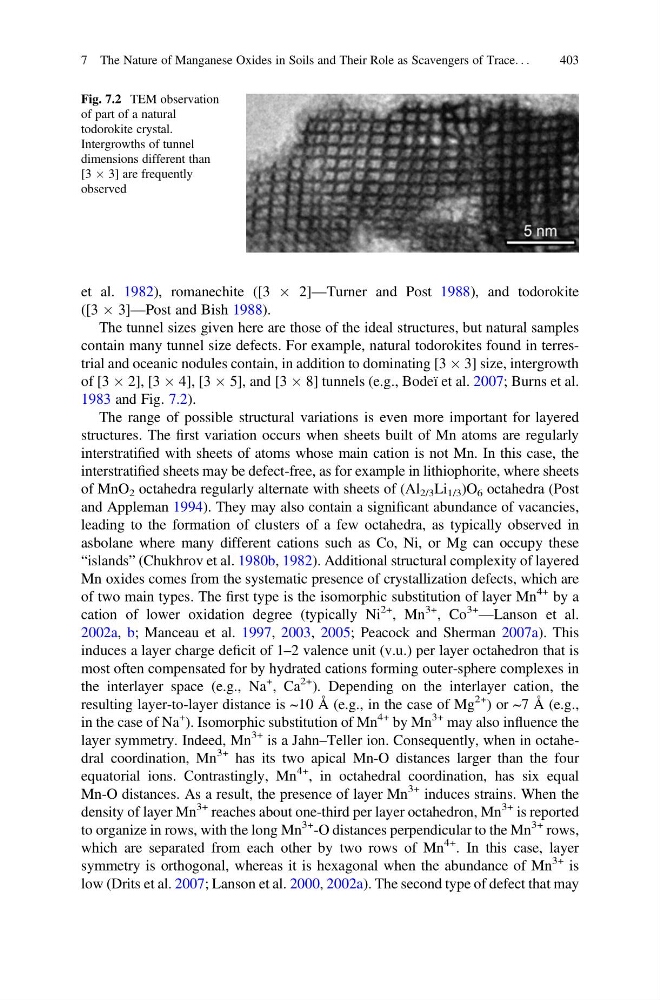
contain many tunnel size defects. For example, natural todorokites found in terrestrial and oceanic nodules contain, in addition to dominating [3 Â 3] size, intergrowth
of [3 Â 2], [3 Â 4], [3 Â 5], and [3 Â 8] tunnels (e.g., Bodeï et al. 2007; Burns et al.
1983 and Fig. 7.2).
The range of possible structural variations is even more important for layered
structures. The first variation occurs when sheets built of Mn atoms are regularly
interstratified with sheets of atoms whose main cation is not Mn. In this case, the
interstratified sheets may be defect-free, as for example in lithiophorite, where sheets
of MnO 2 octahedra regularly alternate with sheets of (Al 2/3 Li 1/3 )O 6 octahedra (Post
and Appleman 1994). They may also contain a significant abundance of vacancies,
leading to the formation of clusters of a few octahedra, as typically observed in
asbolane where many different cations such as Co, Ni, or Mg can occupy these
“islands” (Chukhrov et al. 1980b, 1982). Additional structural complexity of layered
Mn oxides comes from the systematic presence of crystallization defects, which are
of two main types. The first type is the isomorphic substitution of layer Mn
4+ by a
cation of lower oxidation degree (typically Ni
2+ , Mn
3+ , Co
3+
—Lanson et al.
2002a, b; Manceau et al. 1997, 2003, 2005; Peacock and Sherman 2007a). This
induces a layer charge deficit of 1–2 valence unit (v.u.) per layer octahedron that is
most often compensated for by hydrated cations forming outer-sphere complexes in
the interlayer space (e.g., Na
+ , Ca
2+ ). Depending on the interlayer cation, the
resulting layer-to-layer distance is ~10 Å (e.g., in the case of Mg
2+ ) or ~7 Å (e.g.,
in the case of Na
+
). Isomorphic substitution of Mn
4+ by Mn
3+ may also influence the
layer symmetry. Indeed, Mn
3+ is a Jahn–Teller ion. Consequently, when in octahedral coordination, Mn
3+ has its two apical Mn-O distances larger than the four
equatorial ions. Contrastingly, Mn
4+ , in octahedral coordination, has six equal
Mn-O distances. As a result, the presence of layer Mn
3+ induces strains. When the
density of layer Mn
3+ reaches about one-third per layer octahedron, Mn
3+ is reported
to organize in rows, with the long Mn
3+ -O distances perpendicular to the Mn
3+ rows,
which are separated from each other by two rows of Mn
4+ . In this case, layer
symmetry is orthogonal, whereas it is hexagonal when the abundance of Mn
3+ is
low (Drits et al. 2007; Lanson et al. 2000, 2002a). The second type of defect that may
Fig. 7.2 TEM observation
of part of a natural
todorokite crystal.
Intergrowths of tunnel
dimensions different than
[3 Â 3] are frequently
observed
7 The Nature of Manganese Oxides in Soils and Their Role as Scavengers of Trace. . .
403
([3 Â 3]—Post and Bish 1988).
The tunnel sizes given here are those of the ideal structures, but natural samples
contain many tunnel size defects. For example, natural todorokites found in terrestrial and oceanic nodules contain, in addition to dominating [3 Â 3] size, intergrowth
of [3 Â 2], [3 Â 4], [3 Â 5], and [3 Â 8] tunnels (e.g., Bodeï et al. 2007; Burns et al.
1983 and Fig. 7.2).
The range of possible structural variations is even more important for layered
structures. The first variation occurs when sheets built of Mn atoms are regularly
interstratified with sheets of atoms whose main cation is not Mn. In this case, the
interstratified sheets may be defect-free, as for example in lithiophorite, where sheets
of MnO 2 octahedra regularly alternate with sheets of (Al 2/3 Li 1/3 )O 6 octahedra (Post
and Appleman 1994). They may also contain a significant abundance of vacancies,
leading to the formation of clusters of a few octahedra, as typically observed in
asbolane where many different cations such as Co, Ni, or Mg can occupy these
“islands” (Chukhrov et al. 1980b, 1982). Additional structural complexity of layered
Mn oxides comes from the systematic presence of crystallization defects, which are
of two main types. The first type is the isomorphic substitution of layer Mn
4+ by a
cation of lower oxidation degree (typically Ni
2+ , Mn
3+ , Co
3+
—Lanson et al.
2002a, b; Manceau et al. 1997, 2003, 2005; Peacock and Sherman 2007a). This
induces a layer charge deficit of 1–2 valence unit (v.u.) per layer octahedron that is
most often compensated for by hydrated cations forming outer-sphere complexes in
the interlayer space (e.g., Na
+ , Ca
2+ ). Depending on the interlayer cation, the
resulting layer-to-layer distance is ~10 Å (e.g., in the case of Mg
2+ ) or ~7 Å (e.g.,
in the case of Na
+
). Isomorphic substitution of Mn
4+ by Mn
3+ may also influence the
layer symmetry. Indeed, Mn
3+ is a Jahn–Teller ion. Consequently, when in octahedral coordination, Mn
3+ has its two apical Mn-O distances larger than the four
equatorial ions. Contrastingly, Mn
4+ , in octahedral coordination, has six equal
Mn-O distances. As a result, the presence of layer Mn
3+ induces strains. When the
density of layer Mn
3+ reaches about one-third per layer octahedron, Mn
3+ is reported
to organize in rows, with the long Mn
3+ -O distances perpendicular to the Mn
3+ rows,
which are separated from each other by two rows of Mn
4+ . In this case, layer
symmetry is orthogonal, whereas it is hexagonal when the abundance of Mn
3+ is
low (Drits et al. 2007; Lanson et al. 2000, 2002a). The second type of defect that may
Fig. 7.2 TEM observation
of part of a natural
todorokite crystal.
Intergrowths of tunnel
dimensions different than
[3 Â 3] are frequently
observed
7 The Nature of Manganese Oxides in Soils and Their Role as Scavengers of Trace. . .
403