

whose nature and abundance depend amongst other on the size of the tunnels and on
the abundance of Mn(III) in the structural arrangement.
For each structure, many variations are possible, and give rise to a large number
of structures which were given specific mineral names. For example, in the tunnel
structure, n and m are commonly reported to vary between 1 and 3, and resulting
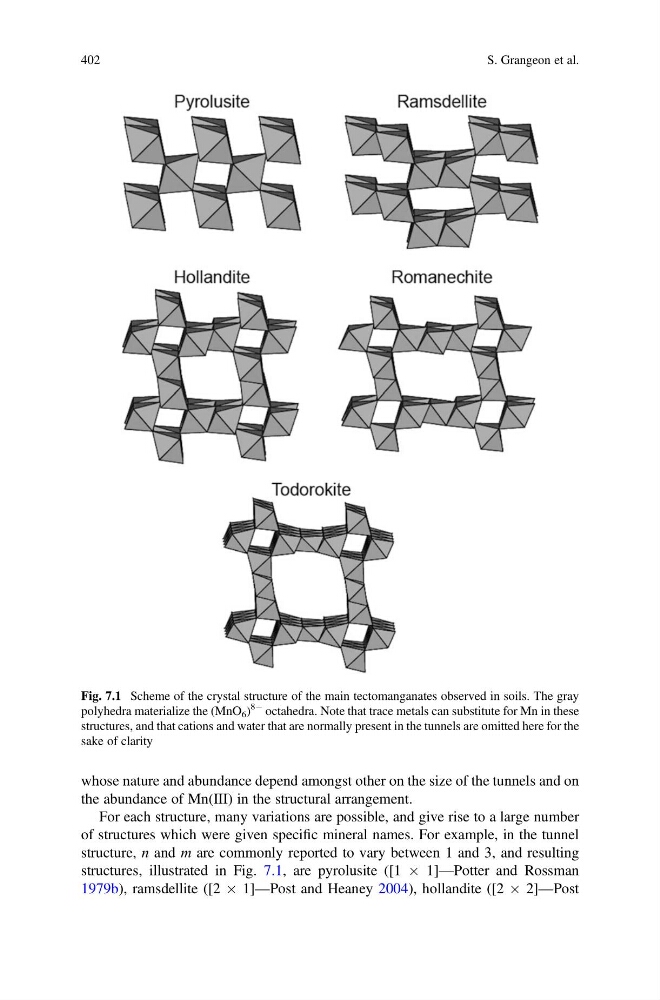
structures, illustrated in Fig. 7.1, are pyrolusite ([1 Â 1]—Potter and Rossman
1979b), ramsdellite ([2 Â 1]—Post and Heaney 2004), hollandite ([2 Â 2]—Post
Fig. 7.1 Scheme of the crystal structure of the main tectomanganates observed in soils. The gray
polyhedra materialize the (MnO 6 )
8À octahedra. Note that trace metals can substitute for Mn in these
structures, and that cations and water that are normally present in the tunnels are omitted here for the
sake of clarity
402
S. Grangeon et al.
the abundance of Mn(III) in the structural arrangement.
For each structure, many variations are possible, and give rise to a large number
of structures which were given specific mineral names. For example, in the tunnel
structure, n and m are commonly reported to vary between 1 and 3, and resulting
structures, illustrated in Fig. 7.1, are pyrolusite ([1 Â 1]—Potter and Rossman
1979b), ramsdellite ([2 Â 1]—Post and Heaney 2004), hollandite ([2 Â 2]—Post
Fig. 7.1 Scheme of the crystal structure of the main tectomanganates observed in soils. The gray
polyhedra materialize the (MnO 6 )
8À octahedra. Note that trace metals can substitute for Mn in these
structures, and that cations and water that are normally present in the tunnels are omitted here for the
sake of clarity
402
S. Grangeon et al.