

addition, this summary solely reports on the occurrence of minerals, and not on their
relative abundance. When Mn oxides occurring in soils are quantified on a relative
basis, it turns out that vernadite can be one of the most common Mn minerals
(Vodyanitskii 2009).
Table 7.1 Quantitative estimation of the relative abundance of Mn oxides in soils
Location
Mn oxides reported
Reference
Australia
Birnessite (n ¼ 10), Lithiophorite (n ¼ 10), Hollandite
(n ¼ 3), Pyrolusite (n ¼ 1), Todorokite (n ¼ 1),
Lithiophorite + Hollandite (n ¼ 1)
Taylor et al.
(1964)
Bermuda and
Europe
Birnessite (n ¼ 4), Lithiophorite (n ¼ 1)
Taylor (1968)
Hawaï (USA)
Todorokite
Glasby et al.
(1979)
Indiana (USA)
Birnessite (n ¼ 3, plus possibly 11 more), Todorokite
(n ¼ 1)
Ross et al. (1976)
Mainly former
USSR
Vernadite, Birnessite, Cryptomelane, Todorokite,
Hausmannite (per order of decreasing abundance,
n ¼ 100 samples)
Chukhrov and
Gorshkov (1981)
Scotland
Mainly Vernadite
Birnie and Paterson (1991)
South-East of
USA
Romanechite
Gallaher et al.
(1973)
Tasmania
Lithiophorite
Tiller (1963)
Texas and Alabama (USA)
Birnessite, Lithiophorite, Todorokite
Uzochukwu and
Dixon (1986)
n stands for the number of samples analyzed
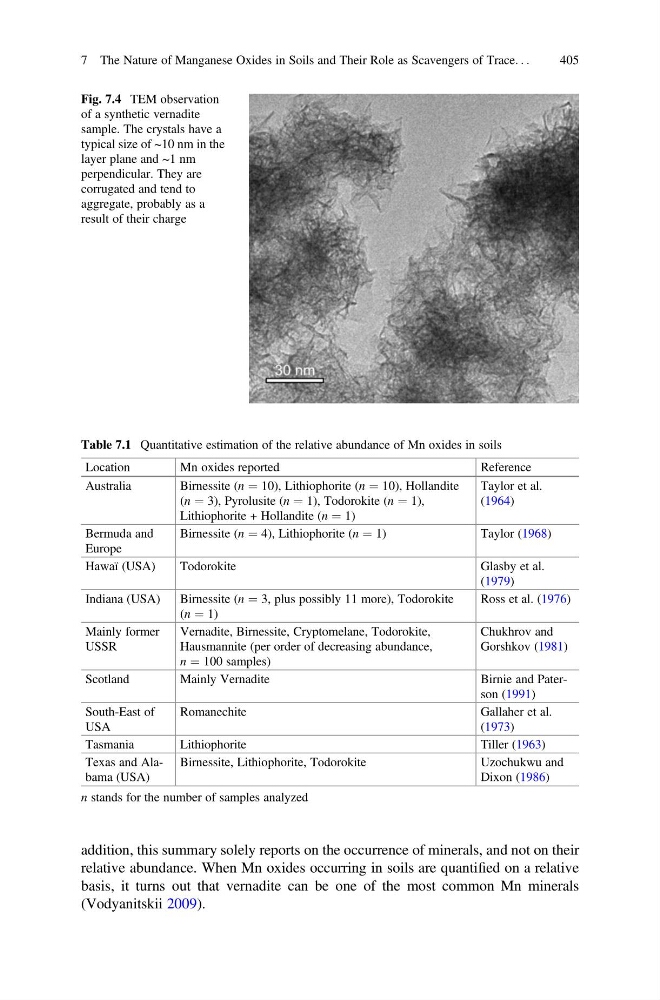
Fig. 7.4 TEM observation
of a synthetic vernadite
sample. The crystals have a
typical size of ~10 nm in the
layer plane and ~1 nm
perpendicular. They are
corrugated and tend to
aggregate, probably as a
result of their charge
7 The Nature of Manganese Oxides in Soils and Their Role as Scavengers of Trace. . .
405
relative abundance. When Mn oxides occurring in soils are quantified on a relative
basis, it turns out that vernadite can be one of the most common Mn minerals
(Vodyanitskii 2009).
Table 7.1 Quantitative estimation of the relative abundance of Mn oxides in soils
Location
Mn oxides reported
Reference
Australia
Birnessite (n ¼ 10), Lithiophorite (n ¼ 10), Hollandite
(n ¼ 3), Pyrolusite (n ¼ 1), Todorokite (n ¼ 1),
Lithiophorite + Hollandite (n ¼ 1)
Taylor et al.
(1964)
Bermuda and
Europe
Birnessite (n ¼ 4), Lithiophorite (n ¼ 1)
Taylor (1968)
Hawaï (USA)
Todorokite
Glasby et al.
(1979)
Indiana (USA)
Birnessite (n ¼ 3, plus possibly 11 more), Todorokite
(n ¼ 1)
Ross et al. (1976)
Mainly former
USSR
Vernadite, Birnessite, Cryptomelane, Todorokite,
Hausmannite (per order of decreasing abundance,
n ¼ 100 samples)
Chukhrov and
Gorshkov (1981)
Scotland
Mainly Vernadite
Birnie and Paterson (1991)
South-East of
USA
Romanechite
Gallaher et al.
(1973)
Tasmania
Lithiophorite
Tiller (1963)
Texas and Alabama (USA)
Birnessite, Lithiophorite, Todorokite
Uzochukwu and
Dixon (1986)
n stands for the number of samples analyzed
Fig. 7.4 TEM observation
of a synthetic vernadite
sample. The crystals have a
typical size of ~10 nm in the
layer plane and ~1 nm
perpendicular. They are
corrugated and tend to
aggregate, probably as a
result of their charge
7 The Nature of Manganese Oxides in Soils and Their Role as Scavengers of Trace. . .
405